


I first listened to Kodomo, electronic musician Chris Child's project, in 2015, when one of the tracks appeared on a streaming service. Ten years later, I've become much more distrustful of algorithms, but, begrudgingly, I have to admit that the computer made a good choice with that specific recommendation. This is because Kodomo's debut album, 2008's Still Life, deeply resonated with me. I was working seven days a week in a job I hated, and Kodomo's enveloping soundscapes helped ease me during these difficult times.
Since then, I've never really stopped listening. Child's music is sweepingly cinematic and enveloping, a 3D collage of different textures and possibilities that feels open and limitless. He creates sounds that are endlessly addictive and fascinating, layering them on top of each other until they tease out into breathtaking new developments. Despite the open possibilities his music seemingly carries, only a few years ago, Child began to question his methods and craft.
Thankfully, Child didn't give up. His latest album, sisu, represents working through this struggle and choosing to create what's important, even when it's difficult. Perhaps even more important, he slowed down. His process pays off, as the artist utilizes new ideas he hasn't previously, such as adding vocal elements and textures, while still providing the lush, ambient soundscapes his project is known for.
Our conversation mirrors this idea of taking the time and slowing down, because Child lives near me in Portland, Maine. On a snowy day, we met at Yuri's Desserts, drinking hot beverages and enjoying Japanese donuts, while talking about his latest album. Afterward, he invited me into his studio, and I was able to ask further questions about his gear and his process. Overall, it allowed me to see how thoughtful and purposeful Child is, both in his craft and in his life, and why he can create such fascinating worlds in his music.
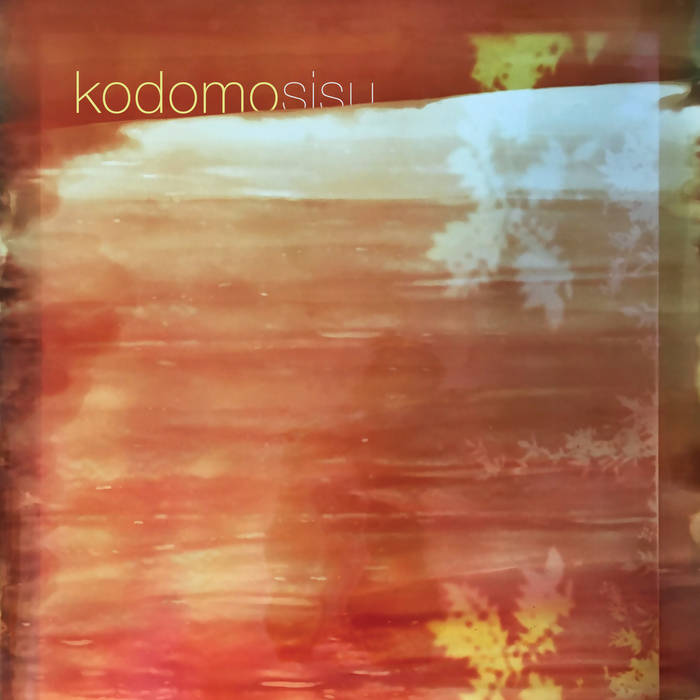
Bill: Talk to me about the album title, sisu. I know it means grit, bravery, and hardiness. How did you come to that title, and how does it encapsulate your album?
Chris: I first found the term while reading an article that mentioned the concept of "sisu." From what I understand, it's a general characteristic of Finnish culture in which its inhabitants embody resilience in the face of difficulty. It stuck with me, and I like the sound of the word, as well as its simplicity.
As inevitably happens when I get to the end of finishing an album, the difficulty comes in: "What am I going to call this? What am I going to name it?" It's always the last thing, generally in my experience. I never really come up with titles beforehand. I keep a running list of interesting words and phrases I collect that could become track or album names or themes. I was going through them, and "sisu" was in there. It just felt right.
When I asked myself what this album is about, I felt much of what I was feeling was the difficulty—or maybe the sense of being overwhelmed—at releasing music in the age we live in. I felt like we're fighting against these massive currents, particularly as independent artists. I found myself coming up against the question, "Why am I actually doing this?"
I had to sit with that for a while. I felt this stagnation, but also an urge to do something. The needle mover for me was the album releases from friends I know but haven't been in touch with for a while. I'd listen to their work, and I'd be blown away. I'd think, "I know this guy, and they're still doing it."
What I took from that was: I have a choice. I don't have to do this, but I get to do this. The implications of it being feasible don't matter as long as I have the space and time to create, to investigate, and to explore. That's really what's important, and that's what I need to be doing.
Then it struck me that it [the creation process] is this kind of full-scale, beautiful feedback system where a piece of music will inspire and motivate me to explore and do the same. Then maybe, in some small capacity, my work can have that effect on someone, enhance or enrich their life in some way. And that, in and of itself, is important.
Bill: One of the things I find interesting about your music is that it's all done on your own. So much of it is in your studio, sitting there. How do you maintain that sense of community being—I don't want to say isolated—but how do you step out of that to get there?
Chris: That was part of the impetus for me to start this record label, Foil Imprints, five or so years ago with Micah Frank, who's in Brooklyn. The idea was clear that I hit a wall, so to speak, with working in isolation. Working in isolation has its own merits, and particularly in electronic music, you have these tools and a kind of private world where you can get lost and create.
That's both beautiful and also challenging, because it's hard for me to gain perspective. It was evident that no matter how much growth I get from developing better mixing skills, interesting sound design techniques, or personal craft, I'm still up against my own internal limits.
Things become interesting when you pair off with someone else who has a different way of working or a different worldview. I intended to create a platform where we can broaden the palette of what I can do by working with other artists. Micah is one of the main artists I work with, and Kasson Crooker, with whom we formed a project.
With sisu in particular, I took the strategy of first coming up with a lot in isolation and then selecting some vocalists I wanted to work with. They would come up with something and give it back to me, and there'd be a lot of back and forth. A lot of times, I would take their vocals and maybe scrap the backing track I initially gave them. Then, I'd use their vocals on a completely different track. It was this freeform experimentation until it felt like I landed on something that felt right.
Inevitably, when I try to plan things, it never works. I take something that was a byproduct of the plan and then recycle it until it becomes interesting. It's still quite a process of trial and error, and it takes time and consistency. I'll collect those little things that I make, and after some time, I'll listen to them. Then it's like magic—things will reveal themselves in ways that maybe I wouldn't have been able to see during those smaller segments.
Bill: Is this the first time you've worked as intimately with vocalists to that degree?
Chris: I thought it would be interesting to explore some song form. Generally, when I start an album, I like to think about what I haven't done before. Whenever I start a project, I try to force myself to follow loose guidelines. Those guidelines start with internal limits, like "Where am I at? What do I actually want to do? What do I want to try to do?" Then, I contemplate, "Why am I doing this?" Because that's something I find is really important—the why.
Then I try to set some external limits, such as "what will be interesting to see in electronic music?" or "what if you fused two very distant genres?" I'm not trying to invent something totally new, but instead, trying to push myself to think about the broader context of electronic music and what I can contribute.
In this case, one of the internal limits for me was that I hadn't really written songs, per se. Everything I've done is very pattern-focused, not song form. I tried it and didn't like it, but I liked how the vocalists sang melodic, lyrical phrases.
What I found was that when I sampled those lyrical phrases and refragmented them against something else, that's when something interesting occurred. That's an example of trying something, and if it doesn't work, instead of quitting—which was also the "sisu" reminder—trying to find another way. That meant taking something from that process and changing it until it felt like it was leading somewhere.
Bill: You also wrote this in your copy, and I agree—it's much more '90s, like IDM sound.
Chris: I had been re-listening to a lot of early '90s electronic music, which was the stuff I grew up with and loved—a lot of the iconic early Warp, side of Aphex Twin. That kind of very raw, simple music that just puts you in a space. I remember being astounded by a few of those tracks that, in some ways, are so simple but just suggestive of a physical space. It really placed you in this context. It had that power.
It's funny because I try to be very minimalist. I love minimalism and constraints. But for some reason, I can't do that in my music. What I can do is try things and know when they work. I think that's maybe my way—being able to combine things in interesting ways until you get something that feels cool.
Bill: I think that's what makes it, at least for me, so cinematic. I don't know how many layers or what you're putting into a track, or even if that's the right term for it, but they build. At least how I feel when I listen to them—you're creating a world is the best way I can describe it.
Chris: That goes back to the beauty of electronic music. I'm not saying you couldn't do this in other genres, but I really do think that electronic music, particularly, has this potency for world-building.
You can view this concept of world-building from a sonic perspective. It's these sounds that take you somewhere: either put you in a certain headspace or a physical space. It's almost like invisible architecture. It has this capacity to do that through sound, which is amazing. It's easy to get lost in.
Bill: When you're creating, is there a visual component? You're not creating for a picture, but is there something that you almost can see when you're creating?
Chris: Sometimes. In the case of the first album, Still Life, it was a springboard for me. I had these photos I'd taken, and I thought that it would be interesting to set these photos down to see how they affect the process of creating music. In other words, how can this photo affect what I'm coming up with without literally scoring the snowy tree?
In the case of sisu, I didn't really have any conscious images in mind. It was more apparent that once a track starts to take shape in a way that intuitively feels right, or it's going to be something that I want to see through. It does reveal a kind of environment in a way, though. A kind of visual environment. It's hard to put into words, but it's suggestive of something.
Bill: Is it easier to describe it as an emotion?
Chris: Yeah, probably emotionally, for sure.
Bill: And how would you describe, then, the emotions that you feel like you created? Is it a range of emotions?
Chris: I would say it's a range. There's a certain power or potency, for sure, as well as this feeling of determination, and agency is maybe in there, too. Courage was certainly reflected. Then, there's the sense of overcoming. Overcoming difficulties, overcoming obstacles, sticking with something stubbornly to see it through. Being deliberate, intentional, going into difficulty, moving into difficulty. I think these were all themes that I was thinking about.
That was almost like a personal difficulty in terms of, "Can I do this? Is this worth doing?" These existential personal questions. Really, I would say it was me trying to tackle my own personal obstacles, and I'm going to do this anyway. I'm up against this. I'm up against myself.
Bill: There's almost a little frustration there. It might have been last year or the year before, but I remember you posting on Bandcamp, "I don't know if I'm going to do albums anymore." What brought you back to wanting to make another album?
Chris: I remember making that post. I thought, "Making an album just doesn't seem feasible for many reasons." Maybe I bought into the cultural meme that the album is dead. For a little bit, I put out some singles, but it didn't feel satisfying. I missed releasing a whole work. Then I started buying music again—imagine that—specifically music on vinyl.
That was a big game-changer for me. When I started prioritizing listening by setting up a nice sound system and organizing my music in a way that felt cared for, it elevated the experience and the medium of music. This meant that I was listening to less music, but I knew it more intimately and became deeply connected to the artist and the music's lineage. I think that lineage is a good word because it was clear to me that this traces back in this very beautiful way of artists and composers who have developed and put their art out into the world for many years. Then, it became obvious to me. I don't care what the vast rest of the culture is doing. I care about albums because I care about music on a physical medium. The art and the listening experience matter.
This is a long way of me saying that I had to re-remember how I valued music and how I valued why I was doing this in the first place. This became the impetus to be really clear about the kind of culture I wanted to be part of. I want to produce the best possible art I can within the constraints and my current capacities, and display it in a way that will hopefully enrich and elevate people's lives, as it has affected me. If I can do that, that's all I really need.
Bill: Is that what success looks like to you?
Chris: I really had to reframe this whole notion of success for sure, because a lot of it was like, "What does success mean? If my music can't reach enough people, is that successful?” That was also injected into the sisu aesthetic—part of this notion of reframing what success looked like to me and what it meant to continue doing this.
It's been almost twenty years since my first album release in 2008. I don't think I ever imagined what my career would look like, even after ten years. But what I realized while making this album is that making music and listening to music are still incredibly energizing and invigorating for me. It's this endless fascination, hunger, and this sense of purpose. These are personal obstacles, but that's also part of the artistic process.
Bill: I'm going to ask a weird question here, but only because you brought up the term purpose. Do you feel like creating music is what you're on earth to do—in a spiritual sense?
Chris: That's a big part of it. I do. I'm fortunate to be able to say this—I do feel aligned in that way. I feel compelled to do it, and I feel compelled to share it. It brings me joy, and it also brings me joy to share it—not just my work, but any music I feel is exciting, inspiring, or motivating.
I think ultimately that sharing part of it—to bring joy and bring light into someone else's life—to me, that's what I do. There's purpose in that.
Bill: So much of your work is about sound. Are everyday sounds inspiring, and to what degree?
Chris: I definitely consider myself a sound collector. I've made avid use of a field recording device I have—to the extent where I just have so many field recordings, and I'm trying desperately to come up with systems of organization.
Another component is mining, specifically for interesting moments that are either inherently musical or texturally interesting. I either start with it as a kind of blank canvas or add to it. For example, it [the sound] might just be this little ice crackling or falling ice rain. Then, I mess with it in software by stretching, pitching, or mangling it, and then, process it in interesting ways.
What happened with a lot of these tracks in sisu—these sounds reveal themselves as the secret missing piece. I'm thinking of two of the tracks. One of them was the opening track, "Constants & Changes." It was a difficult track that went through so many different iterations. I remember thinking it was missing something. I just happened to have taken a trip to this small town in France and had done these recordings, and I thought, let's see what I got. Maybe something in there will work.
Bill: And you found the church bells!
Chris: And I found the church bells. I knew this was the opening because it worked. It just does.
So often, it's great to have these field recordings, because I don't know how I’ll use them. Then one day, they just magically work on something. I even think the church bells were in the same key.
There are these serendipitous moments that I find really useful. It feels like an honest narrative for something I've experienced.
Bill: There are so many options, but you find the right sound, and it clicks. How do you know? Is it a gut feeling?
Chris: That's one of the mysteries of creating music: knowing why something works and why something doesn't work. More often, something doesn't work. But when something works, excitement buttons go off. Obviously, this is different for everyone, but for me, it's also filtered through tastes and prior listening experiences. What I do know is you can't figure it out by thinking about it.
A lot of composing music is problem-solving, but an analytical process can’t necessarily solve these problems. This is because the music will sound very sterile. It's almost like there's a little bit of a mystery to it, where you catch a seed.
I like what David Lynch said once. You catch a seed, and the seed has all these possibilities. But the seed doesn't reveal all possibilities at once. Sometimes, those possibilities are revealed through maybe a more convoluted process. But you have to show up, search, and try. Eventually, it'll reveal itself or not. If it doesn't, then you try something else.
Bill: Do you feel like your process is similar when composing music, too?
Chris: Very much so. Sometimes, I might do a daylong jam session where I improvise with the machines, record a bunch of stuff, and then, boom, I'm done. I'll maybe take what I did there and arrange it. I can come up with something this way. But this other process—it's a mosaic. You're working on all these individual little loops and sounds without really seeing the relation to the whole, and slowly the relationships between them start to reveal themselves.
This process takes time and perspective. It means recording a lot of different iterations, shelving them, and then re-listening to them later. That re-listening—after not listening to them for a while—inherently reveals ideas and possibilities that I was originally incapable of hearing. That's both rewarding and incredibly frustrating because it inevitably leads to a type of thinking, "Why can't I just get it all done?"
Bill: You schedule yourself, too, right?
Chris: Very much. I have to be really disciplined about those chunks of time. It's actually very helpful because it's easy to get lost down the rabbit hole. You can go crazy with getting into particular sound environments.
The more I've done this, the more I realize it doesn't really matter what equipment you're using. What matters more is sticking to specific equipment and one system for each project.
Bill: You mentioned this album was created with slow craft. All of this, including what you talked about before—giving space and coming back—is this slow craft? Or is there more to it?
Chris: That is definitely slow craft. Sometimes, being slow can be exacerbating, particularly in this age. But, I asked myself, "What would happen if I lengthen this period of time and consistently showed up to investigate and try things? What would that sound like at the end of those three months?" Almost invariably, the reward was obvious. It was something that just would not have been possible in just a day session or a week.
Maybe the way creativity in our brains works is that we start making associations. Those associations aren't obvious, so they need some time to reveal themselves. But as long as you're dedicated to consistently investigating and practicing them, and looking at the whole process as a practice, there are obvious rewards. That became a motto not just for how I work on music, but also for everything else I do in my life. For example, if I'm going to cook a meal, I can spend two hours or more. Maybe I can spend eight hours on the weekend if I have the time. Taking a deliberately slow, intentional approach and viewing the results of that is just so much more satisfying.
So, yeah, the whole notion of slow craft is really a choice of how to be in the world. To me, that means doing less. It's a constant practice. I have to check in, do less, and remember this because we’re hardwired to fulfill so many different areas of our lives now. It takes a very deliberate effort to detach from this. And I feel scattered, frustrated, and not present when I feel like I'm not taking that more deliberate, slower approach.
From here, we walked down the street to Chris's recording studio, where he showed me all the equipment he has and uses. Our recorded conversation begins with Chris talking about a late '70s synthesizer (the ARP 2600) he bought and how he has used it, along with other equipment, to create great music.
Chris: Many of these early synthesizers have a lot of personality and inherent inconsistencies that add to their charm. They reveal these byproducts in the sound, much like a Polaroid camera would. There's a beauty in that. That's why they're sought after—in this amazing age of endless options and accessibility, these instruments are still the kings. They can’t be replicated. These circuits had severe limitations, and no one really knows exactly how they're made. They sound alive.
Bill: What led you to this specific model?
Chris: I'd always wanted an ARP 2600. I spent some money to get it properly cleaned and overhauled. The guy took nine months to fix it up, and he did an amazing job. I understand, because it was quite a process, and it's a huge pain in the ass.
What I love about it is that certain days, I'll turn it on and it's like a dying cat. I can't get anything good. Then, on other days, I'll get magic out of it. The weather affects the tuning of the oscillators. It's never going to have the same sound as a modern synthesizer.
Bill: That's so interesting. So, you talk about slow craft and about using an analog machine with inherent inconsistencies. Then, you talk about returning to vinyl. I feel like part of "slow craft" and a "slow lifestyle" is also returning to older tech. Other musicians I've spoken with have said similar things. They've mentioned similar stuff too, like "I feel like it's alive." Tell me more about how analog instruments play into your craft.
Chris: When I'm looking at this synthesizer, I'm not really looking at presets. I'm looking at sliders, and I'm constrained to what I have. From a focus standpoint, I love it because I'm not distracted by anything else. I'm just trying to coax out something sonically or emotionally interesting out of this.
There are a lot of moments of "Ooh, that's really interesting," and you don't get that experience using a plugin. The plugin experience is much more instant gratification, whereas these synthesizers are more serendipitous, happy-accident-prone, and easier to engage with physically. It's like when I play the piano: it feels like I’m physically playing the instrument, so I like the constraints it gives me.
Bill: Cool. What is that machine?
Chris: That’s the modular rack. This is the positive side of the age of dissociation. We have all this creative stuff accessible now. You have all these very niche manufacturers that make their own little modules. Each of these little modules has a specific function, and it's up to the sound artist or composer to combine them as they see fit.
You can build your own modular system. I purposely built this system to come up with serendipity-prone pieces. It helps me not think, "What melody am I going to come up with using this?" Instead, I'm thinking about processes and feeding sounds through different modules, as well as using sequencers to generate and modify patterns until something juicy comes along that sounds cool and is worth exploring or recording. It's really fun, and another deep rabbit hole you can get easily lost in. And it's still a system, so it's constrained to the modules that you have and how you want to use them.
Something I'm doing more now is spending a lot of time with one synth. I'll record it, sample it, and capture interesting sounds with it to build my own sample libraries. So that was the impetus to create sample packs, which I started doing a few years ago.
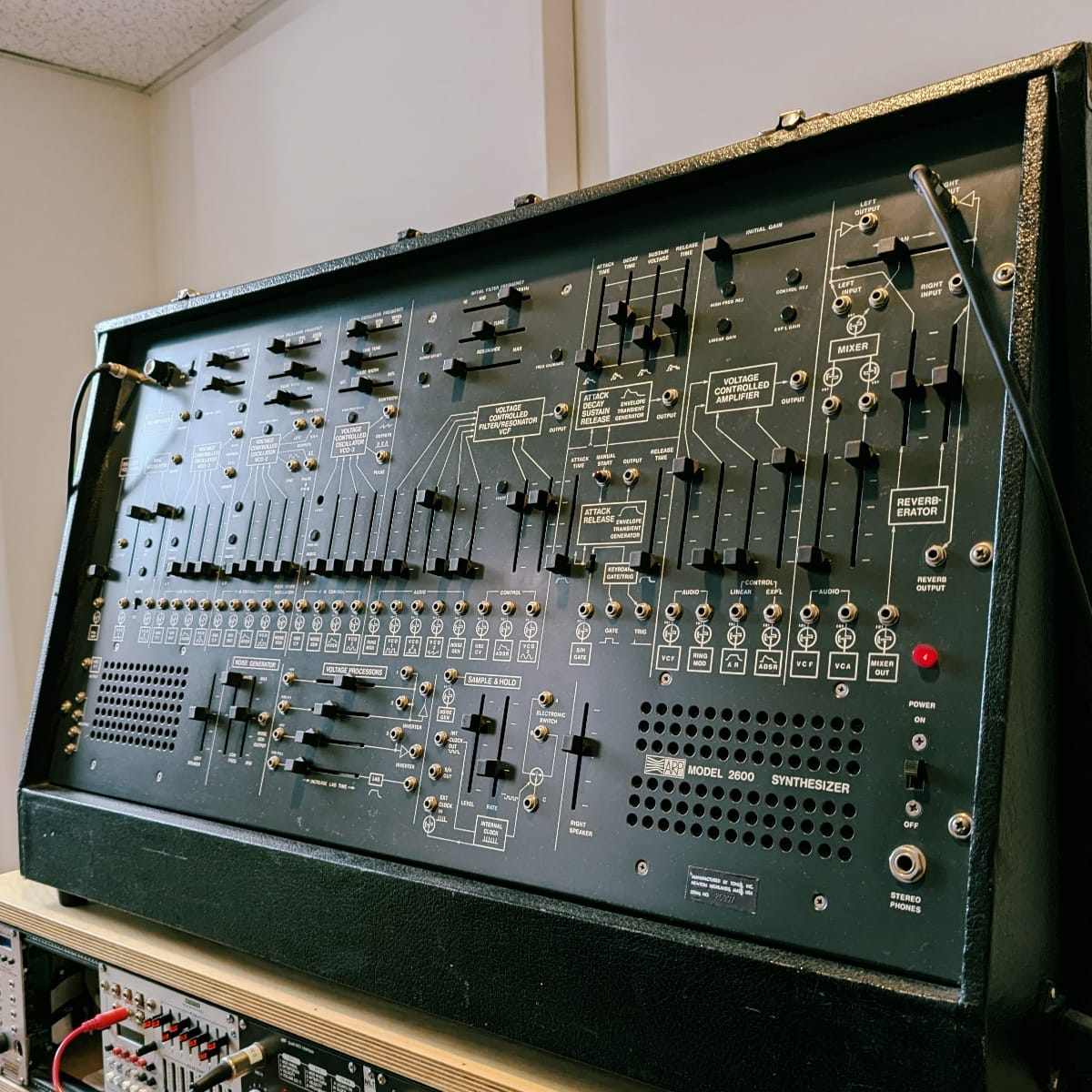
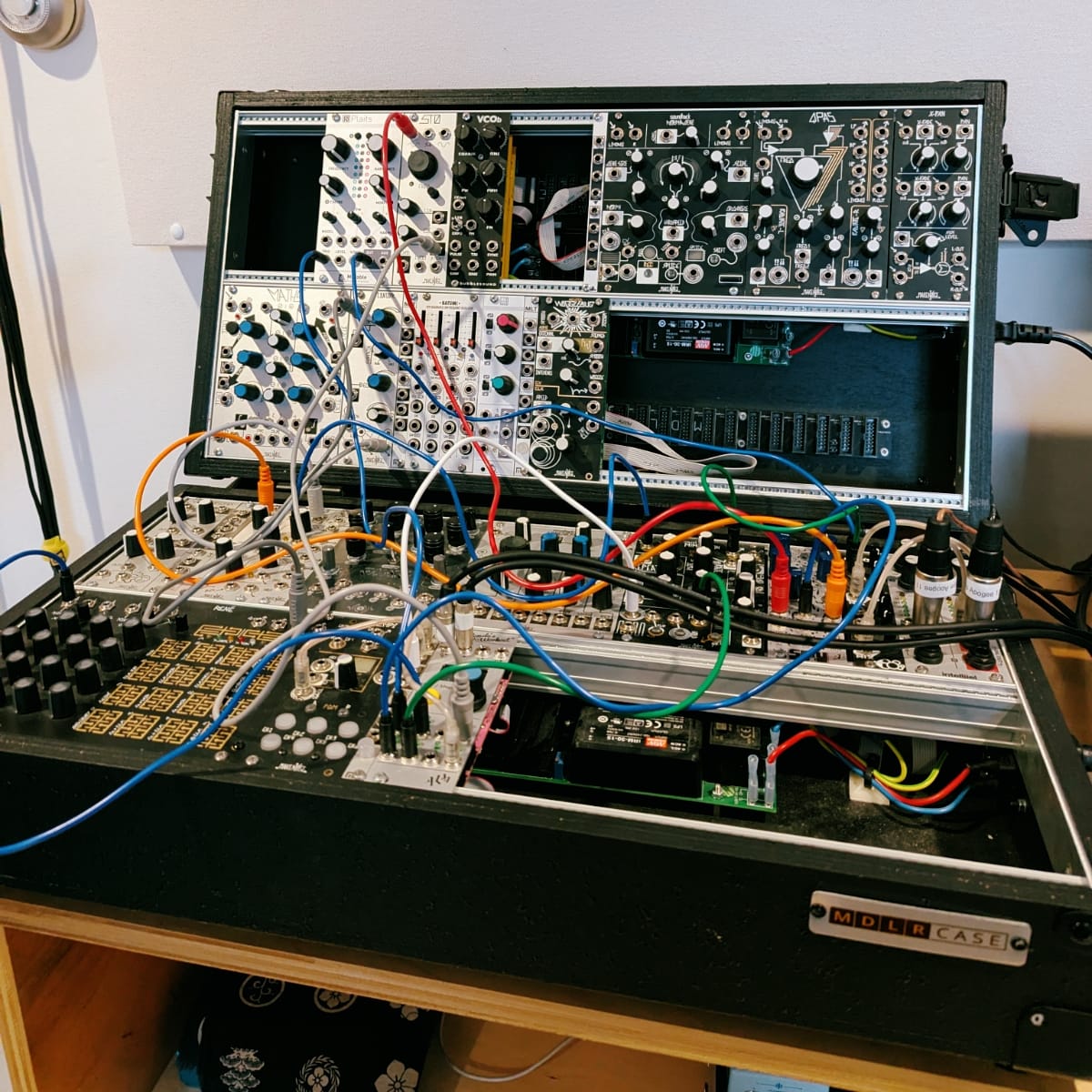
Kodomo's ARP 2600 and modular rack. Photos by Bill Cooper.
Bill: There's a lot of organization and categorization involved in what you're doing.
Chris: I'm not good with percentages of it, but it feels like much of the work I do is organizing. Organizing the sounds, sessions, and everything else. There are just so many different parts.
Bill: I imagine things get lost. Then, you come back to it, and you're like, "I don't even remember recording this." That's probably part of the joy in all of it, right?
Chris: Especially when I like it. That's really satisfying.
It takes consistent reviewing and housekeeping. I've developed a system over the years. Each creative block is a particular session. Even if I have no idea what it is or what it's going to be, I'll record a very rough mix. That rough mix might be just a sixteen-bar loop. And then I'll upload that mix to the software I use for sampling. I use it as a catalog to keep tabs on what I've recorded for later review and to determine whether I want to pursue it.
I find that really useful. Instead of from scratch, I have a starting point. Even if I scrap everything but one loop, it's still worth it. That one loop can be this magic seed that somehow embodies the whole track in just this one loop.
Bill: You mentioned in the write-up of sisu that it is being released within this "age of dissociation." What do you think is our way out of this?
Chris: To me, the way out of dissociation is the simple choices you make. Those choices start with being clear on why you're doing what you're doing and why you're pursuing what you're pursuing. Then, it's about making choices that lead to enrichment and energy, rather than depletion. It really comes down to intentionality—how you want to live and what you can do with what you have on hand. It's about building the kind of world or life that is meaningful to you. But before that, you have to understand what that is and why that is, as well as why that actually feels good.
It's also about taking control of your life. You have agency over how you want to live, and you're reflecting that in the choices you make to help build it.
Bill: It's a lot of stepping outside the limitless and moving into the more concrete. It sounds like making things simpler may bring you that type of focus.
Chris: Absolutely. All this stuff I need to remind myself of constantly. My motto to help with that is, "I'm trying to do too much stuff here. I need to simplify and pull back."
A quote that I really appreciated from a good friend of mine was "Do what matters." In other words, focus on what really matters in this instance. At first glance, you might think, "Oh, this is severely limited. There's not much I can do on a single synthesizer." But you can make a whole album just using the synthesizer if you spend some time with it. You can get such a range out of very simple variables.
That's always been an inspiring notion to me; this idea of complexity arising from simplicity. When you start from complexity, things don't make sense, and get more intensely discursive or frustrating when you have too many options or choices. Starting with a simple system is great because you can push it to its limits, and then it reveals things you would never have expected.
Check out more like this:
 Carolyn Zaldivar Snow
 Lawrence Peryer


Comments