


To most, the harp means courtly elegance, Celtic mysticism, even heavenly choirs. For Bridget Ferrill, the instrument implies something else. On Domschatzkammer, the Berlin-based composer treats the harp as a site for controlled destruction.
Ferrill began piano lessons at four, studied through her teenage years, and at seventeen watched the Fukushima disaster unfold while living in Japan. That experience of massive institutional failure—systems breaking down in real time—changed how she thought about structure, stability, and her place in the world. The disaster drew a line. Before: the ambitious teenager with big dreams and stamina for front-loading the pain. After: someone who understood mortality on a visceral scale, who questioned whether security or significance existed at all, who decided to embrace life with the intensity that only comes from watching that philosophy tested against actual catastrophe.
Ferrill has spent the years since touring internationally as a sound engineer and live electronics performer with Bendik Giske and Aïsha Devi. She's made multimedia works within the SHAPE+ platform and written scores for experimental theatre productions. Her 2022 collaboration with Áslaug Magnúsdóttir, Woodwind Quintet, was released on Subtext Recordings, the same label that released Domschatzkammer. She's also maintained parallel work as a synth builder and engineer at her Real Surreal Studio in Berlin, designing instruments that expand and explore sonic possibilities while questioning the systems producing the sounds. Heady? Maybe. Listenable? Highly.
Domschatzkammer gathers musicians who have shaped Ferrill's musical life. Liam Byrne's viola da gamba offers fragile, minimal patterns shaped by emotional weight as much as technique. Peder Simonsen's microtonal tuba works through just intonation and extended resonance. Lisa Murray, Ferrill's mother, whose musicianship laid the ground for her daughter's idiosyncratic path, performs on organ. These collaborators and the resulting work draw on minimalist classical music and Celtic folk, while giving those combined aesthetics a true ‘punk’ attitude, informed by Ferrill's interest in formal rigor and its deliberate undoing.
Lawrence Peryer: You were studying physics and living in Japan during the Fukushima disaster in 2011. How did experiencing that at seventeen reshape your thinking about daily life versus long-term ambitions?
Bridget Ferrill: Being present for the Fukushima disaster shook me. It was my first experience of mortality on such a massive scale. And it was so literal as well. The earth, which I had always perceived as unquestionably solid, was shifting and rocking underneath my feet like water, not only in the initial quake but also in all the aftershocks in the following days. My sense of control and security was completely undone. I reacted in the years that followed by embracing an extreme form of "living every day as if it were your last." I felt that every moment was entirely vital in and of itself, that in every passing second I was making the choice of how I would be a being in this world, and that there was no security in the accumulation of moments—each was its own independent entity, and each was of utmost significance. It was a vital and free, and manic time.
Aside from the Fukushima disaster, that time was also important in setting me on a course toward music. I was seventeen and showed up in this town where no one spoke English, and all my societal identity markers were absolutely dissolved. I was part of the high school mandolin orchestra, which, given the void, became my sole sense of identity. I lost my entire sense of self in the process of translating myself into Japanese culture, and filled that void with the mandolin, only to lose it all again with the addition of extreme doubt about the reliability of the future, with the earthquake. So, I was coughed up by circumstance as a highly present musician.
Lawrence: What drew you to feature the harp for Domschatzkammer?
Bridget: When the COVID lockdown suddenly became an imminent reality, I had the feeling that if I was going to be locked alone in my thirty-eight-square-meter apartment for the foreseeable future, I should at least be playing harp. And that if it all really went to shit, I could play harp on the street for scraps of bread after the world fell apart. I was living in Berlin, and my childhood harp was at my mom's house in New Hampshire, so I spent what could have been the last of my money ever on a Celtic harp that shipped from within Germany and arrived right before the lockdown started. Very much a repetition of the theme: during a large-scale disaster, I cling to lovely instruments.
Much of the making of this record was direct emotional expression, and the harp is an instrument I began to play during one of the most tumultuous times of my childhood. I experience the instrument as a space of beauty and peace amid the horrors. In the case of this album, the horrors of idealistic romance.
Lawrence: The album includes Liam Byrne, Peder Simonsen, and your mother, Lisa Murray, on organ. How did you think about who should be part of this particular constellation?
Bridget: It wasn't a conscious, active decision. It just felt obvious that these were the instruments that enchanted me with their sound and the people around me with whom I felt a shared creative resonance. Just trusting my gut, pursuing my fascinations with certain sounds and instruments, and lucky to have really talented instrumentalists as friends.
Lawrence: The inclusion of your mother feels significant, not just musically but emotionally. What does her presence bring to the record?
Bridget: To be honest, it's not as much of a story as it might seem. I love my mom so much, and I love that she is part of this, but her inclusion was also, in a way, happenstance. I didn't think, "I want to have my mom play on my album." I thought, "Oh, I have this Norwegian theater commission, and I'd love to record an organ for it. How can I get access to that?" And the answer was that my mom was, at the time, the organist of a Unitarian Universalist church in New Hampshire. So, we spent an afternoon recording together, and then some of that material ended up on the album. My collaborative partner happens to be my mom, and I couldn't be happier about it. She's been playing music her whole life and writes songs. Lisa Murray!
Lawrence: After years of building pieces from archival fragments and processed samples, Domschatzkammer marks your first full-length work composed from original scores. What insights did that bring to you?
Bridget: This process was opened up to me through the confidence given to me from a series of theater commissions from director Jonas Correll Petersen and the trust of Liam Byrne. I've had the ideas forever, but it was something new to believe in their merit. External validation and close collaborative friendship work wonders. It was gorgeous and freeing to finally give space to my own ideas, to have the budget, and to have the long-built working relationship with Liam to pursue my own craft as a composer, and not just a composer of sampled and electronic fractures. I would have loved to work like this from the beginning, but I did what I could with the resources I had. I had always been using the samples to pursue my compositional vision—it's just a lot more efficient to record the compositions than painstakingly construct them from preexisting materials. And yet, I will unquestionably turn to the crafty and integrated world of sampling again in the near future, not out of necessity but for the particular possibilities of that practice.
Lawrence: The album also features a Bach chorale slowed beyond recognition.
Bridget: Yes, I can give you the very literal description of how this went down in the piece I've called "What was the World to me." It's a Bach chorale. On the afternoon of recording the organ with my mom in New Hampshire, I asked her to play through the bass line and simple chord structure of the chorale as slowly as she could manage. A few months later, back in Berlin, I was in Liam's studio and explained the context to him; he had the original chorale at hand but also knew that reinterpretation was highly valued, and he played along to the organ recordings in his own style. Then perhaps a year later, I accidentally played these recordings back at the beginning of a live set. I hadn't planned to play it, but had the audio file in my performance session in case I needed it, and it was sounding as my audio channels were raised in the PA. I decided to follow rather than disrupt the misstep, sent it through my strange, volatile standalone filter, and played it along with these performances from my mom and Liam. Trusted friends in the audience told me the song had worked, and so it was added to the album, much later than all the other songs.
Lawrence: The press materials describe the record as "deeply personal at its core" and mention "an emotional journey of yearning, rupture, and lesbian love." I'm curious whether this led you to certain emotional territories.
Bridget: For me, this record is a pop record. I made this music to jettison my emotional anguish from my heart into the material realm of sound. Before this, I'd mainly been intellectual in all my sonic and structural choices. This time, I could play within my landscapes in service of my own emotional outlet. I felt excessively sad. I was certain I'd found the love of my life, based on initial momentary visions across a room. I held onto that belief if I possibly could, and when it was clearly not panning out, I wrote a bunch of songs trying to capture that pain and confusion.
Lawrence: As an artist who embraces “accident and technological failure as compositional material," can you give me an example of something that went ‘wrong’ during the making of this record?
Bridget: The organ was out of tune, resulting in a strange timbral tension with the other instruments. The electricity in the venue rippled when I used my filter to process the organ recordings live, creating absolute chaos for my audio interface and inspiring the future shape of that whole song. I love digitally looping audio and not fixing any of the clicks that come with it. The microphones in the church picked up the sounds of a lawnmower and birds outside during the organ recording session, which was not my intention, but I found myself enjoying the localization and realism that it brought. Same with the moments when the sound of Liam's movements can be heard.
Lawrence: You describe your compositional approach as "false additive synthesis," one instrument refracted through another. How did you arrive at this concept of embracing mismatch and imperfection?
Bridget: I love materiality, texture, flesh. To refract the fleshy resonance of one instrument through the vessel of another is pure joy and curiosity for me. The overtones of an instrument define its character, and when I isolate those overtones and deliver them as a score to a different instrument, it's like some prismatic sonic version of The Silence of the Lambs. I'm interested in the thin veil between points of confluence and discord. I don't feel that this is something I ever "arrived at," it's just always been there. Curiosity for thresholds, beauty in the tension between two states.
Lawrence: How does touring with Bendik Giske, doing live electronics, working with Aïsha Devi as a sound engineer, and running Real Surreal Studio influence what you're willing to try in your own music?
Bridget: I've learned so, so much from supporting the visions of other artists. They've brought me into their worlds and shown me what the creative process looks like from their center points. It's inspired me, given me reality checks, and provided tools and skills for making my own way as an artist. There are the nuances and magic of creating wordlessly expressive music, something I've really basked in during my time with Bendik, and there's also the absolute shit of the reality of the music industry at this time. Whatever I do, it's coming from a place of realism but also deep care.
Lawrence: You've said your engineering background informs how you experience and work with sound. When you're working on your own compositions versus engineering for someone else, how does that listening shift? Or does it?
Bridget: There are so many layers to this. My main work for the last decade has been live sound engineering. I've heard an absolute overabundance of live music. I'm extremely opinionated about the frequency ranges artists use and the dynamics of their live sets. I can barely go to concerts for fun anymore. When it comes to making my own music, I'm already hyperaware of these issues, and at the same time, it's my break from being the engineer; it's my moment to be the artist. I had great fun with this album, knowing that James Ginzburg would be mixing it, and I could forget all that, and that he would do a better job than I ever could when the time came. And yet, given my cynicism and sensitivity from working as an engineer, I would never compose anything that wasn't, in my perception, tasteful in its frequency range and dynamics. And so much of my compositional process is about listening to the really specific resonant characteristics of instruments. As I said, flesh. Compositional extraction of the flesh of the instrument, thanks to the engineering ears and years.
Lawrence: Your collaboration with Áslaug Magnúsdóttir on Woodwind Quintet was a long-distance affair. What does distance do to a creative partnership?
Bridget: It makes it special—something that you've both done on purpose. It's not casual. There's a sense of commitment that comes inherently with making time away from your immediate reality to work with someone far away, to visit each other, and to maintain that connection even though it isn't convenient. It also means the process can be more disrupted and slower, which gives us time to think and reflect. I really love this way of working. When we get together to work in person, it's a fun and creative time, and the dialogue we maintain throughout our individual distanced lives is grounding and precious to me.
Lawrence: Real Surreal Studio explicitly aims to support “other women and nonbinary people in professional audio." How does that mission inform the sonic culture you're building there?
Bridget: Ninety-six percent of sound engineers are men. It's a wild experience being a woman in the field. I just want to do whatever I can to make this path easier for other women. I happen to have whatever insane fortitude it takes not to get beaten out of the job, and I hope it's less brutal for whoever follows. A lot of what comes to us is projects from other people who have had enough with the complacent, egotistical nature of the default.
Lawrence: What music has been in your rotation while making this record? Or more broadly, what art have you been surrounded by?
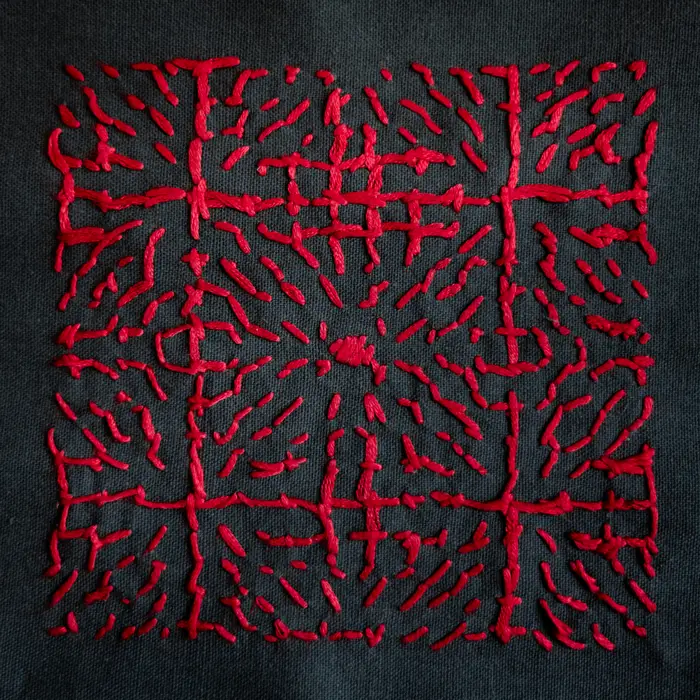
Bridget: I was listening to Fossilized Wilderness, Talk Talk, Caroline Polachek, Britney Spears Nightcore Remixes, and so, so many instances of Bendik's live set. I was consciously inspired by the playful seriousness and diverse instrumentation of Moondog's music. I'm also a textile artist and constantly engage with natural fiber textures and patterns, using numbers and grids to form surfaces from strings. There's a collection of knitted garments I've created that is about to go public.
Check out more like this:
 Lawrence Peryer
 George Grella


Comments