


Musically, there's an element of early Beach House, a vocal nod to Nico, and homages to both sixties pop and shoegaze on My Violence's sophomore album, Monday's Child, but the aesthetics surrounding the project take it all a bit further, creating more of a feast for the senses than its acoustics alone provide. There's a rich literary context woven in lyrically, as the album's title, referencing the 19th-century nursery rhyme, suggests. And singer-songwriter Silvia Ryder expands its fortune-telling quality to flesh out unique characters, such as the "Paper Bag Princess" in the song by that same name.
Her storytelling abilities, sharpened during her days as a journalist in Vienna and her time as the lyricist in the band she had with her ex-husband (Sugar Plum Fairies), come through in both the words of the songs and the way she sings them. The cadence of her singing voice makes it feel a bit like we're being told a tale—and the instrumentation adds a haunted effect to the telling. What else can we expect from an album that makes use of spirit calling bells as a percussion element? Consider the spirits called!
We enjoyed a pleasant, screen-free phone conversation on a Friday morning. The audio-only nature of the interview lent it an appropriately vintage feel, given the visual and auditory aesthetic of My Violence as a project.
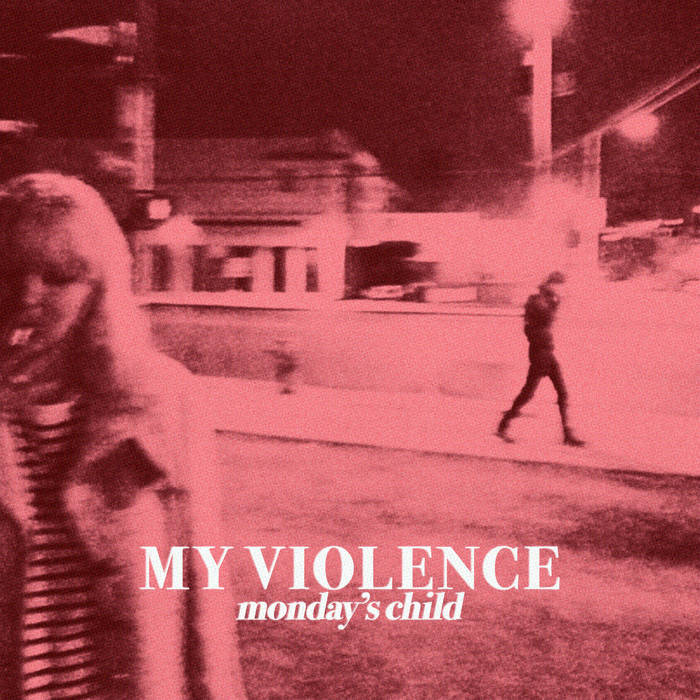
Meredith Hobbs Coons: This album is called Monday's Child, after the famous 19th-century poem.
Silvia Ryder: I want to point out that I actually didn't know that this poem existed, and I was surprised when everybody knew about it.
Meredith: That's interesting. Was it after you'd made that discovery that you did "Monday's Child (Interlude)"?
Silvia: Yes. Since it's a children's rhyme, the music is very repetitive and doesn't really have a melody, and that was actually the hardest song to write in regards to the music, because I did want to keep this childlike feel, but I also wanted to have a proper melody, and not sing the same tones all over again. I knew that there was a poem with that title, but I had no idea that it was very well-known.
Meredith: What did that phrase mean to you: "Monday's child is fair of face?" How did it inspire you?
Silvia: The whole thing inspired me to create some characters. They're described as children, and here's what the future might bring based on the day they were born, but also a kind of fortune-telling for protagonists who are adults and probably in trouble in some way. For example, there's a song called "Paper Bag Princess," which is about a young heroin addict.
Meredith: There's a very strong storytelling element in this album. Is that how you've always liked to write—with stories in mind?
Silvia: Yes, and that's actually how I started out. I used to work as a journalist a long, long time ago—back in Vienna. Then some bands asked me to write lyrics for them, which I did. I started a band with my now ex-husband, who was the main songwriter (actually, the only songwriter), and I just provided the lyrics for many, many years. Then, after we split up, I started composing. So now it's my project, but poetry was where it started with me. What I like to do, which is different from what I did with the Sugar Plum Fairies, is incorporate instruments that are not very common. The interlude, for example, that just has an Omnichord and a 1950s toy piano on it, and that's all. That's the only arrangement.
Meredith: And you used the Omnichord on your self-titled album that came out in 2023. You had a "no guitar" constraint for yourself at the time.
Silvia: Yeah, just because, with my band, it was all centered around guitars. So, to carve out my own identity, I started writing on an Omnichord because I don't properly play any instrument, and that was the easiest for me. A friend of mine, Lael Neale, suggested that, and it changed everything.
We had a percussionist who played, I think, 12 or 15 percussion instruments—some of them he invented, like coins of different currencies in a bag. And there were a bunch of spirit-calling bells and the harmonium: that has always been important for me, because it has this really dark, sad sound. Oh! And the accordion, which I've always used in one way or another, also with the Sugar Plum Fairies.
Basically, the whole album was produced by my son [Marlon Rabenreither], who's in a band called Gold Star. He produced and mixed it. There were only three other people involved. He pretty much played all the instruments that he could handle. That's why it's organic—it's not too polished, which I like. He sang background vocals, played piano, did all the guitars and harmonium, bass, electric bass, and all the noises and drum samples. That was the second time we worked together. The first time, he jumped in when Sugar Plum Fairies fell apart, and I still had an album that was half finished, so he finished it up with me.
Meredith: It sounds like there was a lot more expansion on this album. Were there any constraints you were still operating under? Or were you keen to let the constraints fall away?
Silvia: One big constraint was that I had no money. (laughter)
Meredith: Always that one!
Silvia: I managed to actually make the whole album for $1,500. All the musicians were awesome, and they didn't want any money. And I also had a lot of help with PR, because they didn't charge me much. In the past, some of my albums were like 30 or 40 grand sometimes.
Meredith: I think it's pretty cool that you're being open about that, too.
Silvia: A lot of people think, "How much can it cost to write an album and release it and everything?" It's a lot. And videos and everything? I had to be really crafty. I didn't have any means to actually press physical copies of that album. In the past, I've done CDs—people still like CDs, and it's cheaper for both the buyer and the seller than vinyl—but this album is only available digitally for now. Unless some savior jumps in.
Meredith: Speaking of things in the digital realm, you do have a very cool video for your song, "Isabella Rossellini." Do you want to talk about that song and how you translated it visually?
Silvia: Well, I can tell you, but I might get in trouble because I got it off UbuWeb. It's an archive of music, poetry, and art that has been mostly forgotten. It's all experimental stuff. It's hard to describe, but it's kind of a shadowy pirate site, and some artists are open to it or post their art in the archive. So what I used was part of a performance piece that was originally 40 minutes long, which I edited down.
Meredith: Oh, so you edited it yourself?
Silvia: Yes, I do that with most of my videos. There's also a book out there that compiles, like, about 100 of UbuWeb's highlights, because there are thousands and thousands of things there. Not many people know about it, except those in the art business. The author of the book, who also invented the whole thing, is Kenneth Goldsmith. And the title is Duchamp is My Lawyer.
Meredith: That's so cool.
Silvia: I wasn't hit with a copyright infringement because YouTube usually figures that out really fast, so I assume that Isabella Rossellini actually doesn't mind it being used. I mean, she's in her 80s now.
Meredith: Using the archival media to make your video is just one example of the ways that older sounds and mythologies seem to enter your work. What is your relationship to older things, antiques, and things from another time?
Silvia: I'm obsessed with the '60s and early '70s, especially with film. I'm a big fan of Godard, Truffaut, and also early 1970s performance art. Actually, a lot of it came from Vienna, where I was born. And, also, with the use of film, I've had to use everything, because I sometimes also direct the videos, and I have some that were shot on iPhones, and a bunch that were shot on VHS or whatever I have available—and whatever works with the song. That's the most important thing.
Meredith: '60s and '70s music seems to be an influence, too.
Silvia: Yes. And, obviously, a lot of slowcore, shoegaze, and so forth—even though I try to mix it up and use instruments that are not typical shoegaze instruments, like an accordion. My voice and the way I sing, everybody says, right away, "Oh, this is shoegaze," and "it's whispered," but I mean, it's my voice. There's nothing I can do. And if I belt out a song, it would sound ridiculous.
Meredith: In this album, too, there seems to be a theme of saying goodbye. How did that show up in this work for you?
Silvia: First of all, I was saying goodbye to my old band. That's what we started with, with the self-titled album where I put the "guitar ban" on. It was basically saying goodbye to my previous songwriting style, and also to my previous husband. Also, the difference is that the Sugar Plum Fairies were pretty much shoegaze-pop, while My Violence is way darker and more cinematic. That was also a new identity change, in a way.
Meredith: That definitely comes across. It's a really evocative band name, too: My Violence.
Silvia: Yes. I'm the least violent person, and it's just tongue in cheek. I just hope that some people don't think I'm a hardcore rock band, but I wanted a title that is not who I am, you know?
Meredith: The music isn't heavy rock, like you were saying, but it's interesting how violence can show up in things that aren't physical.
Silvia: Yes. For me, my violence is poetry. That is what it is for me, because words can kill, in a way. And that's why I chose that name,
Meredith: It's an evocative name for sure. How did you start playing the accordion?
Silvia: I wasn't playing the accordion. The only thing that I'm playing is the Omnichord. But then, I was very proud; I actually did provide two piano tracks. One is "Paper Bag Princess's" opener. I can't play piano, but I have one here in the studio, and so I was just using the white keys, because otherwise it would have gotten too complicated. I didn't intend for it to be used; it was just a guide for my son to track. But then Marlon said, "Look, we're gonna leave that. It's raw, and this is very emotional," and I was so happy because I didn't expect that. That's all I can do, in regards to instruments,
Meredith: Yeah, but maybe this will embolden you to play around on some other instruments— giving yourself some constraints, like only using the white keys. That could be very interesting.
Silvia: Mind you, it's not a self-constraint, it's a limitation. (laughter)
Meredith: But limitations yield some very interesting art oftentimes. Some people say that art is created by one's limitations. I think that you can own that. So why Isabella Rossellini in particular as a figure around which to write a song?
Silvia: You know the cemetery movie nights [at the Hollywood Forever Cemetery]? They showed a film with Isabella Rossellini. You won't know until you hit the second verse that that's what this is about. But it's mostly, I would say, a song about loss—about a messy relationship, basically.
Meredith: Loss is a theme, but I also see perception as a theme, like how people are perceived and how that can feel as a woman in the songwriting space in particular.
Silvia: Yes, that's correct, actually. I have a lot to say about how women are perceived right now. That's why I'm using examples of women that I think are strong women, like Isabella Rossellini, you know? There are a lot of female artists right now, but a lot of them are kind of cookie-cutter and pleasing in regards to their music—meaning commercial, basically. Obviously, I cannot compete with that, so I worked really hard to create my own niche with my style of music. A bunch of people are saying it reminds them of Nico from the Velvet Underground, who wasn't technically a good singer but was very unique. I guess it also comes from me having a German accent, as she did.
Check out more like this:
 Arina Korenyu
 Meredith Hobbs Coons


Comments