


Hey, everyone. Thanks for coming on board for another installment of the weekly Talk Of The Tonearm newsletter. We're ramping up our publishing schedule—six new articles (plus a podcast) a week!—so there's a lot to tell you about. Dive into these stories, click links with abandon, and let's discover some cool new things together. Off we go!
Queued Up

Surfin' Bass — Linda May Han Oh Rides an Uncertain Wave
She took up the upright bass because she thought it would make her a better surfer. Lawrence Peryer paddles up next to Linda May Han Oh to chat about her new album Strange Heavens, a chordless trio recording with trumpeter Ambrose Akinmusire and drummer Tyshawn Sorey that explores the human tendency to choose familiar hells over strange heavens. The organizing principle comes from writing around the 2016 election, grappling with questions about power and the decisions we make about what we tolerate. The album's format may seem familiar to Linda, as she was previously part of a chordless trio on her 2009 debut Entry. But there's also something potentially strange—as a musician, Linda and her musicians have traveled considerable distances since then, both literal and metaphorical, and this new convergence is a chart of how far. Linda explains her compositional process as imaginative rather than technical: "I visualize what I would feel if I were sitting in the front row at my own concert." The powerful result moves through anxiety, release, and hopefulness without tidy resolution. Forever a surfer on the hunt for that perfect ten, Linda compares improvisation to riding a wave: "You're never really sure when a wave's going to hit, what type of set is going to come through. Something is thrilling about that element of surprise."
Poetry in Emotion — The Unfolding Vulnerability of Tiberius
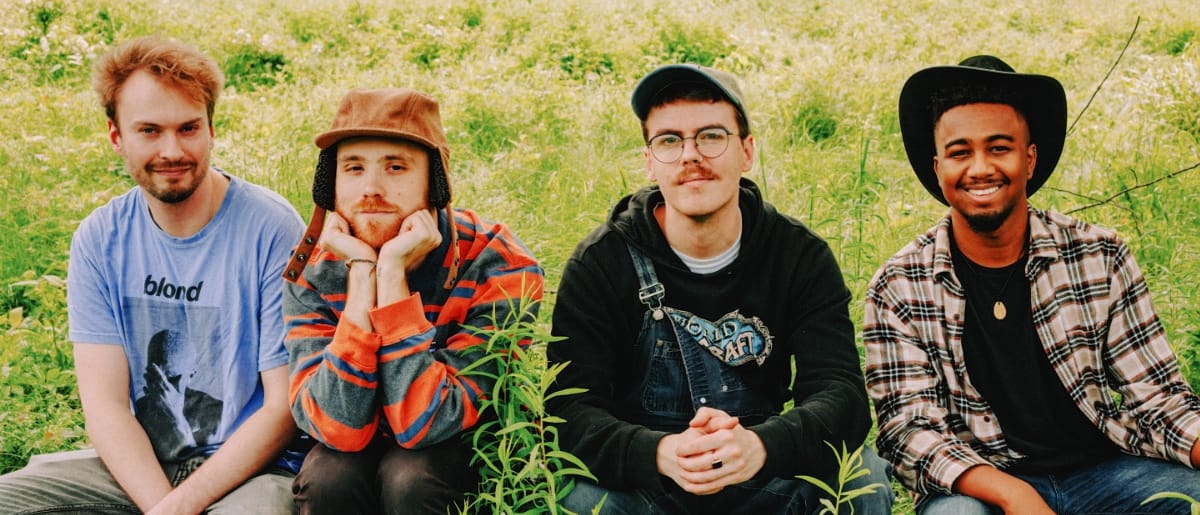
Sam Bradley spoke with Brendan Wright of Boston DIY outfit Tiberius about their latest album, Troubadour, which was written during a tumultuous shift in relationships, an experience Wright described as like "ego death." Sam notes that the record's farm-emo meets alt-country sound will get compared to Pinegrove, but that misses how Wright bottles up Northeast basement rock in ways that balance feedback-heavy density with bouncier melodic moments. What started as a solo project has become a family or collective, and Wright learned to let go of creative control through better communication and trust. "I'm not a very intimidating person," they admit, describing themselves as passionate but gentle, learning when to advocate for strong creative decisions. The conversational lyrics came from rejecting flowery poetry for plain language: "It is vulnerable to say, 'This is what I'm feeling,' rather than finding a beautiful way to say it." But Wright feels more confident when it comes to DIY touring, toughened by gas-station food and the hours spent in cars. Though there's often flakiness and unpredictability, these hardships are made up for by the impromptu living room shows and the fun concert Tiberius gave at an Austin convenience store. As in DIY touring, we all have moments when the whole world feels like it's falling apart, but, as captured on Troubadour, this is overcome by acknowledging our vulnerability doesn't require a resolution.
Robert Callender Reimagines His 1968 Psychedelic Landmark for Modern Ears
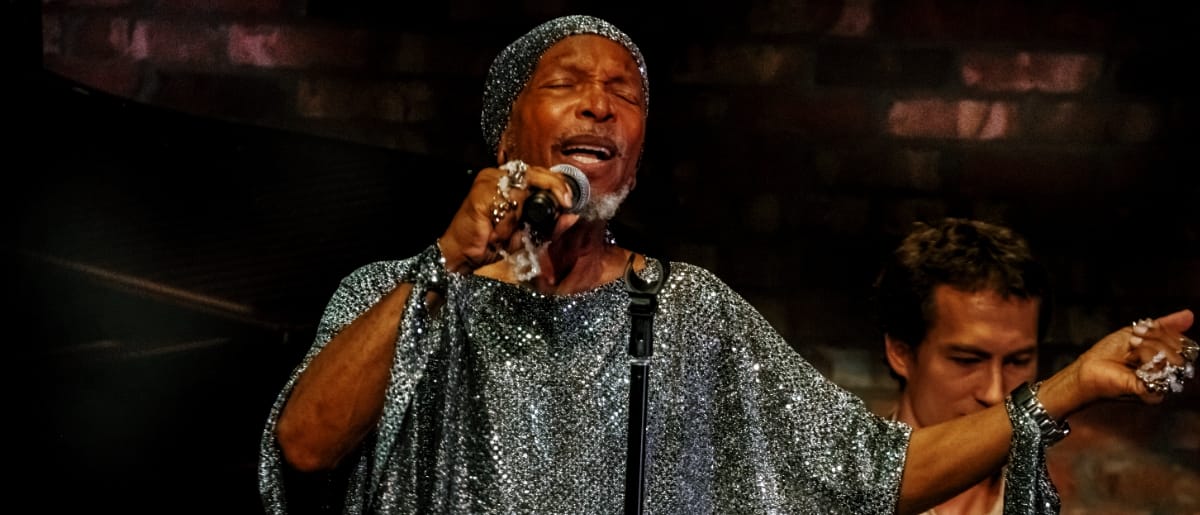
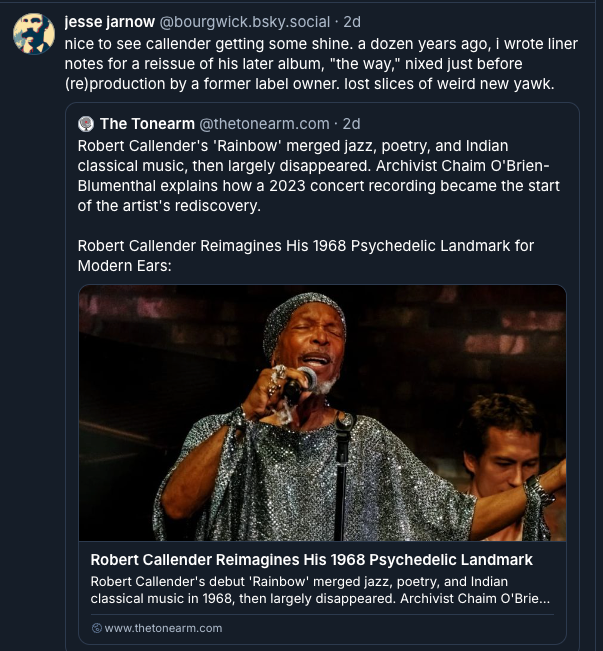
There are tales of rose petals dropped behind him wherever he walked, an entourage in tow, as he spoke only French to the studio crew. The myths about Robert Callender persisted for decades because nobody knew anything real about the artist behind 1968's Rainbow, a remarkable fusion of jazz, psychedelia, and Indian classical textures that disappeared almost immediately after release. Bill Kopp talks with archivist and writer Chaim O'Brien-Blumenthal, who tracked Callender down for a Shindig! magazine feature and discovered "a lovely guy who is very dedicated to his art." Before Rainbow, Callender was Bobby Callender, cutting regional R&B hits like "Little Star." Soon, he was swept up in the creative breeze of the late '60s, studying Sgt. Pepper, hanging with the Warhol crowd at Ondine's, and absorbing everything. Though his debut album featured seasoned young jazz musicians who'd played on sessions for the likes of Aretha Franklin, Callender guided them to fully realize his intricately constructed tone poems. Fifty-five years later, a 2023 anniversary concert at Orlando's Timucua became the catalyst for rediscovery. Chaim watched the livestream and thought, "This is amazing! He's managed to transcend it into something new." The performance, now released as Rainbow: The Anniversary Concert, features Callender accompanied by tabla, sitar, a string quartet, and the band Golden Flower. The recording puts a kaleidoscopic new spin on the original songs. Now, Chaim is helping with touring plans for Callender, looking to (re)introduce him to a young audience that may have only heard the original songs as samples on numerous hip-hop records.
David Byrne's Revival Meeting for the Not-Yet-Joyful
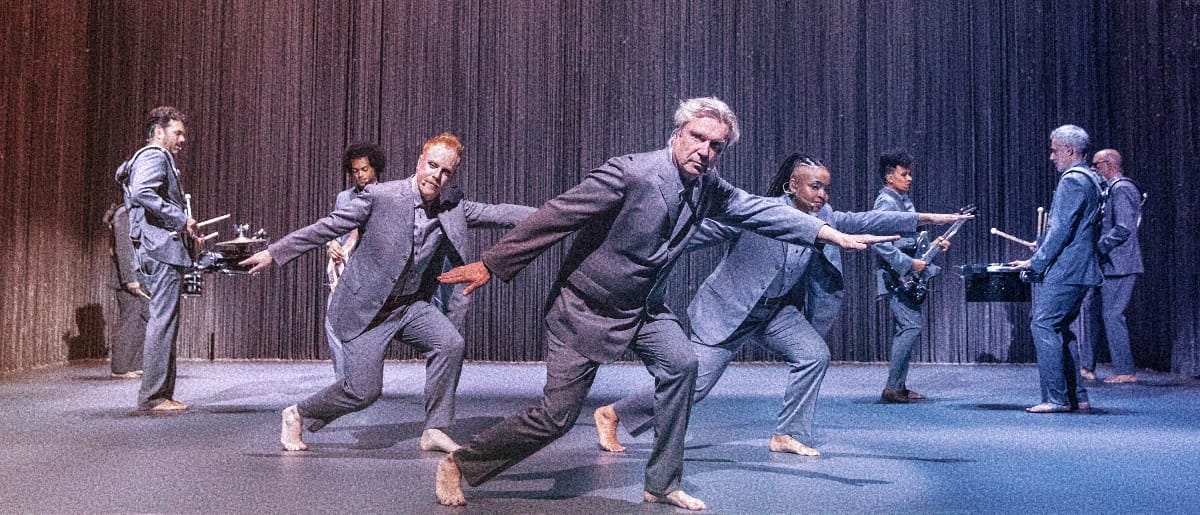
David Byrne opened his recent concert in Seattle with "Heaven," pointing at Earth on the screen behind him: "There's our heaven. It's the only one we have." Lawrence Peryer was there, watching as twelve musicians in royal blue suits moved in constant choreography across the bare stage. Unlike the usual static band, there were no fixed positions; their instruments were strapped to their bodies, allowing eye contact, hands to touch, and small dance circles. "Love and kindness are the most punk thing you can do right now," Byrne announced midway through, positioning joy as resistance. The setlist alternated new songs from Who Is the Sky? with Talking Heads classics, the paranoia of the older material standing in relief against Byrne's noted optimism. "Psycho Killer" felt genuinely ominous, Byrne's shadow growing and overtaking him, while "Life During Wartime" played against footage of ICE raids and protests. Lawrence recognized the performance as proof that it's possible to build a life oriented toward connection and sustained joy, that you can be 73 and still evolving. Byrne and his cohort radiated happiness so pure it felt like they'd figured out something the rest of us are still working on. But how? What did Byrne learn? What burden did he put down? Lawrence tells us that it's like being shown a destination without a map, bearing witness to joy from the outside while still trying to learn the language. David Byrne reveals that the path to get there is what's inspiring.

From Signal to Noise — Loop Music and the Physics of Entropy
George Grella positions two loop albums as opposite soundtracks to the end of the world. Tim Harrison's A Strange Loop (under the project name 'recur') builds intentional forms through time, played live by humans with woodwinds, strings, and percussion—no actual loops to be found. These just repeated patterns rise and develop like a symphony made of discrete units. William Basinski's The Disintegration Loops, now reissued by Temporary Residence, captures the sounds of magnetic tape falling apart as he digitized old recordings on September 11, 2001, an unintended soundtrack to actual disintegration. George pulls back to consider how loop music touches time itself, in turn commenting on the universe's defining feature. Music exists only in time, has no other dimension, and loops create units of time that repeat within the universe's flow. Time moves from order to disorder—entropy, physicists call it—and these albums sit on opposite ends of that movement. Harrison creates signal within noise, a slow burn raging against the eventual dying of light. Basinski captures entropy as moving sonic art, the sound of things losing shape and form. Neither album will last forever (nothing can), but there's wisdom in seeing that the process of life is embedded in the life of the universe. Time flows one way, and we can hear what that sounds like.
The Complete Musician — Three Voices on Gunther Schuller's Centennial
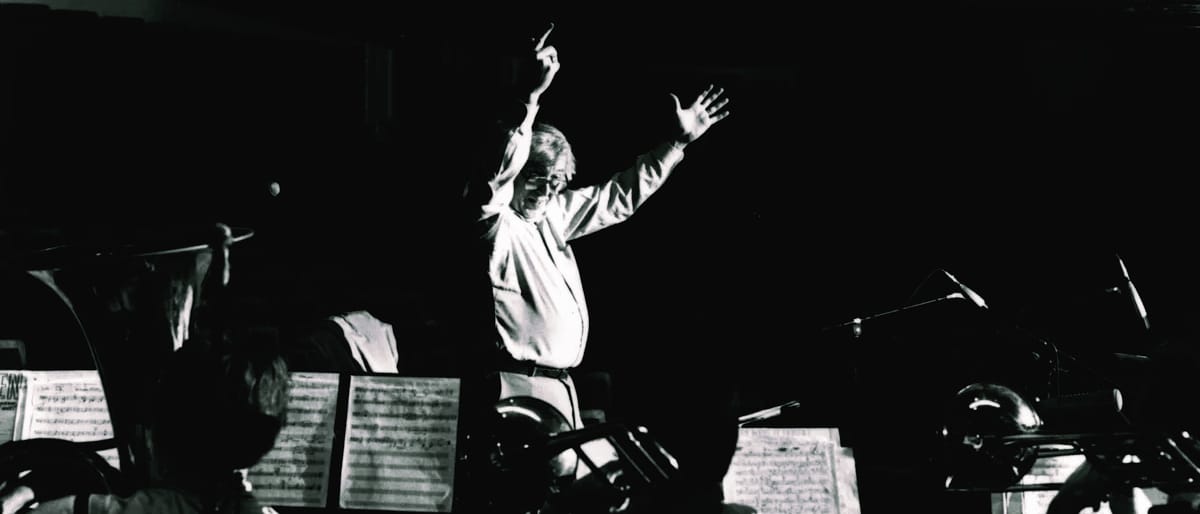
It was a radical thing to teach ragtime next to European harmony when, in 1967, Gunther Schuller established the first fully accredited jazz studies program at an American conservatory. Now it's baked into the curriculum. The New England Conservatory recently celebrated Schuller on what would have been the 100th birthday of the composer, educator, and visionary. To mark the occasion, Lawrence Peryer spoke to three musicians who knew him well. His son George Schuller remembers the work ethic ("unmatched and kind of crazy"), the family station wagon packed for summers at Tanglewood, and a father who championed unheralded musicians while battling the academic music complex. Jazz Studies chair Ken Schaphorst explains how Schuller's status as an eminent classical musician gave him the credibility to argue for jazz's institutional legitimacy, even as few conservatories took it seriously. Former Contemporary Musical Arts Chair Hankus Netsky recalls how Schuller supported his research into Eastern European Jewish music and saw parallels between klezmer's hybrid nature and the Third Stream concept. As George notes, those 1950s experiments "may have fallen short of their appointed goals and caused a bit of controversy among the stodgy traditionalists," but they laid the groundwork for the genre-blending we take for granted today.
Vanguardia Subterránea and the Sound of Sanctuary
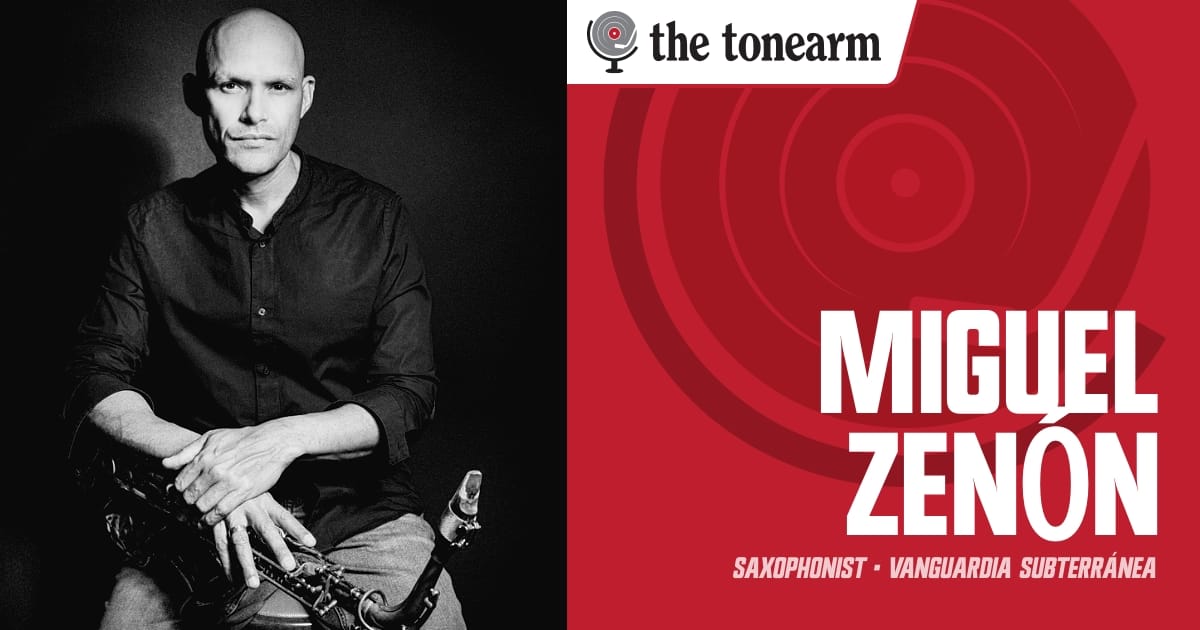
On the new episode of The Tonearm Podcast, Lawrence Peryer reconnects with Miguel Zenón 14 years after their first conversation, finding the saxophonist still "filling holes" in his knowledge of jazz and Puerto Rican music. Miguel's latest album, Vanguardia Subterránea, marks his quartet's first live recording after two decades together, captured at the historic New York venue, the Village Vanguard. This vibrant album and performance features personal tributes, such as "Vita" and "Bendición," alongside reimagined salsa standards by Willie Colón and Gilberto Santa Rosa. Miguel describes his compositional systems, such as encoding the Vanguard’s geographical coordinates and each musician's birthplace into the piece "Coordenadas," though he's quick to note the system serves him, not the other way around. The conversation touches on chemistry in bands ("it really affects the music if there's not a personal kind of sync"), the research process as his favorite part of creating, and how his Golden City project explores immigrant experiences across California's history. Miguel admits he couldn't foresee how dark immigration politics would become, but finds solace knowing people devoted to fighting back. Tune in to this great new episode!
A Shout from the 'Sky
Short Bits
As someone who is always curious about the specific processes of writers and artists of all stripes, I enjoyed this 99% Invisible episode featuring comedy writer Elliot Kalan describing how he writes a joke. • Australian trumpet-meets-electronics player Peter Knight, who we recently profiled on The Tonearm, has a new album. It's called For a Moment the Sky Knew My Name and, of course, I highly recommend it. • Anthony Braxton turns 80, and this New York Times article (gift link) tells you where you can check out recent performances of his work, including one of our favorite online places, the Roulette Intermedium live concert archive. • "Anyone willing to shell out a few dollars per month is welcome to set up an account. And, if they so desire, to start flooding their favorite bands’ profiles with the shittiest music imaginable." A disturbing article from Hearing Things about streaming's AI slop problem. • "I was armed with a budget, a list, and some maximum bids. The auction was streamed live, [and] the process was clear, calm, and collected. Unfortunately, I wasn't." A semi-harrowing account from the Kraftwerk auction. • George Grella on Music Made With Non-Instruments and Music for Many Holidays. • A long and wonderful and—I'll say it again—long Tone Glow interview with Negativland.
Run-Out Groove
Some may be wondering: My eyes are doing great. Thanks to those of you who wrote in with concerns. I'm not 100% out of the woods yet, but I'd say I'm 85% of the way … ? Regardless, I'm editing and slinging words all over the place like a monstertrucker for the first time in months. I am feeling okay.
Please share this newsletter or your favorite stories from The Tonearm with a trusted friend. You are also encouraged to post these things in that opposite of a strange heaven that we call social media. As you know, sharing our stuff is the best way to support The Tonearm, and it always means a lot when we see one of our stories out in the wild. Likewise, please reach out to us with your comments or suggestions; simply reply to this email or contact us here.
There's a big tofurkey holiday happening here in the US this week (and perhaps some comparable event where you are, too). Then we enter a sort of limbonic haze until about the second week of the new year. Do you feel that, too? It's weird. But here at The Tonearm, we keep chugging along. We're even going to publish a big feature on Makaya McCraven on Thanksgiving Day. There's no stopping us now, I suppose. So, take some time for yourself, manage those stress levels that are starting to creep upward, and—yes!—I'll see you again here next week. 🚀
Connect with The Tonearm:


Comments