


Guitarist Nels Cline began his musical wanderings in teenage psychedelic rock with his twin brother, drummer Alex Cline, absorbing Hendrix's feedback squalls and the Beatles' studio experiments. Electric Miles Davis opened doors to Coltrane's late period and the West Coast free jazz scene, where icons like multi-instrumentalist Vinny Golia and bassist-pianist Eric Von Essen provided early mentorship. By the 1990s, Cline was releasing uncompromising albums with his trio and making explosive statements, such as Interstellar Space Revisited, his 1999 duet with drummer Gregg Bendian. Then came 2004, when he joined Wilco. "I've been able to have my cake and eat it too in this insane way," he has said, "play in a prominent rock band and play this brilliant songwriter's songs. And then also have a couple of my own bands and then collaborate with all these musicians from all over the world."
His recent projects demonstrate the breadth of that collaboration. The Consentrik Quartet, featuring saxophonist Ingrid Laubrock and a rhythm section of Chris Lightcap and Tom Rainey, arrived on Blue Note in early 2025 with focused compositions and ample improvisational space. The Nels Cline 4 pairs him with guitarist Julian Lage for the dense harmonic textures and intricate unison lines he's pursued since discovering Sonic Youth. "Certainly I always think two guitars are better than one," Cline notes. Through it all, he has maintained his ear for unlikely combinations and his willingness to work with musicians who share certain priorities. "When I play with people who are invested in sound, not just in technique or notes, and have an openness to improvisation, then I'm in my happy place."
Trio of Bloom, out now on Pyroclastic Records, represents his first meeting with keyboardist Craig Taborn and drummer Marcus Gilmore. Producer David Breskin conceived the project with the precedent of Strange Meeting, the 1987 Power Tools album that united Bill Frisell, Melvin Gibbs, and Ronald Shannon Jackson in category-defying improvisation. That album's influence runs through both Cline's and Taborn's work. For Trio of Bloom, Breskin asked each musician to bring original compositions and a cover song. The results move from Ronald Shannon Jackson's "Nightwhistlers" through Terje Rypdal's "Bend It" to Wayne Shorter and Milton Nascimento's "Diana," with the ten-minute free improvisation "Bloomers" anchoring the album's center.
Cline's approach to collaboration centers on participation rather than assertion. "All I've ever wanted to do since I was 12 years old, I suppose, is participate rather than dominate," he says. That philosophy informs how he thinks about composing for ensemble contexts and how he listens back to recordings, accepting the moments of uncertainty and surprise that make improvised music feel alive.
Nels Cline was a recent guest on The Tonearm Podcast. In his conversation with host Lawrence Peryer, Cline discussed the origin and execution of Trio of Bloom, what it means to keep saying yes to projects that make him nervous, his early encounters with John Zorn, his years living in Brooklyn and eventual return to the West Coast, and the mindset that helps him live with small musical mistakes.
You can listen to the entire conversation in the audio player below. The interview transcript has been edited for length, flow, and clarity.
Lawrence Peryer: I was intrigued by a comment you made that you were somewhat daunted going into the Trio of Bloom sessions. I'm curious about what that comment implies. It could be butterflies, it could be getting amped up, it could be all kinds of things. But what it doesn't seem to be is an uncertainty that causes you to choke, because you show up.
Nels Cline: Well, I do a lot of things that I feel I might suck at, but I still do them. I say yes and hope for the best. Craig [Taborn] and Marcus [Gilmore] are absolute wizard level, and I feel like I personally am really more of a garage band guy who heard Coltrane and Miles, and of course King Crimson and the Allman Brothers Band and Jimi Hendrix. So I'm not coming from as deep a well of knowledge and technique as they are.
Lawrence: When you're in those contexts, what do the other musicians look for in playing with Nels?
Nels: I don't know. (laughter) I think in Craig's case, he was familiar with a lot of stuff that I've done, more so than I actually realized. Craig and I would run into each other periodically when I still lived in Brooklyn—he lived pretty close by, right off Flatbush. I'd never played with Craig, nor Marcus, whom I'd never met. So I definitely can't speak to Marcus's impressions or expectations of me. In Craig's case, I think he's aware of a bunch of my stuff, and we have so many friends in common, people who've played with Craig on and off for years and years. So that was actually one of the things I might have been hanging onto to bolster my confidence in this situation.
Craig was probably expecting some funny noises and maybe some attitude—some musical attitude, not attitude from me personally, but some intensity, some edge of some sort, or the ability to go ‘there’. And I suppose versatility. Certainly, Craig and Marcus are extremely versatile. And then we had David Breskin in there as our producer/svengali, who started this whole thing, making suggestions and brainstorming with us.
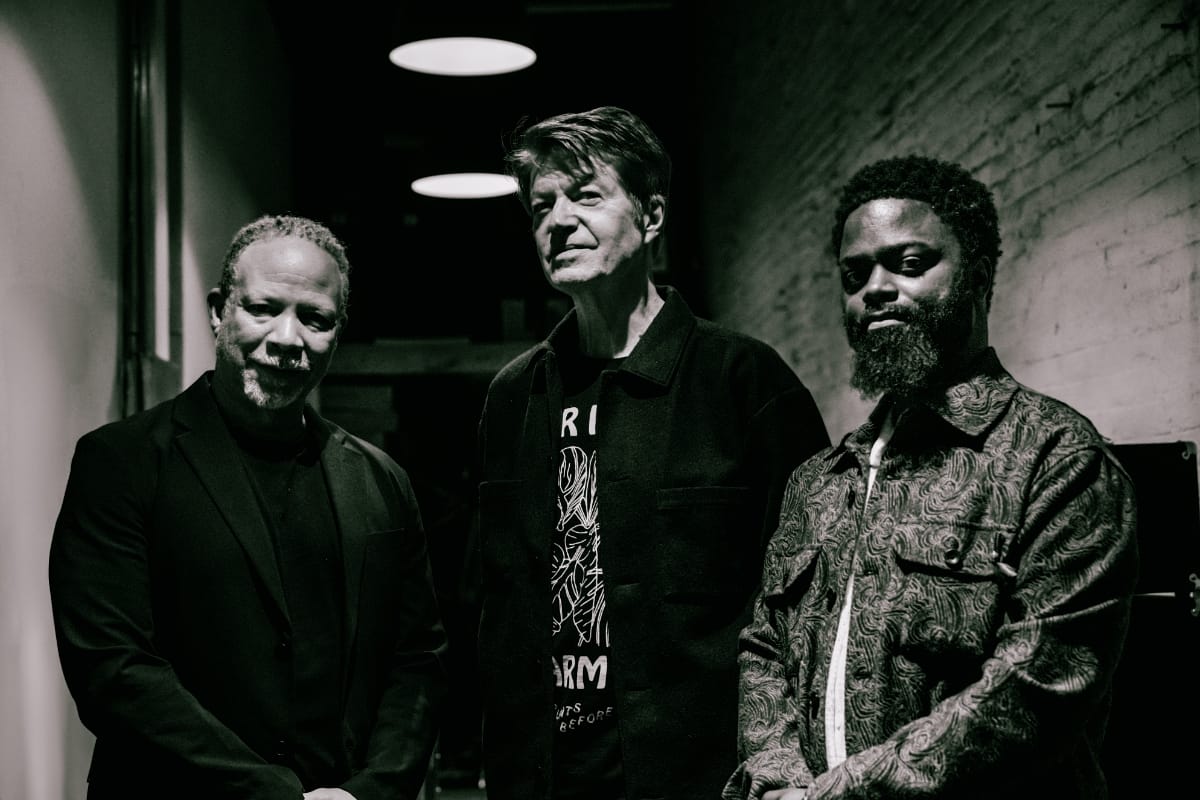
Lawrence: So when you all assembled for the sessions, it seems like it was an incredibly productive few days. How did you prepare when you didn't have the benefit of real professional musical relationships like you have in some of your other projects? What do you need to do to show up and be ready to go?
Nels: It was pretty luxurious from my standpoint because David gave us three days to record, which is one day longer than probably usual, at least. I would have assumed that we could finish and get a record done in three days. As far as preparing and not having played together, we did have some parameters set up by David—assignments, if you will—and that was to bring in two original pieces. They could be pieces we had done before that we would now revisit and revamp, or a cover song, a piece by someone else. That gave us some direction in its own sort of general way.
I had no idea what Craig and Marcus were going to bring in. I was nervous because my music reading is really terrible. You know, I'm kind of like a typical boomer rocker dude who is mainly self-taught, except for music theory—I eventually had a great music theory teacher. But I started my music studies midway through high school, and this would have been 1972 or so. I started discovering this music that was well beyond my grasp. I was a philosophy major in school until I said, "I can't kid myself. This is not what I want to be doing. I want to play." So I started over with music studies, but only in theoretical studies, not in technical studies.
So I'm very much self-taught on the instrument, and I was afraid they were going to write some super intense, really hard-to-play music. I was asking them to please send it ahead so I could be working on it a couple of months before the session. And that didn't happen. So I was glad that the music wasn't super brainiac, insane, or hard to play or read. But not knowing didn't help my nerves.
In the case of what I brought in, in my prep, I knew that Marcus had not just the ability but maybe also a propensity to play a steady, multifaceted groove and just sort of stay the course. That was something I sort of kept in the back of my mind that we might want to exploit at some point, which usually makes me think of ostinato, some sort of worked-out groove. And then I wanted to do this piece of mine that was on the [Nels Cline] Singers' record, Initiate. It was just an intro to the live disc, an excuse to make a big racket at the end. So I fleshed it out a little and turned it into what I was conceiving of as a drum concerto of sorts. So it just gets louder and louder. And Craig had complete freedom until this melody, which I didn't have initially on the Initiate version, comes in. And then he's sort of free and playing the melody, but Marcus is just ramping up as intensely as he can. And the result was quite satisfying for me. It's like, really, an avalanche of drums, which makes me happy. I was so stoked when we finished that take. And then we did a lot of production, overdubbing, and things like that.

A friend of mine who was texting me yesterday—we were going back and forth, many of my friends, about Jack DeJohnette's passing—and then he mentioned how much he's listening to Trio of Bloom. He wanted to ask me some questions about the overdubbing because it feels to him like we're just playing in a room. There's quite a lot of, I guess you'd call it, production involved with something like "Forge," the piece I'm talking about, where I like to double guitars so they have just extra overtones. And then I overdubbed the melody, and Craig overdubbed, I think, the melody at the end. And then he was free the rest of the time. So I really liked that he had my part in front of him, but I just let him do whatever he wanted because I knew it was going to be good.
I conceived of that as an intro to the Terje Rypdal piece called "Bend It." I've been obsessed with this record since it came out in 1974. It's one of my favorite records, and it's overlooked. I think a lot of people focus more on Terje's more sweeping, Miles meets Pink Floyd kind of stuff that he ended up doing a little bit later. And What Comes After is definitely coming more out of the sort of Joe Zawinul Weather Report, John McLaughlin world, and has some of these more classical elements with the oboe, but Barre Phillips is really free on it. And "Bend It" is also an ostinato. So I just looped the bass, and we played to that.
I guess I wanted it to be really pretty open so that we could mess around and find our language. And that's what it sounds like to me. And I find my playing on "Bend It" to be a little disappointingly conservative, but Marcus and Craig do amazing stuff on that take. So I just have to live with my boring ideas.
Lawrence: Commemorated for all eternity. (laughter)
Nels: Yeah, it's just the endless conundrum of surrender. There was a story, and I'm seriously paraphrasing, that I heard years ago about George Mraz listening back to a John Abercrombie Quartet take. As you might imagine, when you're playing live in the studio, you're trying to capture performances. There are solos involved, and inevitably, this moment comes where you're listening back to it and saying, "Well, you know, I got all this great stuff going on, but then this one phrase, I just hate that phrase. I want to redo that." And George Mraz apparently said, "The worst thing you can ever do is to take out your mistakes because those are the most interesting parts." And I think that's a beautiful way of looking at it. I mean, obviously, we're talking about something subtle here, not like a trainwreck, but just like a moment where you're like, "Oh, that's not quite what I wanted to do." But it ended up being part of the language and part of the conversation. So I try to remember that when I'm listening back to things.
Lawrence: That's a really healthy perspective. I want to ask you about the cover songs that you all chose. You've talked about "Bend It." What were the other cover selections?
Nels: Craig chose Ronald Shannon Jackson's "Nightwhistlers" from Eye on You, the 1980 debut by his band Decoding Society. And Marcus suggested "Diana" from the 1975 Wayne Shorter/Milton Nascimento collaboration Native Dancer. The trio's rendition takes full advantage of the studio's capabilities, with Craig playing crystalline celeste, me tailoring ephemeral loops, and Marcus tuning his toms like timpani for each chord change. Marcus said, "It's a really beautiful tune, but it's daunting. You can't try to make it better because it's already perfect. So we just had to make it different." And I think the original is so profound, but it became a new version in a beautiful way. And that had to happen, or there wouldn't have been much reason for it to exist.
Lawrence: I'm curious about your relationship with producer David Breskin. He's been such an important figure in your career and in this whole world of creative music. How did you first connect with him?
Nels: Well, David and I met, I think, in the nineties. I can't remember exactly when, but he was aware of my work and reached out to me at some point, and we started working together. I think the first project was probably around the time of the Nels Cline Singers, which would have been the early 2000s. David produced Instrumentals and The Giant Pin for us on Cryptogramophone. And then we did the Dirty Baby project, which was a multimedia piece featuring Ed Ruscha's artwork, David's poetry, and my music. That was in 2010. So we've been working together for quite a while now.
David has this incredible ability to hear potential in combinations of musicians and to create contexts where something special can happen. He's done that throughout his career—he produced the Power Tools album with Bill Frisell, Melvin Gibbs, and Ronald Shannon Jackson, which was a huge influence on Craig and me. So when David suggested this trio with Craig and Marcus, it was a no-brainer for me. I knew it would be something special.
Lawrence: The Power Tools connection is interesting because conceptually, Trio of Bloom does harken back to Strange Meeting in some ways. That kaleidoscopic vitality, that genre-defying approach. Did you have that album in mind at all going into these sessions?
Nels: Absolutely. The category-less, open, and rocking precedent of that music was a very freeing inspiration for me. I mean, that album just does its own thing without worrying about what genre it fits into. And I think we were trying to approach this project with that same kind of freedom. We all share the broadest possible range of influences, and we wanted to lean into them rather than delimit a certain space. I was very aware of how everybody played, so the real question became what that signature would be overall. We tried to leave the possibilities open and to engage each piece on its own terms.
Lawrence: I want to ask about the album's centerpiece, "Bloomers," a ten-minute free improvisation. How did that come about?
Nels: That was completely spontaneous. We just started playing, and David was recording the whole time. We were messing around with these fringe-probing sound effects, and Marcus was doing these slippery, shifting rhythms, and it just coalesced into this vitalizing delve into the outer limits of dub. It's one of my favorite things on the record. I could just do a whole night of that.
Lawrence: It's really the emotional centerpiece of the record. I think that must be why David put it in the center.
Nels: Yeah, exactly. It's this moment where all three of us are just completely in the zone, and the music is taking us wherever it wants to go. Those are the moments you live for as an improviser.
Lawrence: I want to shift gears a little bit and talk about your broader musical world. You've been the guitarist for Wilco since 2004, which has been this incredible two-decade run. But you've also maintained all these other musical identities and projects—the Nels Cline Singers, the Nels Cline 4, the Consentrik Quartet. How do you balance all of these different contexts?
Nels: It's not always easy, but I think it's necessary for me. Wilco is obviously a huge part of my life, and I love that band. But I've always needed to maintain these other outlets for different aspects of my musical personality. The Singers, the Nels Cline 4 with Julian Lage, the Consentrik Quartet with Ingrid Laubrock, Chris Lightcap, and Tom Rainey—these are all opportunities to explore different things, to work with different people, to challenge myself in different ways. And I think, ultimately, it makes me a better musician in all contexts because I'm constantly learning, growing, and being pushed in different directions.
Lawrence: The Consentrik Quartet record just came out on Blue Note earlier this year. How did that project come together?
Nels: That was another case of me wanting to work with specific people. I'd played with all three of them in various contexts before, but never in this combination. Ingrid is just an incredible saxophonist and composer, and Chris and Tom are two of the most creative rhythm section players out there. We recorded it pretty quickly, actually. I brought in some pieces, Ingrid brought in some pieces, and we just went for it. It's a different vibe from Trio of Bloom, more focused on composed material but still with plenty of room for improvisation.
Lawrence: You mentioned Julian Lage. The Nels Cline 4 with two guitars—that must create some interesting sonic possibilities and challenges.
Nels: Oh, absolutely. Julian is such an incredible guitarist, and we have very different approaches to the instrument, which makes it really interesting. We can do these tight unison lines, trade off, and create these thick harmonic textures. It's endlessly fascinating to me. And then with Scott Amendola on drums and Trevor Dunn on bass, we have this really flexible, powerful rhythm section that can go in any direction. We did Currents, Constellations for Blue Note in 2018, and I'm really proud of that record.
Lawrence: I want to ask about your relationship with New York because you lived in Brooklyn for a number of years. What was that experience like, being a West Coast musician who moved to New York?
Nels: It was intense. (laughter) I mean, New York is always intense, but for me, coming from LA, it was a big adjustment. I moved there in the late nineties, I think, and it was just this incredible time in the downtown music scene. There was so much happening, and I got to play with so many incredible musicians. But I also found it challenging in some ways. LA has its own incredible music scene, and I missed that. I missed the space, I missed the light. Eventually, I moved back to the West Coast, but I still have really deep connections to New York, and I go back regularly to play.
Lawrence: I'm curious, when did you first encounter John Zorn?
Nels: Oh, well, that would have been 1978, maybe. A good friend of mine and my brother's [Alex Cline], who we played music with in high school, Lee Kaplan, became really invested in improvised music. He and I worked together at Rhino Records in West Los Angeles, and they got a concert series going that Lee booked for local improvisers, as well as for improvisers who weren't playing in Los Angeles. People were kind of avoiding it like the plague. Among the concerts he presented, one was a two-night event with Eugene Chadbourne and John Zorn as a duo. John, I think, was just fresh out of college at that point. And they were doing a tour on Greyhound buses, with Eugene Chadbourne wearing all white, like he was dressed like a milkman, with no change of clothes, as far as I know. It was just crazy and bold. And I don't think I had a conversation with John Zorn at that point, but that was my first encounter with his playing, with his thing.
I think the next time, the only time I saw him in the eighties in New York, my brother Alex and I went to see Cobra at Roulette. I think it was the first Cobra in 1984. And it was really, really mind-blowing. We had just been in Europe, actually, my brother and I, with Julius Hemphill and the Jaw Band, and played in Willisau, our first gig in Europe, my first gig in Europe ever, in Switzerland. And we opened for John, and John was at that time playing in a group he had put together with David Moss, Christian Marclay, and Arto Lindsay. And then George Lewis sat in with them. [Ed: Lawrence exclaims “Jesus!” under his breath at this point.] I ran into Arto and John at a gas station somewhere on that tour.
I remember Arto looking at my regular Fender hardshell case for my Strat, my horrible Strat that I used to play, and just basically shaking his head like, "Are you crazy?" And he was right. The case got destroyed by the airlines, but it's a Fender, you know—just try to break it. It was pretty sturdy. Anyway, days later, I was standing at the corner of Fourth and Broadway to go into Tower Records, and there was Christian Marclay. I didn't realize he lived in New York City because he's Swiss, and we were playing in Willisau when he was doing all this wild stuff with turntables. We just said hello, and the next thing I knew, he was on this Cobra gig. So Christian became very heavily on my radar in one week. It was really wild. In the band, the Cobra band at that time, the three guitarists were Arto Lindsay, Bill Frisell, and Elliott Sharp.
Lawrence: Murderers' row.
Nels: Yeah. So there was a lot of stuff going on there, with John holding up the cards and doing the bird calls.
Lawrence: That's really something. You know, I was fortunate enough to see some of the run of shows when he turned forty, when he turned fifty, and then that marathon show when he turned sixty. A couple of years ago, my son started college in San Francisco, and he called me one day, and he said, "Dad, I'm going to see Electric Masada for Zorn's seventieth." And I thought, "I did okay as a dad." (laughter)
Nels: Oh yeah, man. Well, John's been super kind to me, and when the old Stone was still happening, I did a couple of those improv nights. That's the only time that he and I played together. But that's super fun. He's always been kind and generous to me and some of my pals.
Lawrence: Beautiful stuff. Nels, thank you so much, not least of which for all the music.
Nels: Oh yeah, absolutely. Thank you for listening to Trio of Bloom. I don't know if this band's ever going to play anywhere. It's like the attempts to schedule Trio of Bloom have been failing consistently so far. But I also wonder what we'll do, because like I said, there's a lot of overdubbing and stuff on this record. It should be interesting. And I just love that jam, the one that David Breskin called "Bloomers."
Lawrence: That piece is something else. I might go listen to that right now.
Nels: Crank it up!
Check out more like this:
 Lawrence Peryer
 Lawrence Peryer


Comments