


Movement promises freedom; stillness promises clarity. Most lives unfold somewhere between the two, suspended in the ongoing negotiation between control and surrender. On Heaven 2, Lala Lala (aka Lillie West) inhabits this liminal space—the quiet reckoning that follows motion, when certainty erodes, and the illusion of authorship over one's life begins to dissolve.
Written across continents and emotional states, the album is shaped by gradual intensification rather than immediacy. West's voice gathers weight over time, phrases stacking and stretching until they feel almost pressurized. Electronic textures move in broad, enveloping motions, while the rhythmic elements stay close and insistent, grounding the songs in repetition. When the music finally breaks open, it does so without restraint: extended instrumental passages take over, where instinct and scale override polish.
In conversation, Lala Lala speaks with the same openness that animates the record—circling ideas of resistance, solitude, collaboration, and creative trust. What unfolds is not a manifesto, but a meditation on how meaning emerges over time: in repetition, in restraint, and in the courage to let go when holding on no longer serves the song—or the self.

Arina Korenyu: Heaven 2 feels shaped by the tension between movement and settling down. When did you first realize that steadiness could actually fuel creativity rather than limit it?
Lala Lala: I don't think I've fully realized that yet. I think of songwriting as an ever-changing riddle—you have to constantly experiment to get songs out. What worked before doesn't necessarily work now. It's something I'm still figuring out.
Arina: You once said you believed you could dictate the course of your life. When did that belief crack?
Lala Lala: I don't think there was a single moment. It happened gradually. There's that phrase—If you want to make God laugh, tell Him about your plans. The older I get, the more I realize I have no idea what's going on or what's going to happen. I had ideas about what my life would look like, who would be there, what we'd be doing. But you don't really have control. All you can do is show up and try your best. The rest—well, more will be revealed. You just don't know.
Arina: Resistance shows up on the album as both pain and protection. What were you most resistant to letting go of?
Lala Lala: Control. Letting go of control is the hardest thing. The illusion of control makes you feel safe. If you think you can control the environment or what happens next, it creates a sense of security. Releasing that illusion—that's the hardest part.
Arina: "Even Mountains Erode" suggests that being alone isn't a failure. When did you stop equating solitude with abandonment?
Lala Lala: Maybe when I was writing that song. As I've gotten older, I've become more comfortable leaving situations that aren't meant for me. When I was younger, I needed people and places to make me feel safe. I'd put myself in uncomfortable positions or contort who I was to fit. While writing that song, I realized: I don't need to be here. This isn't for me.
Arina: You've said catharsis isn't just about pain, but the escape that comes from freeing yourself of it. What does musical joy sound like to you on this record?
Lala Lala: The moments where I'm the most unhinged. I love one-note solos—I find them incredibly satisfying. There are two on the album. One is in "Anywave." That kind of relentlessness, just going hard, feels the most fun and free. On "Anywave," Melina [Duterte aka Jay Som] and I actually disagreed about a sound I wanted to be deafening. She thought it should be quieter. Ultimately, I said, "Turn it way up." That was joy to me.
Arina: You wrote Heaven 2 across Chicago, Taos, Iceland, London, and Los Angeles. Do certain songs still feel anchored to specific places?
Lala Lala: Definitely. "Wyoming Dirt" is about New Mexico and "Arrow" as well. "Even Mountains Erode" belongs to Iceland. "Anywave" and "Tricks" feel like California. Each song is tied to the place—and the mindset—I was in at the time.
Arina: Iceland seems especially formative for you. What did living there, particularly during a small-town residency, teach you about solitude and focus?
Lala Lala: It was about asking: What are you going to do with what you have? I was lucky—I had access to a studio and treated it like a nine-to-five. That concentrated time was invaluable. In Iceland, and in Europe more generally, there's less obsession with career identity. No one asked, "What's your job?" That was relaxing. At the same time, people work a lot—it's cold, you're indoors, you make music. It created this quiet, focused environment.
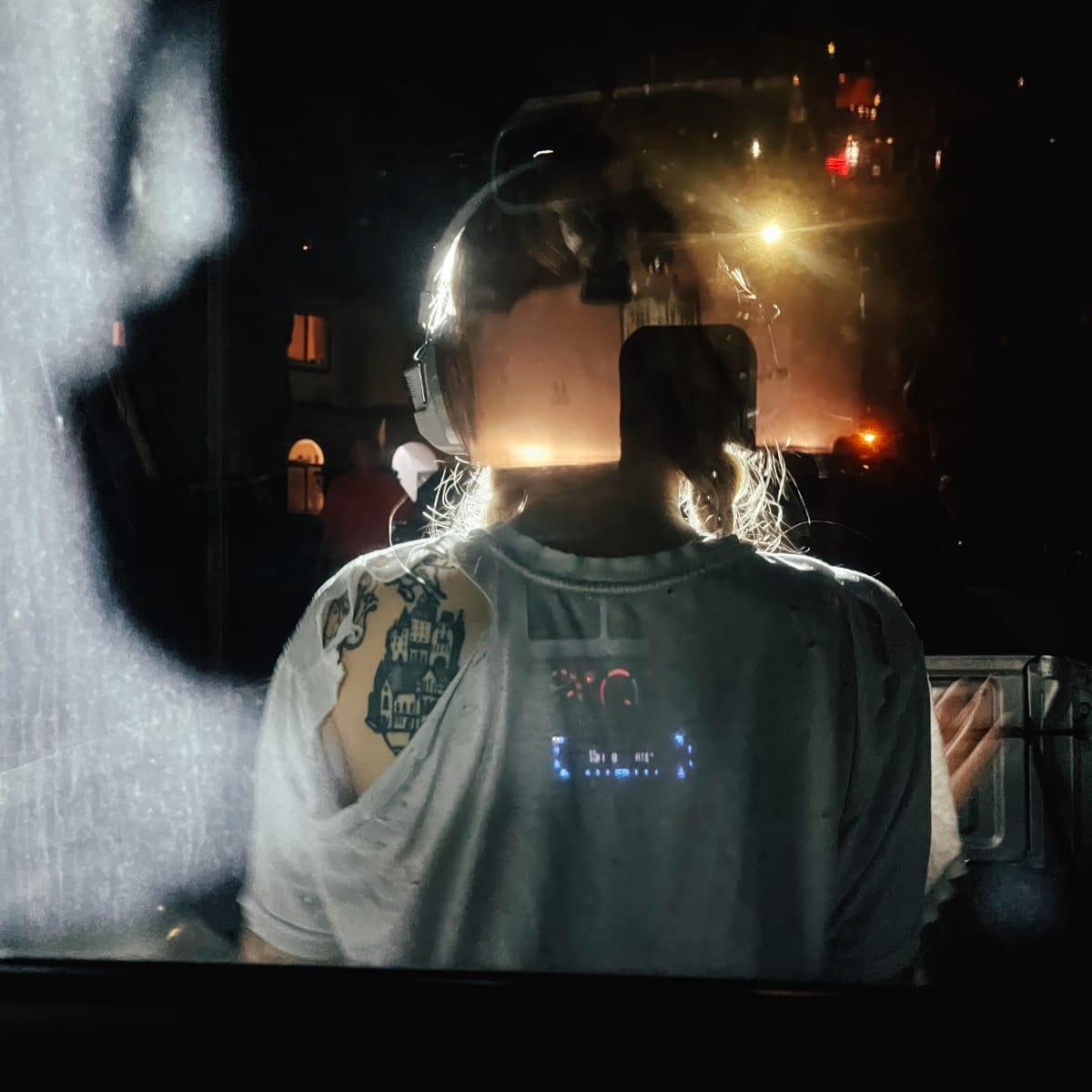
Arina: After years of movement, you've unexpectedly settled in Los Angeles. What does home mean to you now?
Lala Lala: The people I love. I have a little one-bedroom house now that I'm obsessed with. It's the first time in a long while that I've truly built a home. For years, my belongings were scattered across storage units in different countries. Now everything's here. I also fell in love when I moved to LA—that's a big part of it. The only hard thing is that my family lives in England. But ultimately, home is the people you love.
Arina: Are there lyrics on the album that revealed their meaning only after the music was finished?
Lala Lala: That happens every time. Sometimes I write something and think, "What is this even about?" Then six months later, it's obvious—it was about something very specific I was going through. On this album, though, some songs were clear from the start. "Even Mountains Erode," "Arrow," "Wyoming Dirt"—I knew exactly what they were about while writing them. But songs like "Tricks," which are more abstract and poetic, tend to reveal themselves later or shift meaning over time.
Arina: What drew you toward synths on this record compared to your earlier, more guitar-driven work?
Lala Lala: I work with what's around me and what the song seems to want. For "Wyoming Dirt," leaning into something dramatic and sad felt right, and the synths supported that emotion. We were thinking about Thom Yorke's "Dawn Chorus." Meanwhile, "Arrow" started as a slow, sad demo. Melina heard it and imagined a dance-pop direction—and she was right. The instruments led us there.
Arina: What made Melina the right collaborator for this album?
Lala Lala: I trust her completely. She's incredibly talented, open, supportive, and quick at translating ideas into sound. We had done a few test sessions before committing. I also went through something new for me—I had demos and did one-off sessions with multiple producers. Some great stuff came out of that. Daniel Memmi, for example, contributed to "Heaven2." But with Melina, things just clicked. It felt like we could really get it done.
Arina: The instrumental outro of "Heaven2" comes directly from the demo. What makes a demo untouchable?
Lala Lala: You just know. There's that thing that you can't let go of. Sometimes that's unhealthy. But sometimes you capture magic the first time. The "Heaven2" outro was improvised in the demo, and it felt epic. There was no reason to change it.
Arina: How do you know when a song is finished, rather than just endlessly refined?
Lala Lala: It's tough. Sometimes you need someone else to tell you. With "Arrow," I wasn't sure it was there yet, but Melina was confident—and she was right. Predicting what resonates is impossible. On The Lamb, there's a song called "Destroyer" that became massively more popular than the others. I had no idea. It was just another track to me.
Arina: What compromises are necessary to actually finish a record?
Lala Lala: I honestly don't know. Sometimes you just have to let go. I write quickly, but there are always songs where you feel there's something there—you just didn't crack it in time. Maybe they'll surface later. Maybe not.
Arina: Has making this album changed how you approach performing live?
Lala Lala: I'm not sure yet—I'm about to go on tour. But I will say I'm less uptight than I used to be. I'm trying to have more fun.
Arina: What can people expect from the upcoming tour?
Lala Lala: A full band. Live sax, drums. It's going to be fun.
Arina: Looking ahead, do you feel more drawn toward continuity or change?
Lala Lala: Change. Always. I want to keep it interesting—for myself first, and hopefully for other people too—even if sometimes they'd prefer I stayed the same.
Check out more like this:
 Meredith Hobbs Coons
 Arina Korenyu


Comments