


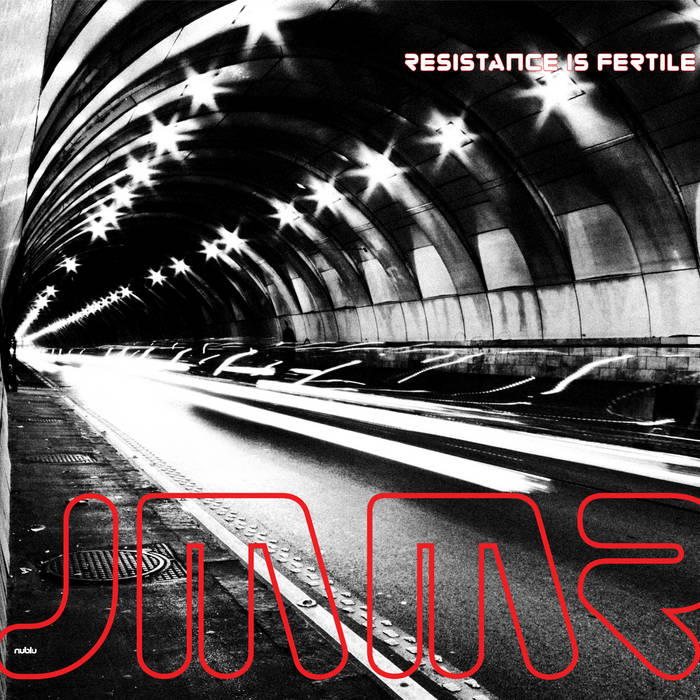
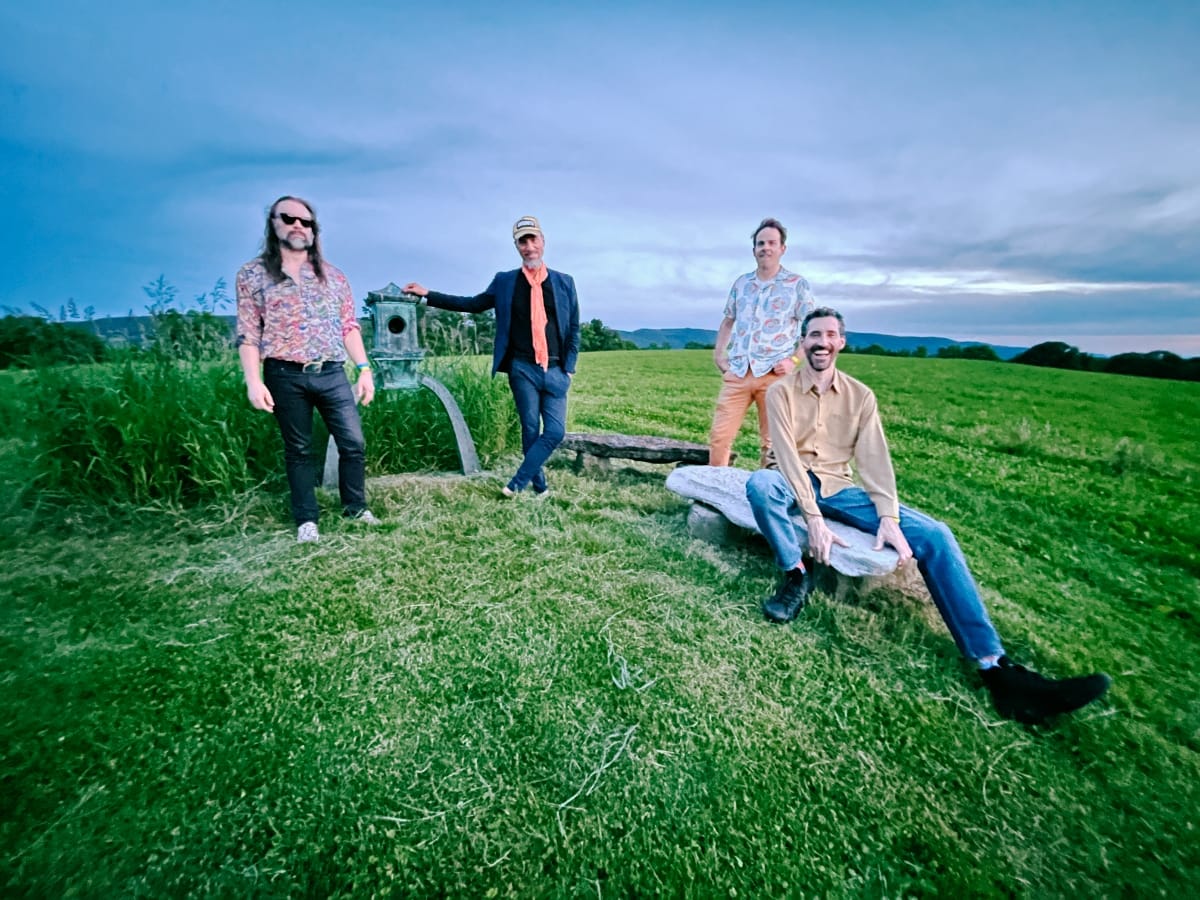
Jordan McLean's Musical Resistance presents a chaotic collage of uptempo slices of ‘electrobeat’ on their debut record, Resistance is Fertile. The project, JMMR for short, is led by Antibalas trumpeter and namesake bandleader Jordan McLean. He is joined by Dave "Smoota" Smith, Tony Jarvis, and John Walter Bollinger. Resistance is Fertile also features a wide array of guest musicians. Per the press release, "JMMR is built for guests, and the album features blinding improvisational contributions from reedmen to the stars Stuart Bogie and Cochemea Gastelum, and global sensations Morgan Price and Ricardo Quinones."
The Resistance's music borders on the possibility of definition, where comparisons to Ornette Coleman and Alice Coltrane are uttered in the same breath as Death Grips or Aphex Twin. The opening track, "Virtue Signaling 139 BPM," finds a groove that balances droniness with danceability. See their rendition of Can's "Vitamin C" for a more linear, synthier take on their sound, paying homage to the krautrock greats. "Climate Wars 172 BPM" feels like a hypnotic theme song for a Hunter S. Thompson detective show. All the while, racing breakbeat tempos are slammed against Stuart Bogie's wailing saxophone in "Right to Die 162 BPM," in a way that feels both rushing yet inviting. They hope you stick around, but might not expect you to.
I chatted with Jordan McLean about his early inspirations, creating music that paints outside the lines, the machine influence of JMMR's music, and the fine line between dance music and chaotic noise. Our conversation, edited for clarity and length, begins with some of that chaotic noise as Jordan gets off the subway and emerges onto Manhattan's busy street level.
Jordan McLean: I'm just getting off the subway. I'm learning that the noise cancellation settings on these earbuds don't really work.
Sam Bradley: I always remember the first time I ever tried those on a plane, it was wild.
Jordan: Sure, sonics are some of the most easily forgotten aspects of civilized life. Our visual sense is so much more advanced than our sonic aesthetics. I noticed that sirens, police, and emergency vehicles have made real strides in using the technology. It's not as high-pitched or full throttle; it's kind of got a muted something going on. You feel it a little bit, but it still really cuts through sonically. Nowadays, they're kind of generated and dispersed in a different way than just that harsh single source. Anyway, have we started?
Sam: We certainly can start. For background, when did you start writing original pieces and composing?
Jordan: I started taking piano lessons around age five and picked up the trumpet at around ten. Let's call it 1979. High school was when I first started sitting down with other guys in bands and writing original music. I went to music school right out of high school in 1992. So it took about 13 years of playing in grade school band and plunking out Gershwin as a very, very small child with my first piano teacher.
My teacher was a guy named Michael Raskin, son of Gene Raskin. Gene wrote "Those Were the Days." He was one of the last silver-era Broadway composers. Michael was kind of the sad son of that family, but he taught me piano. He was something of a Saint Christopher, like a saint of animals and a junkie. He was a daily pot user, and he didn't really leave his house much, but he played piano every single day. He was having me play music from Porgy and Bess, the first music I ever played. My mom's a painter, so it was a very artsy scene, and it kind of made sense.
Sam: Do you consciously and intentionally take inspiration from growing up in New York and experiencing the nature of the city's musical and artistic worlds?
Jordan: I think intention is the key word of your question. It's fitting that we're having this conversation while I'm walking through Manhattan. Growing up here very much influences how I understand how sounds interact in public; there's a lot of rhythmic dissonance in life, especially in a place like New York City. There is almost score-like music and a sonic soundscape to Manhattan. That experience of the real world going into the way we all make music together, I think that's got to be in there. Not intentional, just unavoidable.
Sam: What can you tell me about the name Resistance is Fertile?
Jordan: I wish it meant something deeper than it sounds. Resistance is Fertile just came in out of nowhere, it's just good wordplay. But the first thing I think of is resisting bullshit. It's so easy to let bullshit thoughts ruin our system, our balanced mental and physical system. As far as the band's name, I honestly don't really remember. I was just getting a couple of guys together. It was more of a concept, which has definitely been refined. The concept is different now than it was when the first Jordan McLean's Musical Resistance played a show. Currently, this is a set band, whereas previously it was any four people on a given night.
Sam: Was anything written out or charted going into the sessions?
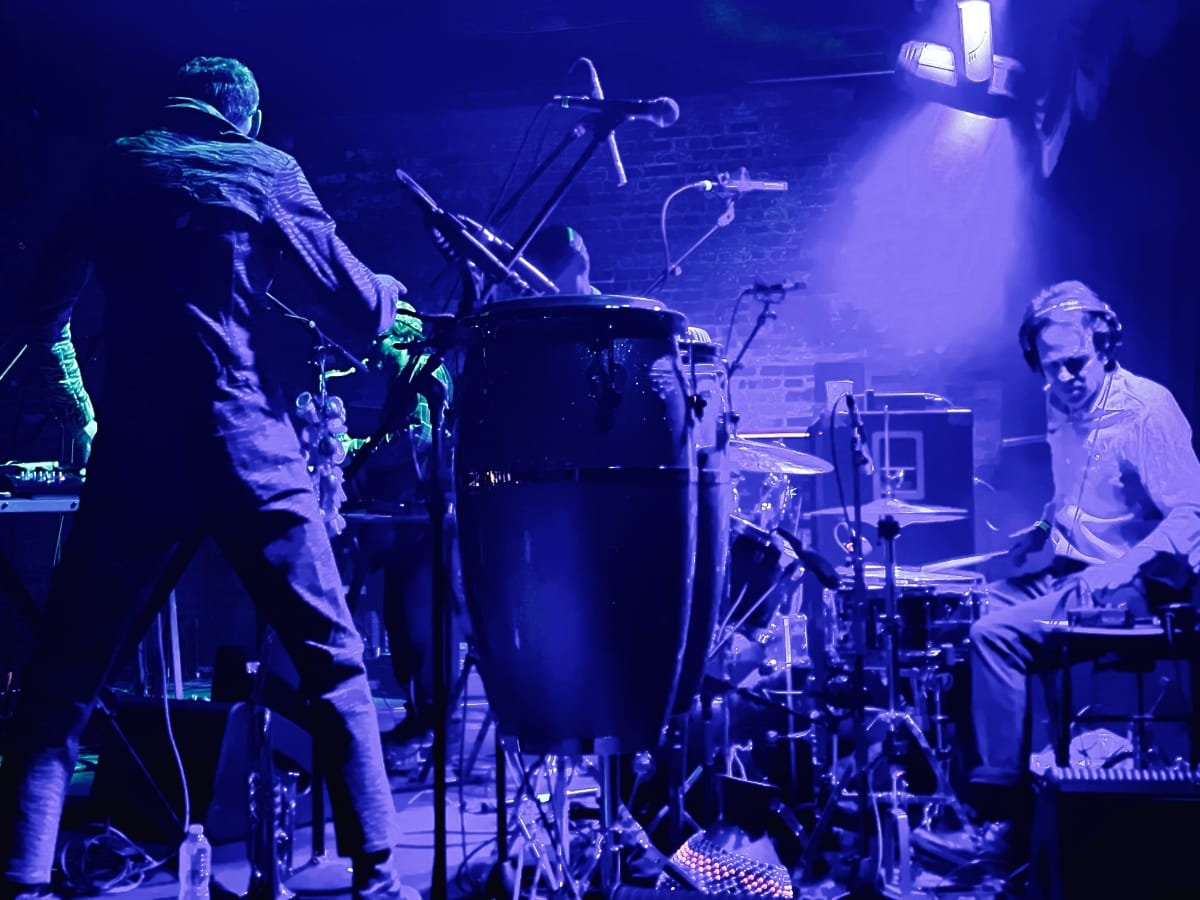
Jordan: I'll spill the beans completely. It’s very process-oriented. Other than the Can cover and "Uptown Swing," which is a tune I wrote maybe 30 years ago, the rest of the record and the concept for the band, even when we play live, is that it’s all improvised. There are certain parameters, the main one being tempo. The arrangements really stem from the tempo map across time—if we're doing a 40–50-minute set, I know about how long we'll spend in each tempo. The drummer, John Bollinger, and I will synchronize. I have a step sequencer that I sync to his click track, which he has in cans, and then he's just playing his incredibly creative beats around that. The other guys don't even necessarily need to know what tempo it's going into, because we're also not trying to talk about it too much.
If I recall correctly, the way the first record was made is a little different from the two we have in the can and that I'm editing now. On Resistance is Fertile, everything stems from these beatbox voice demos that I made to a tempo, and we layered on top of that. These are all one-takes. It's like "that's what you played, let's go because we got to keep this live." Then we just started layering people, guitars, horns, and improvised solos.
Sam: For the beatboxing, was that already set to your desired tempo, or did that come after you had already verbalized the idea?
Jordan: Tempo is the parameter, so yes, it was set. Those choices are very specific. The tones, textures, and samples, all of those choices made afterwards to round out this mini orchestra concept.
Sam: I definitely feel the layered element of this record. Live and spontaneous are two things I had noted here; it comes across.
Jordan: Great, I'm glad to hear that! It very much becomes about orchestration after that. Orchestration is one of the domains in music that actually allows for the most innovation because there are only so many pitches and rhythmic variations, but we have almost infinite choice in composing. Practically speaking, orchestration and the combination of different instruments is what gets you the newest sounds when making music out of whole cloth. Then you have to have a concept, and our concept is improvised in tempo.
Sam: I notice the tempos are listed with each song title, all in the high upper range, at or over 120 BPM. Would you call this record dance music? Is labeling a project like this difficult?
Jordan: I recognize that one of the things humans do best is name things. That's why I called this 'electrobeat.' I'm not sure if somebody else was using that before, but you know, having spent so much of my musical life playing Afrobeat, I recognized that. Afrobeat is a style of music invented and named by its creators. Electrobeat just kind of became a label, but is it dance music? Smoota calls it 'avant-rave.' I like throwing that around sometimes and seeing if it sticks, conceptually and just in terms of the headspace and the heart of the thing. Avant-rave, I think, is an excellent way to describe it. But is it dance music?
I'll answer your question. I chose these tempos very consciously because they are, quote unquote, dance tempos. So, 120 to about 150 BPM, the whole record is in that range.
Sam: Could you talk a bit about your approach to building tension and chaos within the framework of dance music? Is there a fine line? What is your relationship with that idea? Specifically, I noted "Kiosk Radio."
Jordan: Yeah, you couldn't pick a better example. I think intellectually, and musically, that's actually the core of the concept. I see us as a musical Voltron, where four of us are coming together to form one internet radio DJ. That's mostly what I listen to around the house. Conceptually, we are an internet radio station, so I think to maintain your credibility on the underground, there has to be an element of chaos.
I like existing in that. I think it can be background music, and that's great. We'll put on Ukrainian drum and bass radio stations and just let it play for like an hour while we make dinner. We want to have a little something on, but we're not trying to engage fully. Ideally, that's what's happening with this music, too. And then New York jazz or New York music in general—that's definitely in there, probably in a more conscious way. It's a slice of our own personalities.
Sam: Looking ahead, do you have any tour planned around the record?
Jordan: Not in the way a lot of my friends do touring, or the way Antibalas does. We'll be in more of a residency situation. We're working on plans to collaborate with Antibalas in town. I think we're built more for residencies. If you want to hear this band live, you have to come to us. We can't wait for the first time we go to Turkey, go to London or Paris or Amsterdam, and Brussels, you know, the places where the people in Europe can easily get to as well.
Sam: Something discussed in the press release was this quote about the record and the fusion of synthetic and natural elements, "where machines enhance human expression." What is your relationship with the hold that tech has on music? How do you see furthering that without losing what makes music human?
Jordan: Smoota and I have had this conversation many times in terms of our aesthetic and the value we put into the making of the music. We are distinctly anti-AI when it comes to creativity. In terms of technology, since we hollowed out the first bone flute, it has advanced human expression and, in particular, music. All of the advances made in early electronic music and synthesizers, up to what we're doing now, I see as totally on a continuum. Find sounds you like, then you just go with those. The trumpet is technology. It's an advanced version of the original design.
That's all we're doing, anyway: exploiting technology and making it work for us, not against us. Machines enhancing human expression. I stand by that. You know who wasn't afraid of technology and music? Ray Charles, Stevie Wonder, Sun Ra, and Herbie Hancock.
AI, just to bring it back to that emergent technology, seems to be meant to basically gather all the creative wealth, separate it from the makers, and prevent them from generating any wealth from it. It just puts the wealth in the hands of the patent-holders of AI. That goes back to streaming in general, too. They pretend that Spotify is a friend of the artist, but if you spend long enough in the business at any point, you realize record labels aren't really your friend.
Sam: A healthy understanding and healthy distrust of some of those systems will always be a good thing to have.
Jordan: I always want to have that optimism, just as an artist and a maker. It's kind of my deal, you know? A lot of records drop where nobody, including the artists themself, is really that invested in it.
Sam: On that train of thought, is there anything you hope that people take away from the record?
Jordan: I guess just to listen. If you can listen to the bizarreness of two to three minutes at a time on this record and make it through even one track from beginning to end, it's going to make you pause, if only for a second. You might consider whether that was a waste of your time. And if it was, I get it. If it wasn't, then come back for more. That's the message. It is what it is and it ain't what it ain't. That goes for live performance, also. I've been really surprised by the response of people in the room, and by the feeling that they know we're taking a chance with this shit.
Check out more like this:
 Sam Bradley
 Sam Bradley


Comments