


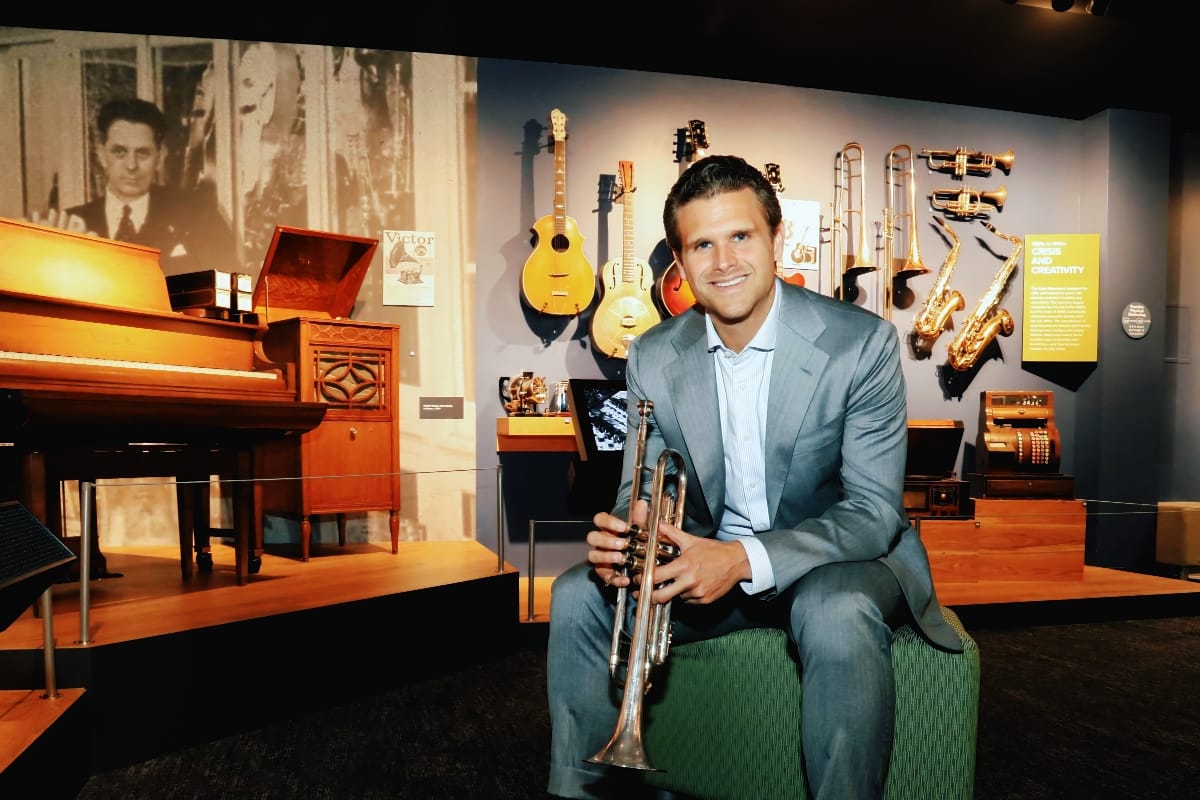
The president of a 124-year-old trade association should probably have decades of experience in retail, manufacturing, or convention management. John Mlynczak brings none of those credentials to his role as leader of the National Association of Music Merchants (NAMM). But he understands how people actually learn to make music in 2026, and he knows how technology companies serve those people. That background—from teaching band in Louisiana to running education initiatives at Hal Leonard and PreSonus Audio—positions NAMM differently than traditional trade association leadership would.
Mlynczak's career has moved through the interconnected worlds of music pedagogy and product development. He taught online graduate courses at VanderCook College while serving as Director of Education at PreSonus, where he built curricula and assessment models for creative disciplines. At Hal Leonard, he oversaw worldwide education-market strategy and managed programs such as Noteflight and Essential Elements Interactive. He holds advanced degrees in both Music Performance and Education Leadership from Louisiana State University, and he continues to perform as a trumpet player with MetWinds and various ensembles. His advocacy work includes leadership roles with the Massachusetts Music Educators Association and the Technology Institute of Music Educators, where he served as president.
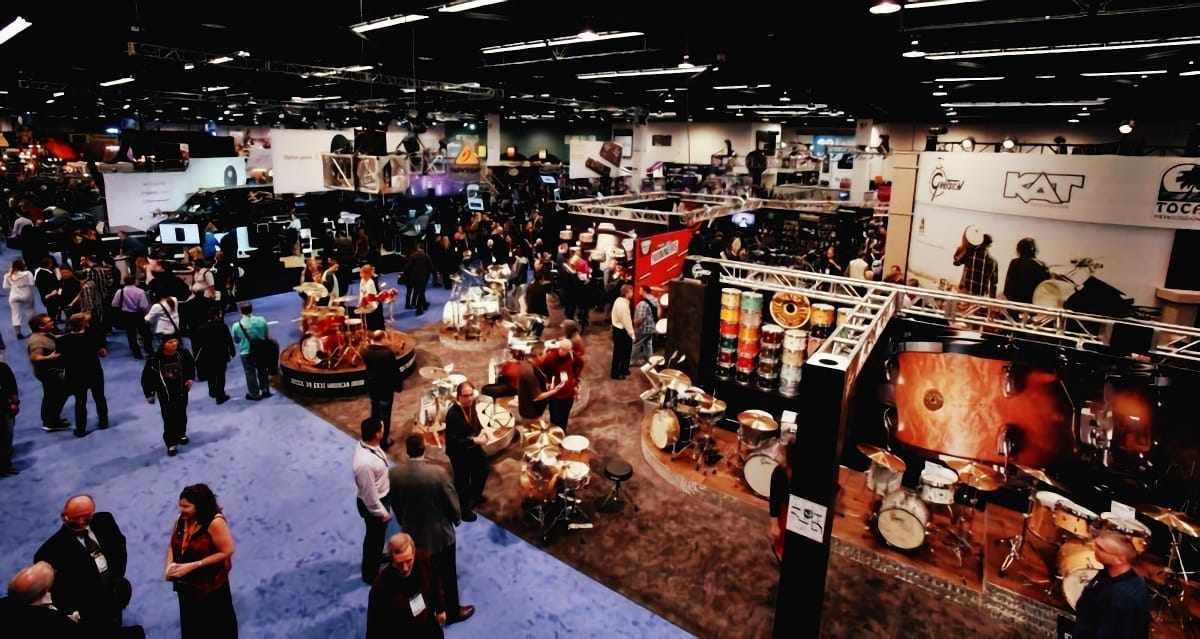
NAMM hired Mlynczak in April 2023 after what he describes as a nine-month interview process focused on post-COVID needs. The pandemic had forced the organization to answer fundamental questions about value and relevance that had been obscured by decades of operational momentum. Under Mlynczak's leadership, NAMM has reframed its annual Anaheim convention as a five-day curated experience rather than a transactional trade show, generating 39.4 million views of product content in 2025—a figure that reflects his understanding of how creators discover and evaluate instruments outside traditional retail channels. His work emphasizes content creator economies, educational technology integration, and what he calls "brand demand" over simple booth sales.
John Mlynczak recently joined host Lawrence Peryer on The Tonearm Podcast for a refreshingly optimistic and inspiring conversation. The pair discussed, among many other topics, how passion brings students to teach themselves, why advocacy requires daily offense rather than defensive crisis response, and technology's double-edged role in music-making.
You can listen to the entire conversation in the audio player below. The transcript has been edited for length, clarity, and flow.
Lawrence Peryer: When did you first see how performing, teaching, and technology could all work together? Does that go back to your student days, or did that reveal itself to you later?
John Mlynczak: I know exactly when I saw it. I was a freshman in the second semester. I was the hotshot trumpet player in college. I was first chair, so obviously, I thought I was the best and knew everything. A trombone professor called me into his office and said, "Hey, I want to give you a lesson." And I'm like, what? You're a trombone professor. What are you possibly going to teach me about the piccolo trumpet? I was every cocky trumpet player you could ever imagine.
So he sits me down, and he records me. He says, "Play your solo." I had played a recital at the school, and I thought I was amazing. He plays it back at half tempo, so it's down an octave. And what I heard in my head as a trumpet player—it was the Arutiunian concerto. I sounded beautiful. Half tempo, it sounded like Charlie Brown's parents were drunk and having an argument. He's like, "Do you hear that? Every articulation has this pop, and then the air compresses, and then the note goes flat at the end." And he looks at me, and he says, "John, I have to play it back half speed so you can hear what we hear all the time. Your ears don't hear it."
So you ask about a moment of performance, technology, and teaching locked together. Technology will help me learn to be a better performer and train my ears. So I went out that day—this was 2001, 2002—and I bought a little Sony MiniDisc recorder and a little microphone. I would start practicing, doing nothing but recording myself and listening. It just transformed immediately. We have to use technology as a teaching tool to make ourselves better and use that feedback loop.
Lawrence: That's phenomenal, your personal epiphany moment. I'm curious what your years as an educator taught you. How do students actually learn music?
John: Everyone learns differently. Most people don't learn by having a teacher stand in front of them and tell them what to do. They learn by a teacher inspiring them to develop the drive to figure out how they learn and to see the successes of that. As an educator, I realized very quickly that it's not my job to say, "You're flat, you're sharp, play this, push in, pull out, play." It's a matter of inspiring students to understand why they practice. How do you motivate them? Positive reinforcement. Praise. Get them on stage. Get them that bug for music-making.
That's really what it came down to: inspiring students to want to learn, and then to use every tool available so they can teach themselves, find feedback loops, and find ways to improve when they're on their own without a teacher next to them at all times.
Lawrence: I speak to a lot of people, either who are educators or are artists who have an 'air quotes' day job as an educator because it's part of what you do, or people who are working in more mission-based roles around music education. There really seems to be a shift over the last, let's call it roughly twenty years, maybe a little less: just getting kids up and running and playing. When I was a kid taking piano lessons, I don't think I was allowed to touch the piano for a year, maybe more. I had to sit there with the book and draw notes, and it was zero fun. Now it seems to be much more about putting instruments in the kids' hands, getting them to make noise.
John: Yes. There are two reasons for that. One is that we're competing with instant gratification. You pick up a video game, you're off and running. We can't compete with that if we say, "Sit down and learn all this theory before you can play a song." We're going to lose music makers.
We've realized that if we get that kid to learn a song, then go to other friends and play it, and they say, "Wow, that's cool," they'll come back and say, "I want to learn more songs." Well, great. While we learn more songs, let me show you a technique that will help you. I think we've also learned that to get people going quickly and just experiencing the love and joy of something, because we as musicians are passion-driven. I have to want to play, I have to want to create. So we need to drive that in kids sooner, because if we do nothing in education but just plant "I want to create every day," then, as adults, we're going to create every day.
I'll tell you a funny story. My other passion is sailing, and I started teaching sailing—I'm such a teacher at heart. I realized that people always wanted me to be their teacher, and my students were always happy. Everyone else would stay back at the dock, overexplaining every component. I'm just like, "All right, let's go sailing. We'll figure it out as we go. Let's just get on the water. Feel the air, catch the bug." It's the same thing as teaching music: get out there, catch the bug, find the love of what you're doing, and then you create a thirst for knowledge.
Lawrence: I think we all know the narrative of music and arts education being under such pressure in this country. But there are all these new ways to learn, whether it's YouTube, online platforms, or peer learning communities. I'm wondering, are we in a good place because of those other things, or are we still fundamentally losing something because of budget cuts and other pressures?
John: There are two questions here. One is just the idea of cutting music or the arts. But I firmly believe we should be using every tool imaginable. We should be exposing students to it. What we should really be preparing students to thrive in a world that doesn't yet exist.
College students today didn't have AI when they were in elementary school. They're now graduating, entering the workforce, and trying to use tools that didn't exist during their entire education. I think education's sole purpose is to create better humans, build strong social skills, give people the tools to adapt and learn, and teach them to embrace new tools.
Lawrence: What's the role of curiosity in all that? I think the teachers have to be curious and continually learning, and they have to build that mindset in our workforce and our students.
John: I absolutely think so. I've done advocacy my whole life, and NAMM has data and research on how music affects the brain and how music is social-emotional. You've got all the data that demonstrates what we know as musicians: music has so many superpowers about making you a better person.
But at the end of the day, we should be educating better humans. We want to raise the next generation to be better humans than we are. I think that's the goal of society. And right now, especially, we're at each other's throats. We're divided. We're not really good humans right now. We can debate facts, opinions, and political sides, but we have to be good humans and think creatively while respecting each other. I think that's one thing that the arts embody. Playing in a musical ensemble, you have to be a good human. You have to respect someone and have skills. You have to be motivated to practice. You have to show up and support your team. Those are the things that I think should be fundamental to educating a society.
Lawrence: On the music advocacy side, so much of the work is about playing defense. We have to protect these programs. We have to fight these budget cuts. Either at NAMM or other parts of your professional life, is there an offensive role? How do we go on the offensive on behalf of the arts, education, and that type of literacy?
John: I think advocacy has to be offensive the entire time. For me, it's always about starting with the joy, pleasure, and benefits of creating and experiencing music, because that's what we feel all the time. The defensive tactics are, "Oh, but wait, the test scores are improving. Oh, but wait." This is the product of the early 2000s, No Child Left Behind, when everything went to test scores, and we got defensive on it.
But you're right, we have to constantly promote the joy and pleasures of playing music and get out there even when times are good. I've said this to teachers before, in clinics to educators: when do you advocate? And they're like, "Oh, well, when our numbers go down or when our job's on the line." I say, no, you advocate every day. Advocacy is every day. Everything you do is advocacy. That's what's really important.
I used to tell my students in class—this was shameless, but it worked like a charm—"When you get in your car today, you get home from school, your parents are going to say, 'How was school?' and you're probably going to say, 'Fine.' Don't say 'fine.' Tell them about this moment you just had in music class. Did this feel good playing this thing? Was that really fun? When your parents ask, 'How was your day?' tell them about how good this moment felt." I'd tell my students that all the time, and the parents are like, "Oh my God, all I hear about is how great music is." Yeah, because I told the kid to tell you. That's an example of going on the offensive. That everyday moment matters so much because if all we do is grab the pitchforks and storm the castle with data when budget cuts are coming down the line, we're not actually advocating for music-making in the world. We're just advocating for our jobs.
Lawrence: I love that example of turning the children into little propaganda machines.
John: They'll say anything! If there's anything about kids, they'll actually say anything you tell them to. I'll tell you another example that worked like a charm, too. The parents would come at the end of the band concert—you'd have one every semester—and they'd say, "That was so amazing. I had no idea my student could do that." They'd go on, and I'd say, "Oh my gosh, thank you so much." But you know what? I get to hear your kid every day, so you don't have to tell me. Will you tell others what you just said with that much passion? Will you tell the principal that? Because the principal's not in there every day. Will you go to the school board and say that?
I'd flip that every time. I'd say, "You don't have to tell me how great your kids are. Go tell someone that's not in the classroom and didn't hear this concert what you just experienced." I'd say that every time immediately. The principal's like, "Oh my God, I got seven parent emails already about this concert." And guess what? The principal came to the next concert.
Lawrence: It's really powerful, and it creates a culture and an environment of enthusiasm. You're enlisting people in the cause, basically.
John: Exactly. It's influencer marketing 101. It's really what it is.
Lawrence: What's your philosophy of introducing something new, idea-wise, to an education curriculum or even with NAMM?
John: They always say when you're trying something new, the first year you're trying it the way you think you're doing it, and then you're listening. In the first year, you should have a hypothesis, but just listen. The second year you test, you try. Then the third year, you really have an idea of how it's going to work. Building a curriculum: first year, I tried to do it my way. Then I realized, well, the kids actually want to do this. So the second year, I started experimenting. By the third year, it's like, "Ah, I now see how this is going to work." And it starts to take off. Same with NAMM. I'm in my third year, and it's the same thing, just being patient.
Lawrence: A lot of what we've talked about so far has to do with applying creative thinking in different ways—in education, in advocacy. The music industry and retail have changed so much. What does that mean for NAMM's role?
John: I want to define NAMM as the association and the NAMM Show as the trade show—two areas here. We at NAMM will celebrate 125 years next year.—since 1901, the longest-running national trade organization.
Our mission is to strengthen the music products industry and promote the pleasure and benefits of making music. Any good nonprofit is absolutely mission-driven. All the evolution—whether it's the phone book or the first web page, or now 50 percent of sales being online and all the direct-to-consumer brands—all of that's somewhere in the middle.
The middle evolves. What's at the end is where you keep your eye on the prize. At the very end is people's desire to play music. If you keep your eyes on that prize, the middle will change and keep evolving. But what we need to do is make sure we help our members and companies evolve and adapt so they keep their eyes on that end goal: more people playing music. Not become roadblocks—"No, it has to be bought this way," or "It has to be learned this way." At some point, we become our own enemies.
Lawrence: You have a very specific background—education, working in music technology companies. What do you think that your hiring says about how the governing body for NAMM views the future?
John: I can tell you for sure because I was in those interviews for probably nine months. It was an extraneous process. The interview process focused on what NAMM needs post-COVID. They recognized the evolution of education and to think about what the next thing's going to be. Embrace technology in a different time.
Lawrence: You talked about that brash, headstrong, eighteen-year-old trumpet player. From where you sit now, what would you go back and tell that young man? What's the most important thing that you could be telling him to prepare himself for where you are now?
John: I know exactly the answer here. We're built on mentors and mistakes. Mistakes are okay if you learn from them, and with good mentors around, they sort of guide you through it. When you're young and getting a lot of information from teachers and others with experience, do not underestimate or devalue experience. Knowledge is great , as is studying the book, but knowledge without experience—there's a chemical bond. The hotshot, egotistical people of the world—they have a ton of knowledge, but they don't have the experience necessarily to grasp it.
There's something powerful about that because there are things that have occurred to me in my twenties and thirties where I'm like, "Aha, that's what that person was talking about ten years ago." I didn't understand it at the time because I didn't have a life experience to attach that to. But now I do, and I wish I had learned that quicker. Save everything. If you hear something, don't say, "Oh, that doesn't make any sense. I know better." No, you just don't. You might not have the lived experience yet to really grasp what that means. Put it in the bank, put every piece of knowledge there. I'd go back to myself and say, if it makes sense, use it. If it doesn't make sense, save it; one day it will.
I'm so lucky in my job to have a million people tell me what they think I should, could, and shouldn't be doing. And I mean that. I'm in a job where everyone has an opinion, and I embrace that. If I hear something I disagree with, I go back to my younger self and say, "You know what? I want to put that in the bank because I might not understand it yet. Or maybe it's from a different time." But I don't blow off things I hear that I don't think make sense because I have enough understanding now that I wish I had when I was younger to say, save it, put it in the bank, because it might make sense for NAMM in five years, or maybe I'll share it with someone else who has a different experience.
That's the number one piece of advice I give to every young person: put every piece of knowledge in the bank, wait for lived experience, and see where those two click.
Lawrence: It's funny, but as I gear up to let you go, it doesn't sound boring.
John: It's so much fun. This industry, the people, the passion, it's so much fun.
Check out more like this:
 Lawrence Peryer
 Lawrence Peryer


Comments