


There is something about Infinity II that I cannot disassociate with the Earth's slide into the colder months. This is my first time experiencing a Northeast winter, and the newest offering from Australian saxophonist and composer Jeremy Rose has held such a mystical "put it on" factor in recent weeks. From the shivery, slow awakening of the record on "Full Moon" to its denser moments in "Perpetual Motion," there is so much natural wonder found within its 10 tracks. Time passes in a way that feels completely free yet somehow deliberate; it's like the moment you look up, however many hundreds of seconds after lunchtime, to see it is pitch black outside on a mid-November day. There it goes, "I've listened to this whole thing once again," I realize.
Infinity II finds itself nestled somewhere comfortably between jazz and electronic music. Synth flourishes add such interesting counterpoints to the wailing sax melodies and masterful live drumming. Rose reunites with pianist Novak Manojlovic, drummer Tully Ryan, and modular synth artist Ben Carey, all of whom are also featured on Project Infinity: Live at Phoenix Central Park. You can feel the intimate embrace of a song like "Impermanence" as Rose and crew craft immersive soundscapes that feel both timeless and urgently present, per a press release for the record.
Infinity II urges listeners to be present, to live within an almost meditative state as the record envelops the senses. I can envision the day's colors changing, lit by the passing of rush-hour traffic from the living room window, as "From Now On" transitions from its droning, drum-heavy beginnings to the glitchy, cinematic brain massage that Carey introduces about two minutes in.
I spoke with Jeremy Rose via email about the new record, Australia's melting pot-esque improvisatory music scene, and how nature and minimalism influence his creative process. This conversation has been edited for clarity and length.
Sam Bradley: What were the early things that drew you to making music, and what is your relationship with that stuff today?
Jeremy Rose: I was drawn to music from a young age through my parents' CD collection—a diverse range of jazz, world music, folk, and pop. I recall the idea of creating my own music pretty early on in my journey. I started learning piano and would often deconstruct the pieces and improvise with them. In primary school (aged nine), I formed my first band and composed solos for all the performers. This gave me a great sense of joy and belonging. But I've always been drawn to the idea that music can transform you through immersion—it's kind of like a drug for me. That curiosity has never left. If anything, Infinity II is a continuation of that early impulse. I still chase that visceral sense of searching, listening deeply, and letting the music reveal itself rather than forcing it into a fixed shape.
Sam: What is one thing about the music scene (or just life) in Australia that you find unique, or something you cannot find elsewhere?
Jeremy: What stands out about the Australian music scene is its openness—the way musicians here draw from so many backgrounds without feeling bound to strict traditions. There's a real sense of cross-pollination that's genuine and born out of newfound opportunities. People often say Australian improvisers sound like themselves, and I think that freedom—shaped by geography, distance, and community—is genuinely unique.
Sam: Was Infinity II tracked fully live?
Jeremy: Yes. Infinity II was recorded live at Lazybones Lounge in Sydney. We performed it as a single long-form piece with no overdubs and minimal editing. It was later edited into distinct tracks where we felt appropriate. That live energy—the interaction and unpredictability—was essential to how the music evolved.
Sam: Did any charts or song outlines go into the sessions?
Jeremy: Actually, no. We strictly don't speak about the music before we play at all. The interesting thing is that the group improvises song-like forms, so there must be a natural affinity to this type of structure.

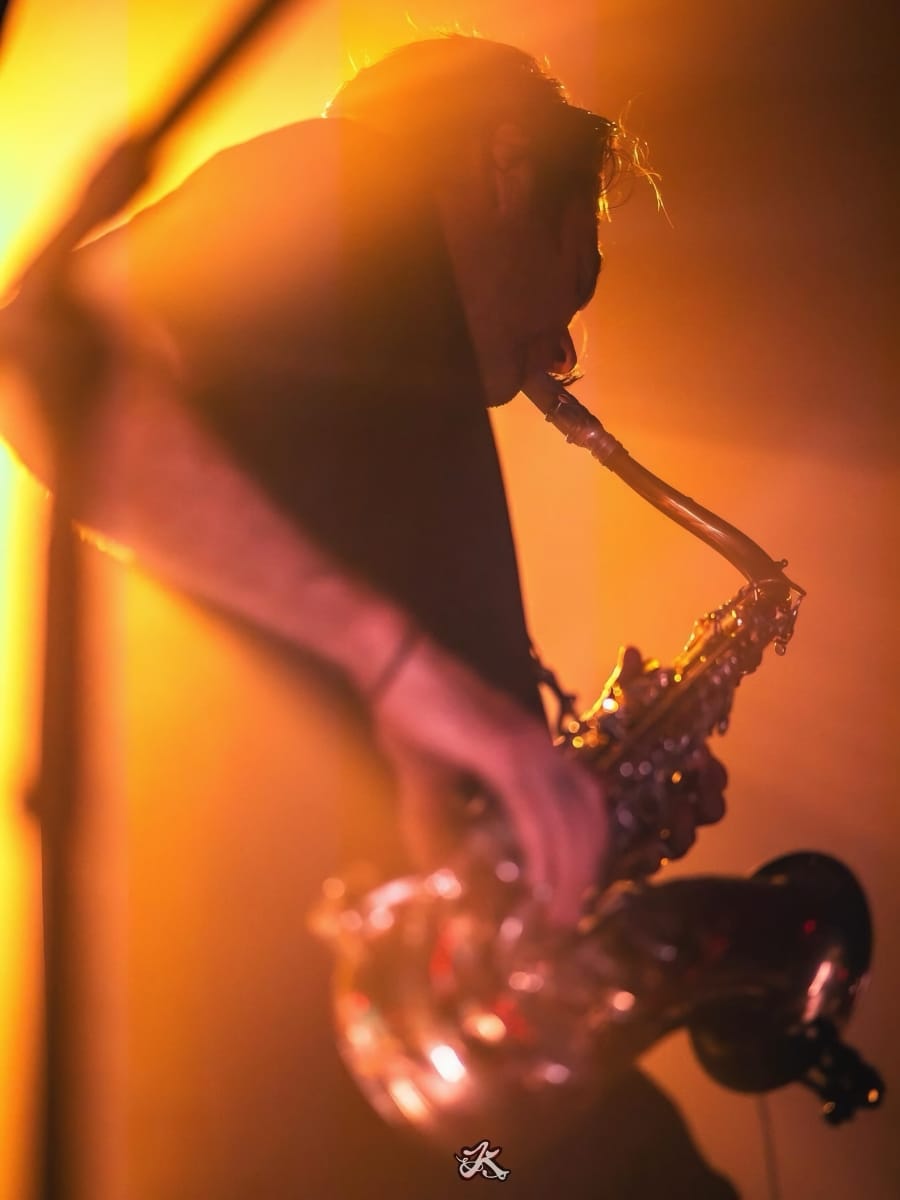
Sam: How do you approach building tension within longer, ambient stretches?
Jeremy: Personally, I like to repeat phrases until something in the music suggests that I change them. The tension is inherent in the use of repetition, and I guess we are feeling that both on a micro level (phrase to phrase) and a macro level (piece to piece/the entire set). It's a humanist approach to minimalism. We aren't forcing anything, or even particularly thinking about it when we play, but a natural gesture-like performance that can feel magnified.
Sam: Can you talk about the instrumentation choices on the record? I felt moments of juxtaposition between glitchy electronic elements and the live saxophone and drum kit interplay—like on "Tides."
Jeremy: I love using juxtaposition as a way to create unpredictable contrast and tension in music. In this record, I wanted the quartet to function like a living system: acoustic instruments interacting with electronic textures in an organic way. The modular synth (Ben Carey) brings instability, surprise, and a sense of expanding space. Novak Manojlovic's keyboards and synths bridge the acoustic–electronic worlds, while Tully Ryan's drumming provides both pulse and coloristic detail. The saxophone becomes another texture rather than a lead voice. On "Tides," those glitchy elements feel like friction against the breathiness of the sax.
Sam: Do you have any hesitation about incorporating technology in your music?
Jeremy: Technology, for me, is simply a tool to extend the palette. I use it when it helps articulate ideas that acoustic instruments alone can't. Interestingly, I tend to play differently when I have effects on my saxophone—I tend to play less and let the effects have space to create their own effect. I'm drawn to the use of effects to create the sense of distorting time, in particular, to create a sense of space in the music.
My only hesitation is when technology doesn't work—it can work so well, but when it goes wrong, it can be hell.
Sam: There are a lot of natural-world moments in the record—thematically and musically. How much was nature an inspiration, and what were you trying to capture? I noted down a particular moment on "Resonance" that sounds like bird chirps.
Jeremy: Nature is a huge inspiration for me. The cycles, the rhythms, the sense of vastness—these ideas parallel the music in a number of ways. I'm interested in capturing the feeling of being immersed in a landscape: timelessness, subtle motion, the sense of something larger unfolding around you. I'm not trying to create a literal translation of these settings, but to express how those environments shape inner states.
Sam: One listener might consider this album to be jazz; another might call it electronic ambient. Do those labels influence your creative process whatsoever?
Jeremy: I've never been overly concerned with genre labels. My background is in jazz and improvisation, but I'm equally inspired by minimalism, ambient music, experimental electronics, and various non-Western traditions. Infinity II sits somewhere between those worlds. For me, the process leads the genre, not the other way around. If listeners hear different things in it, that tells me the music is resonating in multiple directions, which I love.
Sam: What is your relationship with performing, touring, and traveling?
Jeremy: Performing live is where the music comes alive. Touring can be exhausting, but it also brings a sense of community and perspective—you feel how audiences in different places listen differently. I just got back from a two-week tour of the UK and the EU, and I had the most wonderful time. Particularly, in Poland, the audiences were so appreciative and deeply moved by the music. It reveals quite a lot about a nation's culture when you have a reaction like that. I've always placed an importance on connecting with audiences internationally in my career, and so I love having these types of responses.
Sam: Random question, but are you a video game guy at all? Some moments on the record felt like they could belong in a video game soundtrack.
Jeremy: I'm not a huge gamer now—I seriously don't have the time, but I grew up with games and always loved their immersive worlds and atmospheric soundtracks. Maybe some of that early impression carries through—those expansive environments, slow-building tension, and sense of journey definitely parallel what we explore on Infinity II.
Sam: Is there anything you hope listeners take away from Infinity II after that first listen?
Jeremy: I hope listeners feel transported, as if they've been on a journey that unfolds in its own time. Infinity II is about cycles, change, and openness. If listeners come away with a sense of spaciousness or reflection, or simply feel that they've experienced something evocative and immersive, then that's enough for me.
Check out more like this:
 Lawrence Peryer
 Sam Bradley


Comments