


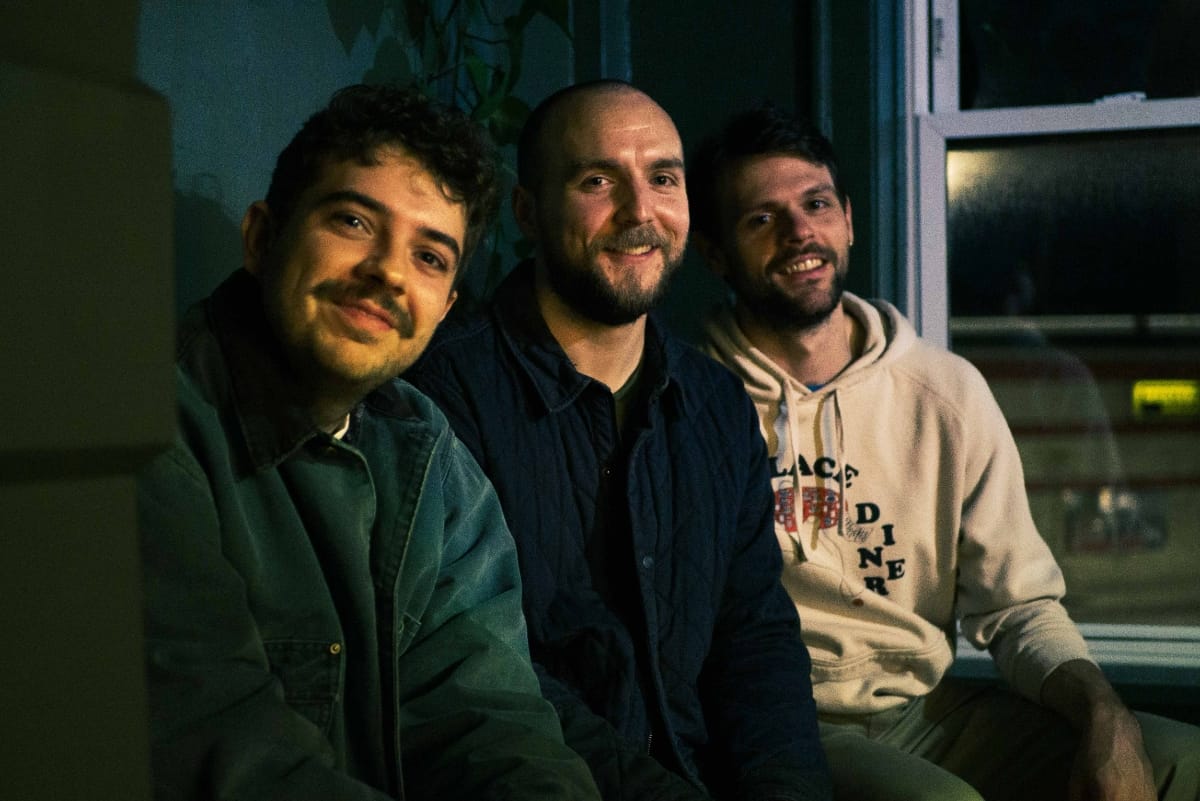
In a very real instance of "one man's trash," the Chicago-based trio Alta Vista came together over a box of unrecorded and unknown early 20th-century country tunes set out for disposal by bassist Jakob Heinemann's neighbor. Five years after finding treasure in the collection of nonstandards, carefully yet playfully reinvented on their self-titled debut, the trio returns with their first album of original music in Won't Believe In Dust. Their second offering finds Alta Vista veering away from the sun-bleached, ambient-leaning western waltz of the debut into their own element: a sound escaping genre and embracing the future.
In addition to Heinemann (now located in Los Angeles), Alta Vista features Chet Zenor on guitar and Andy Danstrom on drums and keys. Their musical chemistry is as deep and pronounced as their personal chemistry; they describe a playful, kitschy approach to their recording process. Engaging with the absurd and surreal is no challenge for the instrumental group, who cover a lot of ground over Won't Believe In Dust's 11 tracks. Their influences range from classical composition, western swing, soundtrack-worthy ballads, and free-flowing post-bop jazz. See "Starman Junior" for a sound that feels fully their own, equipped with e-drum 808 hits and, dare I say, an almost Brit-pop chime to Zenor's driving guitar. The calypso bounce of "Pianta" could be an alternate-universe Vampire Weekend doing an off-the-wall Berklee-adjacent student recital. "Holly"'s electric freakout reminded me of similar high-pressure moments on the latest mssv record.
I spoke with all three members of Alta Vista about their shared sense of humor, the changes in process from reinventing sheet music to composing original pieces, and how the newly introduced geographical distance presents an opportunity to bring the project to new heights. This conversation has been edited for clarity and length.
Sam Bradley: What were the pillars of influence that you all shared when putting this project together?
Jakob Heinemann: We started playing together before the pandemic in 2019 in this band called Lucky Cloud, which is Chet's sort of singer-songwriter outlet. Before that, we had met through our friend Jake Victor, putting together a more modern jazz quartet. We all studied jazz in college, and that was the first music that we played together.
Andy Danstrom: I think the thing that connected us in the modern jazz thing was having a huge love and reverence for that music, but also wanting to figure out ways of creating music that goes beyond the tradition. We were trying to figure out an authentic way to include all of that, while also making sure our own life experiences filter through what we're doing, so it doesn't just feel like a historical reproduction type of thing.
Chet Zenor: Andy and I went to the same college. Around 2019, I was writing some songs where it was just me playing guitar and singing. I just love playing music with Jakob and Andy; I knew these were the first guys I'd call to perform some of this music. Later on, Jakob found this book of music from the 1930s, and it was kind of a bizarre collection. We couldn't find any information about any of the songs. That became a platform to basically try to discover the group dynamic, how we were going to perform together, and how we were going to arrange things. We had all these songs to draw from; we didn't have to write a whole bunch of material to then try to develop. We sort of had a bit of a platform from the beginning.
Sam: Were the things you found just lyrics or fully charted-out songs?
Andy: The book is like that classic vocal melody line with a piano accompaniment fully written out underneath, and it also has ukulele chord tabs. We kind of pieced together a few things about it. Before the advent of radio, sheet music was a big industry, just to have music in your home. It was common to buy a book of sheet music to have songs to play with your family. It's almost like a vestige of an earlier time that still existed culturally. So we think that those songs were all kind of fake in a way; they were written specifically for the book, faux-country songs in a way.
Chet: There wasn't really a composer credited. We had to do some digging to find out who was involved in even making this thing. But this sort of artificialness of that book, that collection of songs, inspired a lot of the stuff. But this record is all music that we wrote; we each brought a bunch of songs to the table, and we're kind of drawing on a lot of the same genre influences, some of the sort of Americana country style, but definitely a little bit more expansive harmonic approach and compositional approach.
Sam: It's interesting too because in the jazz world it's so common for people to find that chemistry by playing the standards. It's almost the opposite of coming together over standards; you were finding footing in songs that are so obscure, maybe almost fake. How did you approach the idea of moving away from reimagining into doing your own compositions?
Jakob: You know, I was kind of thinking about this the last few days. The first time we got together, I think Andy brought in one of his tunes that's on this latest record, called "The Last Time." Through playing these compositions from the 20s and 30s, I think we kind of found a sound that was separate from those tunes. We didn't rely on playing that old music at a certain point in order to sound like Alta Vista. It felt like we had developed our own vibe of playing together.
Chet: I remember at one point we had talked about trying to find another book of songs. (laughter)
Andy: Once we released the first record, we were like, "Okay, that's done." It kind of lifted a weight off of us. "Okay, let's add some originals." So they kind of filtered in slowly. In performances, we would incorporate the new thing with all the old stuff. We're a band that really considers the audience's experience in a performance. We're always thinking about how we can make this kind of a poetic experience in terms of how we arrange songs in a live set. We'd like to sort of build a story into the set of music.
I mean, we're all pretty goofy; we have a lot of fun in rehearsals, and we're just laughing and finding joy in what we're doing. Some of those songs we would just be laughing at how corny they were, like, how are we going to turn this really corny melody into something? There's a level of fun and play that is also a part of the process. That’s definitely in the second album, and I hope the edge of goofy spirit comes through.
Jakob: The idea of kitsch is really important to this band in a certain sense. Sometimes we'll do different tunes from the '60s or '50s that we feel fit the band's vibe, which are kind of tongue-in-cheek. Obviously, we really believe in the shit we're playing, but I think we are interested in the idea of kitschiness. On this record, there are definitely some songs like that. I'm thinking of Chet's song "Pianta"; whenever we play that song live, we're all just smiling and laughing.
Andy: I think that's one of the things that excites me, having a humorous thing and lining it up right next to something that is much more serious, experimental, or like capital A 'Art'—like a highbrow, lowbrow combination. I feel like this band is also such a product of the times that we live in, a post-internet music experience, where all these styles of music are jutting up against each other. There's something unique about the time we live in, where everything can go into this blender and produce a weird, unique combination of all those things.
Sam: The blender is a good analogy. I definitely felt many moments when what was happening didn't sound like anything that had happened 10 minutes ago.
Sort of shifting gears here, are you all still based in Chicago?
Jakob: No, I live in Los Angeles now. We recorded right before I moved, so it was a time crunch with this one.
Sam: What is your relationship with touring, and how does that new geographical distance play into that, looking forward?
Andy: The distance is definitely hard, and it can be a bummer, but I think it will also open up some fun opportunities for having tours in the Midwest based around Chicago, with the possibility of touring the California coast. We haven't really started talking about the next record, but I actually think the distance could be an interesting new element in creating the new music. Not to say we would remote-record, but maybe remote-compose.
Sam: How much improv goes into these sessions?
Chet: I feel like there's such a mix on the album of songs that are pretty much totally written and performed verbatim, and then there's a large chunk of the record that is fully improvised. "Holly" comes to mind, and then "Hometown." I think a lot of Jakob's songs lean more into improvised sections. Mine are probably the least improvised out of all of them.
Jakob: I can speak to this: improvising is central to my practice. In general, I do a lot of improvisation, and for this band, my process of composing the music just comes from improvising on the bass. It's how I find ideas I like and then just develop those over maybe a couple of weeks until I have something that I like. That is way different than how I write for other projects, usually just writing pen to paper on a desk.
There was a sense of this band feeling organic and just trying to hear the music in my brain and translate it to the trio. All my tunes that are on this record come from improvising. There was definitely some trial and error with some of them, though. My song "Ask Around"—we recorded that a bunch.
Sam: It's funny, I had written down here just how difficult that one sounded to play. (laughter)
Jakob: What was funny about that one is that we loved how we did it live. When we play it live it sounds great, but we just couldn't get that magic in the studio at first.
Andy: I don't know if you're familiar with the music of Paul Motian or people like that who play with no time, but it's also in time at the same time. You feel this flow of time, but it's not like on a grid or with a beat. For "Ask Around," it's like we're all moving forward, but based on what each person plays in the next moment, that recontextualizes everything that just happened and everything that's going to happen.
Generally, songs come in a certain state where they're still malleable. I don't think anyone's really brought something in that's so composed that each of our voices can't influence how it sounds. We're always discovering its final form together. This band is really cool in that we explore improvisation in tons of different ways. What we can do is kind of play with all the spectrums that have been made available to us; that's how really unique musical things can be found.
Sam: Is there anything in particular you guys hope people take away from the record?
Jakob: My first thought is that I want people to be able to feel inspired to make music or make art. I wanted to show how we're playing with all of our different influences and letting them exist in some sort of dialogue with one another. In a way, it's like our own influences and experiences in life.
Chet: Jumping off of what Jakob said, I hope that anybody who listens through to the end of this record leaves feeling just a little bit more down to be themselves or free to be themselves. I also hope that they laugh at some point during their listen. I want that to happen at some point. So yeah, those two things.
Andy: I pretty much feel exactly the same way. I hope always to do that in all parts of life: inspire others to be their authentic selves. That's just hugely important to me as a person, musician, artist, teacher—all that stuff.
Check out more like this:
 Sam Bradley
 Steven Garnett


Comments