


Ahoy to the most beloved of The Tonearm's readership, gathered together on this stormy Sunday for another installment of the Talk Of The Tonearm newsletter. I'm Michael, your ready and willing guide through topics, recommendations, and rabbit hole-triggering links aplenty. There's a bunch of great stuff in here (if I'm allowed some quick boasting), but I can't believe it took me this long to include something about numbers stations. Here we go!
Surface Noise
 Gerry Hectic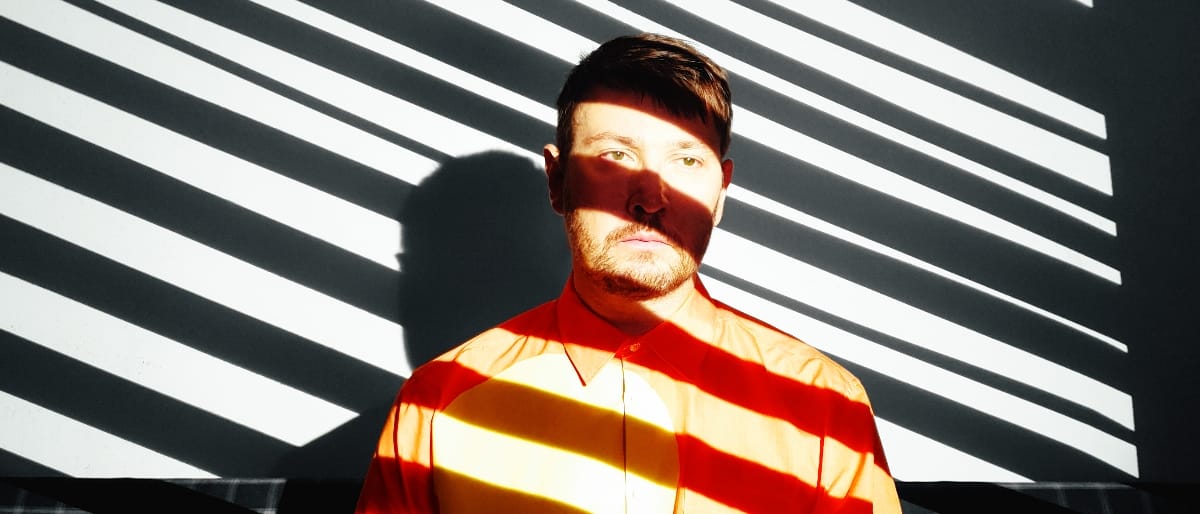
Leo Chadburn's Sleep in the Shadow of the Alternator features bits from shortwave radio, incorporating the "alluringly strange noises in between stations." If you're a radio enthusiast, you know these airwaves contain more than intentional broadcasts. They also hold the residue of vanished institutions, defunct governments, and abandoned communication systems that are ripe for artistic appropriation. The transformation of Cold War shortwave paranoia to sound art probably began with The Conet Project, a four-CD compilation released in 1997 that inadvertently created a museum of phantom radio transmissions. This collection gathered decades of numbers stations recordings and their mysterious and haunting broadcasts of unidentified mechanical voices reading number sequences.
(Side note: on my first trip to London in 1997, I popped into Slam City Skates and the small record shop connected to it by an upward stairwell. I walked into the shop to the sound of the newly arrived The Conet Project CD playing through the store's speakers. Both the store's customers and employees stood around motionless, confused, mesmerized.)
The archivists stockpiling these recordings are practicing speculative documentation, as there's no clue what purpose these transmissions serve. Our guesses are now much more informed by (sometimes declassified) information that has since come to light, but in 1997, there wasn’t much to go on. There was just the 'art' inherent in the hiss of atmospheric interference, the slow drift of unstable oscillators, and the degradation of unmaintained broadcast equipment. Chadburn's decision to include shortwave radio in his thematic work acknowledges this shift from surveillance to sound art. The radio accesses what he might call the "labyrinthine narrative" hidden within the electromagnetic spectrum.
Numbers stations have little purpose in 2025, but seem to continue broadcasting as monuments to institutional persistence and gradual decay. Some stations have sent out identical sequences for decades, perhaps maintained by bureaucracies that no longer remember why they're necessary. So, if you're an artist working with themes of institutional and industrial decline, what's not to love? Chadburn's vision of post-human England "one thousand years hence" finds its radio equivalent in these phantom broadcasts that outlive their creators. We're accessing what he calls the "slippage between dream and reality that memory can resemble." For Chadburn and other artists like him, that means tuning into the spaces between stations where the ghosts of twentieth-century communication still flicker in the electromagnetic dark.
Playback: From Lagos to Bogotá — La BOA's Rhythmic Dialogue with Tony Allen → With permission, Colombian combo La BOA posthumously collaborated with famed Fela drummer Tony Allen using drum recordings recorded in 2011. This might feel like a phantom radio transmission, with communications that continue broadcasting after their original broadcaster is no more. Allen's recorded drum patterns become 'spectral transmissions' that La BOA receives and recontextualizes.
 Michael Donaldson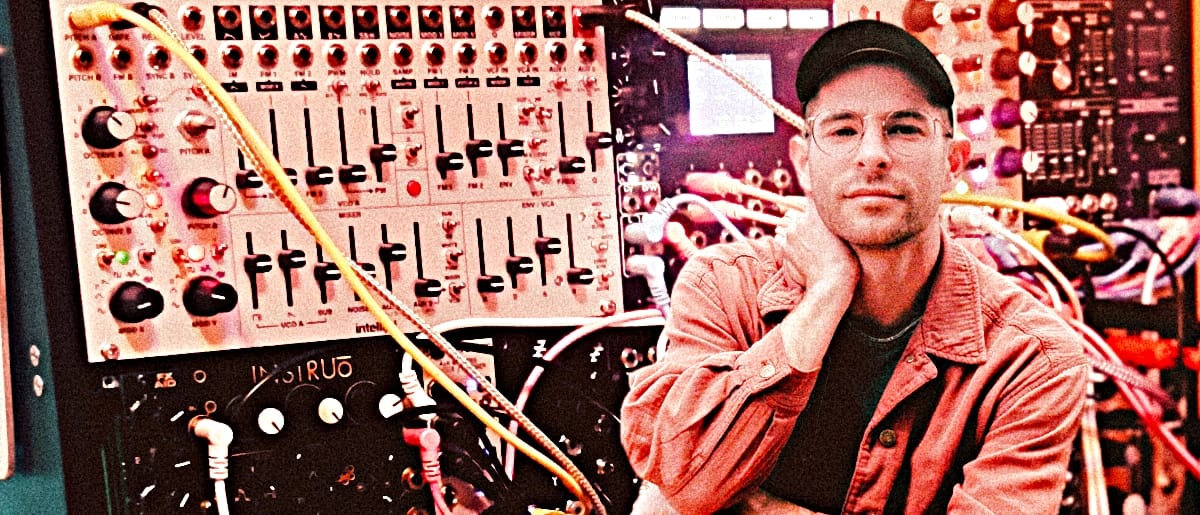
If you pay Isaac Sherman a surprise visit at his Highland Park home, you might catch him singing gibberish over electronic sequences. He records everything, then plays it back later, listening for patterns his brain reorganizes into words. What he hears becomes the "lyrics" to his songs, meaning recognized within the static of nonsense. Sherman's practice reminds me of a tradition of jibber-jabber that stretches from Dadaist happenings at the Cabaret Voltaire to contemporary EVP research. What happens when we surrender semantic control and let pattern recognition take over?
At Zurich's Cabaret Voltaire in 1916, Hugo Ball recited sound poems—"gadji beri bimba glandridi lauli lonni cadori"—as audiences struggled to parse meaning from his intentional babble. Ball aimed to destroy rational language, but discovered the impossibility of truly meaningless sound. Listeners can't help interpreting vocal chaos—our brains hunt for linguistic patterns even when there are none. Then, to slyly connect to the previous section, there's Friedrich Jürgenson, listening to "spirit voices" in 1959, later claiming the dead were speaking through his radio equipment. Whether or not you believe in postmortem radio broadcasts, EVP demonstrates our auditory cortex's relentless pattern-seeking. The human brain refuses to accept pure noise as just pure noise.
Sherman's lyric-writing method is somewhere between Ball's deliberate destruction of meaning and EVP's accidental discovery of it. Like Ball, Sherman starts with utter nonsense. Then, like EVP enthusiasts, he finds language lurking in the playback. But Sherman makes this perceptual quirk into a compositional tool, using pattern recognition as a collaborator. His vocal processors create a sonic distance that helps him hear his own voice as foreign material, ready for interpretation. The song exists not in what he says, but in what he thinks he said, arriving at pareidolia as an art form.
Playback: Scott Metzger Gets in the Telepathic Groove with LaMP → Guitarist Scott Metzger describes how his trio LaMP develops a collaborative "X-factor" or "telepathy" and musical ideas arise from subconscious connection rather than deliberate planning. His emphasis on listening to bandmates "more than I'm listening to myself" is a form of Sherman's process of treating his voice as something he may not recognize as his own.
 Lawrence Peryer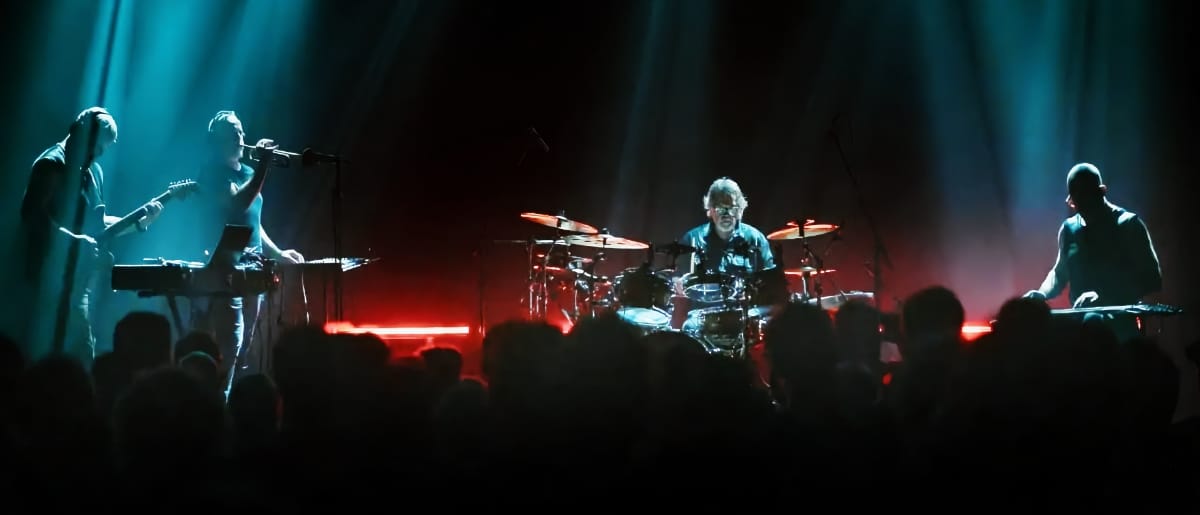
Slovak guitarist David Kolla, of the band KOMARA, was commissioned to score movies about 1990s crime boss Mikuláš Černák, a controversial assignment that cost him relationships, even though most of his cues never made it to film. Those unused sketches became the foundation for his progressive trio's latest album, KOMARA II. Kolla joined Pat Mastelotto and Paolo Raineri for recording sessions in Texas, shaking loose the music’s scandalous associations by bringing the source material across cultural lines. But this highlights a sort of post-communist burden where musicians in Eastern Europe can find themselves conscripted as guardians of historical memory. Western musicians of the same age don't have to deal with such responsibilities.
Mastelotto approached Kollar's rejected film cues with detachment. Working from his Austin-based studio, the American drummer saw these fragments as atmospheric and inspiring rather than provocative. He did watch scenes from Slovak mafia films while overdubbing his drums, but likely didn't consider how these movies are a political landmine for some Eastern Europeans. Raineri, the Italian trumpeter, brought a similar historical distance to the project. Without the lived-in cultural context, how could they experience anything more? Each musician contributed ideas through KOMARA's democratic "no rules" approach, with Kollar's original film cues becoming substrates for group improvisation, layered with international input and finally transformed beyond recognition.
This goes to show that controversy that feels urgent in one national context becomes abstract once removed from its territory. The monster on KOMARA's album covers might present a metaphor: something that's built from familiar pieces, but assembled to create something new without pre-existing baggage. The question remains how much that transformation changes the nature of its components, or if it simply obscures their origins, hidden behind the ideal of international collaboration.
Playback: ETHEL's Dorothy Lawson — From Downtown Streets to Uptown Symphonies → Dorothy Lawson mentions how classical music became trapped in academic constraints during the twentieth century, excluding artists working with modern or popular references. As cultural mediators, ETHEL takes marginalized music from traditional classical contexts and uses international collaboration to offer something new and exciting.

The Hit Parade
- Francesca Marongiu - Still Forms in Air → This debut album from the Italian composer draws from mid-1980s Japanese ambient music—particularly Hiroshi Yoshimura, Satoshi Ashikawa, and Takashi Kokubo—without completely ignoring Italian experimental traditions. This is the sound of urban and emotional landscapes through the lens of the mid-1980s and early '90s, a period of subtle change in shared spaces later termed "les années d'hiver." A contemporary perspective is adopted through four lovely, chiming tracks, though the historical influences are easy to spot. There's also a spatial awareness in the cross-temporal dialogue that's clear-eyed, affectionate, and quietly luminous.
- Peter Chilvers - Dust 4 → In his latest installment of the Dust series, Peter Chilvers combines piano improvisation with electronic elements and exudes his nearly two decades of software collaboration with Brian Eno. These gentle recordings originated from live performances, abstracting earlier Dust compositions into real-time improvisations and are undeniably lovely. The 60-minute album is also accompanied by a companion film created with filmmaker Dion Johnson, with contemplative visuals that respond to this sparse music. If Thursday Afternoon is one of your go-to life soundtracks, then this album is for you. As Mixmaster Morris is fond of saying, "It's time to lay down and be counted."
- Aki Onda - In the Depth of Illusion: A Soundtrack for Nervous Magic Lantern → OK, not the relaxing ambient of the previous two selections, but a sometimes jarring soundtrack to a provocative piece of avant-garde cinema. Ken Jacobs' Nervous Magic Lantern project features a hand-built apparatus that creates holographic-like visual illusions through spinning shutters, light sources, and hand-painted slides. Composer Aki Onda has been collaborating on this project for decades, creating soundtracks using Jacobs' extensive field recordings—street sounds, conversations, daily life—to ground the otherworldly imagery in reality. These audio collages are treated evocatively and accompanied with 'music' sourced by musique concrete, experimental synthesis, and who knows what else. The album is a document of a Nervous Magic Lantern performance from 2015 in Tokyo, but, standing on its own, the recording comes off like listening to dreams that others are having for you.
- I’ve also got to mention that I saw the Aaron Irwin Trio play in a small used camera store last Thursday. They were stunning, intimately displaying the talents of Bill Campbell on drums, Mike Baggetta (who we profiled on The Tonearm) on guitar, and Aaron Irwin on the saxophone. There’s a modern hybrid of jazz that thrives on both the improvisation of the form and the grit and tunesmithery of independent (as in DIY) rock music, and I’m here for it. If that’s got you curious, the trio’s 2024 album (after) is a great place to hear what I’m talking about. It’s an exceptional album.
- Short Bits: This week on the Spotlight On podcast, guitarist Rez Abbasi reconnects with host Lawrence Peryer for a fascinating discussion about craft, impermanence, and cultural identity. • Contributor to The Tonearm Garrett Schumann wrote an excellent article for NPR commemorating Samuel Coleridge-Taylor, an overlooked icon of Black classical music. • Tying in with last week's Stalker talk: 10 great Eastern European sci-fi films. • George Grella surveys the musical architecture of Iannis Xenakis • A brand new banger from the Open Reel Ensemble.
A Shout From the 'Sky
The Hit Parade
We asked Isaac Sherman the magic question—"What's something you love that more people should know about?"—and he ricocheted out of left field for his thoughtful response:
I was thinking about this and thought there were a few different things I could talk about, like my filmmaking. But—and I feel like I've been talking about this to everybody lately—the thing I really want to mention is how I've become a proponent for nuclear power. The fears about nuclear power and potential for disaster are very real, and I’m not trying to be utopian about it. Still, I think a lot of what we’re warring over is resources and energy. I'm curious about the potential for what kind of peace nuclear power could bring, aside from averting our impending climate disaster. When I was first jumping into my research about this, it was just like, "Oh my God, there's this almost infinite power source that we have access to that we're not using. It's clean energy. What the fuck?" There's a film called Nuclear Now that is a heady, pro-nuclear power documentary, making it a good entry point for those curious.
Run-Out Groove
When Isaac told me his answer to the magic question, I recommended that he read Kim Stanley Robinson's Ministry For The Future. I'm kind of like a broken record on this book with everyone I meet. Check it out if you aren't familiar with it: this book is important, thought-provoking, and entertaining, too. (I just started Green Mars, by the way. I'm a KSR fanboy.)
Thanks for reading to the end! No side-eye if you skimmed your way here, just keep in mind that it's about the journey, not the destination. Please share this newsletter with one friend who loves shortwave radio and may or may not work for a clandestine security agency, or anyone else, for that matter. You can also post that 'View in browser' link at the top of this email on social media. Be sure to include a mysterious series of numerals in your post. That'll keep 'em guessing.
And please let me know what you think of this newsletter or anything else on your mind. I'm a good listener. You can reply to this email or contact me here. BTW, there's an old photo of a cute dog at that link.
Enjoy the rest of your day and don't let the week ahead intimidate you. There's time. Let's take a long moment to relax and take care of ourselves. "Lie down and be counted," right? OK — I'll see you next week! 🚀
Connect with The Tonearm:


Comments