


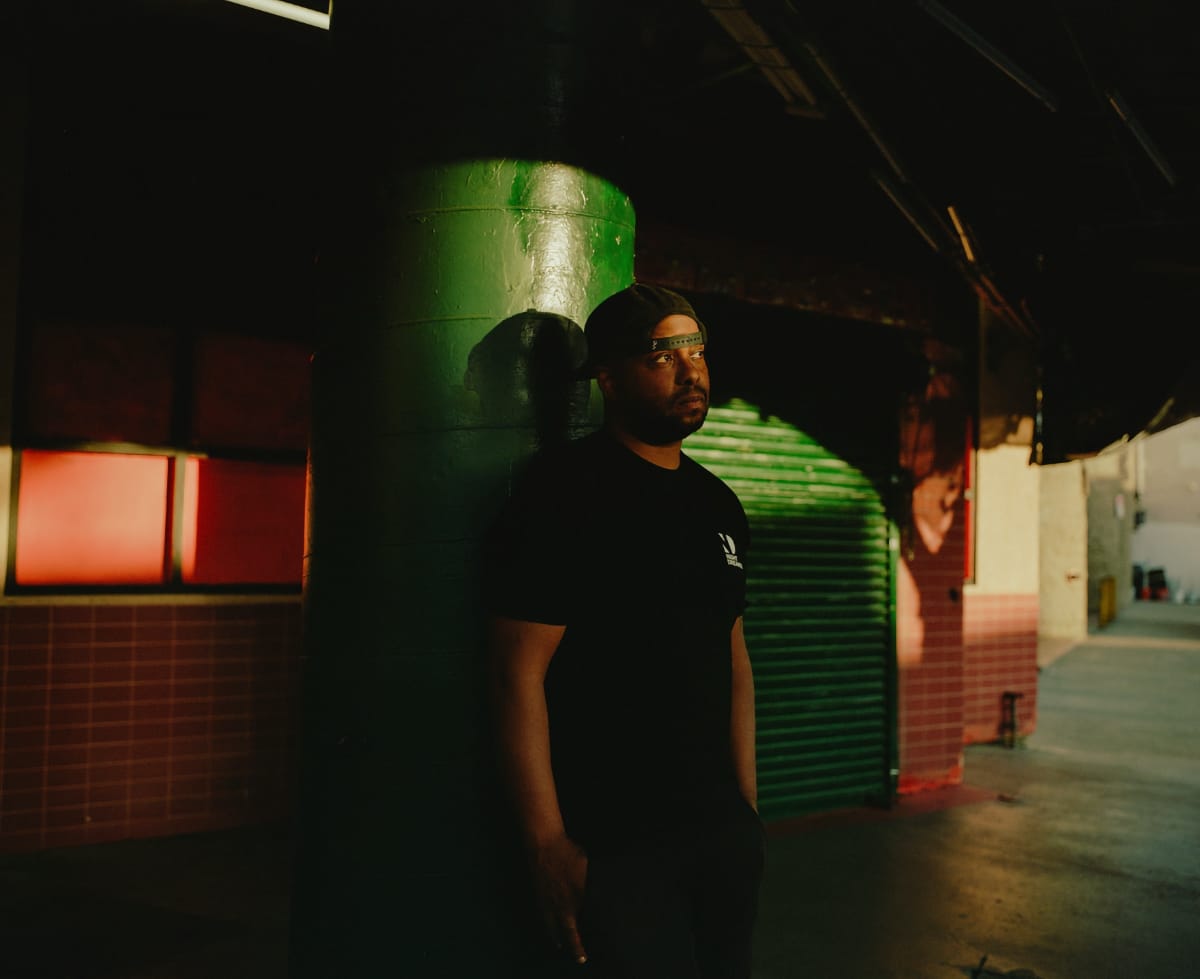
Some musicians build careers on genre. Ben Marc built his on openness. Try to summarize his background, and you end up with a list of giants: Radiohead's Jonny Greenwood, Ethio-jazz icon Mulatu Astatke, the Sun Ra Arkestra, Shabaka Hutchings, Dizzee Rascal—the kinds of collaborators who usually belong to different universes entirely. Yet Marc moves between them with ease, not because he chases prestige, but because he approaches music with a rare mix of curiosity and humility.
Despite a résumé that could put him miles above the rest of us, Marc is startlingly down to earth. He laughs a lot, speaks generously, and insists—without irony—that he'd collaborate with anyone willing to share ideas. In his world, community matters as much as virtuosity, and even the most far-flung collaborations begin with a simple desire to learn.
That sense of openness sits at the heart of his new album, Who Cares Wins—a swirling, multi-layered project shaped during his time volunteering for the NHS, and one that folds his jazz roots, his Caribbean heritage, his Birmingham upbringing, and his global experiences into a sound that refuses to stay in one lane. In this interview, he talks about building his own studio, his love of film scoring, and creating a deeply collaborative record featuring artists like Kay Young, Khazali, Wahid, Confucius MC, Σtella, and Speech (Arrested Development).

Arina Korenyu: Who Cares Wins has been released in three stages, allowing each chapter of the album to shine. What does each EP represent for you within the complete fourteen-track project?
Ben Marc: I have a catalogue of songs that cross into so many different genres. Ben Marc exists in two different worlds in my headspace. There's such a wide range of sounds in my mind, so breaking things up felt ideal. As a listener, you can tap into a smaller fragment of what you like—or don't like—and then another EP offers an entirely different energy or style.
The first EP is more for the hip-hop heads, I think. The second has a different energy. Not quite ‘dance,’ because it's not 140 BPM or anything, but a different vibe. Hopefully, when the third EP, meaning the full album, arrives, people can take what they like or listen to the whole journey. A fourteen-track album can be a lot to take in at once, so breaking it up just felt right.
Arina: Talking about the album’s genre, you've said, "It's just me." How would you articulate this personal genre?
Ben: It's personal because it is just me, and every artist says that. "Ben" is my jazz nickname, and "Marc" is my hip-hop nickname. It really is me. And you probably know my real name is Neil Charles. So Ben Marc is two nicknames, but Neil Charles is the name that plays a lot of jazz, free jazz, and collaborates with people like Kamasi Washington and musicians associated with Charles Mingus. Bringing that element—Neil Charles—into the Ben Marc headspace becomes a kind of collaboration or cacophony of sound that I'm trying to put into the world.
Arina: You also mentioned being inspired by the '70s crime series Columbo. How does that show's musical adventurousness show up in your compositions?
Ben: Definitely in the string arrangements. I'm a big fan of Bernard Herrmann, and I love Columbo. The whole cinematography of sound is where I'd like to go—scoring films, scoring in general. That's where I'm leaning, with my classical background. I just enjoy the sonics of that world.
I think the sparseness of the music and the instrumentation just rubs off on me. Especially the early works from the '60s and '70s. Amazing pieces by amazing composers. And back then, directors sometimes hired jazz musicians—Oliver Nelson, Charles Mingus—to compose entire episodes. That was unheard of later, though it might be returning now. Terrence Blanchard is doing a lot of scoring today, but back then, it was common. I love that.
Arina: The album was developed during your time as an NHS volunteer. How did supporting the elderly during the pandemic reshape your understanding of community and creativity?
Ben: It was incredibly important. When I moved to the area ten years ago, I didn't know many people. Then the pandemic hit, and suddenly you had to care. Music became second nature at first—but then it became first nature again because you start having conversations with people, and they're listening to the same things, the same news. You start asking: “What's making you happy? What do you want to listen to?”
Reconnecting with people—whether in the park or through the NHS work—was meaningful. What was scary was not knowing if you'd ever see someone again, especially the elderly. You'd drop off food, stand meters away, and then the next week . . . sometimes they weren't there anymore. That happened to me. It wasn't a nice time. But it created a real sense of community.
Arina: You play several musical instruments and work in a variety of styles. How do you choose which instrument or sonic palette to start with?
Ben: It depends on how I feel. As a creative, you find spaces each day. Sometimes it's one oscillator sound that you run through hardware, or reverse, or manipulate. That oscillator might come from a cello, a sample, anything. You just find creativity wherever it shows up.
Arina: You set up your own studio for this album, which I imagine gave more freedom. How did your production approach evolve compared to your last album?
Ben: So much. I used to share a smaller space with a fantastic producer, Danny L Harle. He does everything in the box, digitally. I learned a lot from him.
But when I'd bring in a cello or guitar, it got crowded. He needed the room every day. Moving out was heartbreaking because it was in this amazing building, The Premises Studios. Everyone rehearses there—Radiohead, jazz bands, pop artists. You'd see Little Simz or Jarvis Cocker at the café.
Leaving that space was sad, but it led me to my current studio—a former Liberal Democrats office. When I got it, it was smelly and unused since COVID, but I made it work. I'm alone in the building every day, which is the complete opposite of Premises. But I can make as much noise as I want. That's the blessing.
I had more time to experiment with things, and it gave me the opportunity to buy hardware, learn a patch bay again, and be able to move audio around and just be creative with it. Some of it was just trial and error. I've now got a tape machine. I would never have had that experience of what analog distortion sounds like if I hadn't moved here. All of those things—it was definitely a learning curve leading up to this record.
Arina: "Homeless Maccabee" marks your first full song collaboration with Σtella. How did the two of you come together, and what made the partnership feel natural?
Ben: We were both signed to Sub Pop Publishing. The person who signed me said, "You two have to meet." I heard her music and loved it.
I was worried because my old studio was tiny. We couldn't even record drums. So we jammed on guitar and bass, and it ended up being for her record first. We hit it off, spent an afternoon creating, and some ideas went on her album. Months later, I asked her to sing on a track I was writing—that became "Homeless Maccabee."
She lived in London for a bit, came to gigs, hung out. She's really cool, a big star now. I'm grateful she worked with me.
Arina: Talking about your other collaborators, like Speech, Kay Young, Khazali, and Wahid, what do they bring to the sonic identity of Who Cares Wins?
Ben: Everyone brings their own artistry. Rappers, singers, poets—they all have different skills. I tap into poetry, hip-hop, singing, and harmony. They each bring their own fine art. I'm grateful to have that community. Collaboration and sharing ideas are so important.
Arina: What makes you choose someone that you want to collaborate with?
Ben: Honestly, I'd work with anyone. I don't turn people away. There's music I don't understand, but the artists making it are killing it. So I need to learn. I want to learn. I want to share my skills with people who might not have the same background. I'm a creative first—more than anything else.
Arina: You just mentioned that you want to continue learning from the people you're collaborating with. And you've worked with many legends in the business, like Sun Ra Arkestra. What were the things you learned from accomplished artists like them that you carry into your solo work?
Ben: No ego. You can't have an ego in that environment. You might know everything, but once you're on the bandstand, you're in a community. You have to deliver for the audience.
I've learned so much—from Sun Ra, from Mingus-related musicians, from David Murray, from Kamasi Washington. And from Mulatu Astatke, whom I've worked with for twelve years. Mulatu taught me that he needs to see the audience to play. In big theaters where the crowd is hidden, he struggles. He wants to play to people. That stuck with me.
And at the Sun Ra Arkestra, everyone is an artist in their own right. Marshall Allen is the leader, but also not the leader. Yet everyone listens. It's beautiful chaos. I learned a lot.
Arina: Lastly, what new musical or conceptual territory do you want to explore next? Did you think about it already?
Ben: I want to keep learning. But I'd also love to move deeper into the Columbo headspace—scoring films and TV with a hip-hop freedom to let ideas morph naturally, like an EP that grows into something else.
I also work with the band Gabriels—a pop band signed to Warner. They're incredible. They started by scoring and are now doing major film work. I'm lucky to be part of their writing team. They're in LA, though, and that makes things tricky. So I'm looking for directors here in the UK. That's the headspace I'm in.


Comments