


Language at an Angle, released by Lobby Art Editions, is Sam Wenc's first record under his own name after thirteen years of recording as Post Moves. It’s described as an eight-part tone poem that treats language as a living process rather than something fixed or knowable, a description that fits both the music and the moment it captures. The album is dedicated to the late Susan Alcorn, the pedal steel guitarist whose work transformed how Wenc thinks about the instrument.
Wenc built the Post Moves catalog across labels including Lobby Art Editions and Where to Now? Records, Noumenal Loom, and Moone Records, accumulating press from The Wire, Boomkat, and A Closer Listen along the way. Boomkat described 2022's Heart Music as blending folk with spiritual jazz and post-rock minimalism; Byron Coley, writing in The Wire, noted Wenc's "complex approach to contemporary acoustic primitive/art techniques" on 2023's Clarity Surrender. He performed at the Brooklyn Academy of Music, held a composer residency at Stockholm's Elektronmusikstudion, and toured Japan. Through all of it, his pedal steel work kept expanding: metal pipes bowed across strings, inverted cymbals pressed against them, blocks of wood positioned at different points along the body to alter texture and harmonic content.
Language at an Angle is the first of Wenc's releases to fully document what that approach has become as a live solo performance. The album draws on free improvisation, East Asian court music, and overtone-centered drone, with pianist Sam Yulsman contributing throughout. Wenc mixed the record himself and released it on his own label. He described the combination with characteristic bluntness as the work of "a total control freak."
Lawrence Peryer recently hosted Sam Wenc on The Tonearm Podcast. They discussed the extended techniques and compositional thinking behind Language at an Angle, the physical and harmonic possibilities Sam continues to find in the pedal steel, and Susan Alcorn's profound influence on his playing.
You can listen to the entire conversation in the audio player below. The transcript has been edited for clarity, length, and flow.
Lawrence Peryer: I am curious to start with what made this the time to put out a record under your own name?
Sam Wenc: I've been thinking about that question—now that the album is out, it's having me reflect on it a bit more. I have been recording under the name Post Moves since about 2012. That started as a songwriting project, and when I moved into more solo-based, experimental work, I decided to keep the name. But as time went on, I felt more distanced from it. And then I released an album of songs, written on guitar, with vocals, lyrics, and all that. Something about that felt like a real closing of a loop. It had been about nine years since the last ‘songs record.’ And then I put it to rest. There are practical things, too—it was always a little awkward introducing myself as a solo performer with a project name, when it's just me.
Lawrence: Tell me about the genesis of Language at an Angle. My understanding was that it grew out of a bunch of live work.
Sam: I think an important thing to note about this album is that it's the first album I've done that is a total reflection of my live set. Prior albums had always been different studio improvisations, things that I wouldn't and couldn't perform live as a solo performer. It was becoming clear that it was a single piece of music. When it came to recording, there were these discrete movements that broke it into eight tracks, but I see it as one unit.
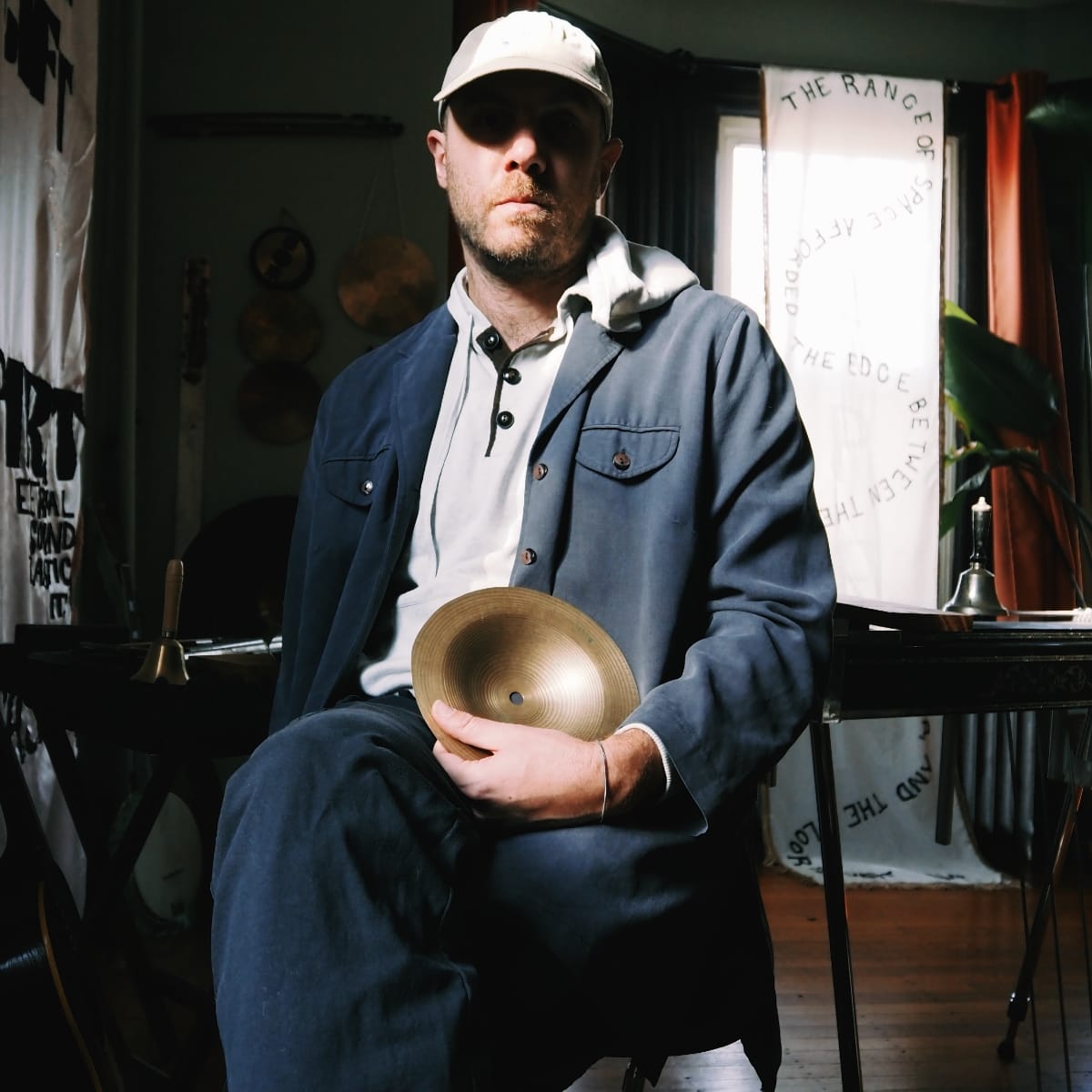
I think a lot of it also reflects the years I've been working with the pedal steel guitar—working with different approaches, different arrays of tools and modifications, things that would get at different harmonic potentials of the instrument. Often, that comes about with metal pipes that I'm bowing across strings, or cymbals that I'm gyrating to create friction, or balancing pieces of wood over the pickup to get different textural effects. That was becoming a language of sorts for how I was performing. But I think it took time to figure out those tools and their compositional language.
At the end of the day, I'm curious about these sounds and the potential of harmonics, timbre, and texture insofar as they serve a larger compositional arc. I'd reflect after a show and write down what was working and what didn’t—like, if I position my arm in this particular way with this implement, I can get the circular feedback. Like on the first track, "Limitless of Blue," there's this kind of positive feedback cycle that occurs purely from the friction being caused by this inverted eight-inch cymbal that I'm rubbing against the strings. So you're getting both—the strings are vibrating, but then that vibration is turning into a positive feedback cycle, and you're getting a whole array of overtones, a complex and rich harmonic field. It just took time to know what was going on. It was a lot of distilling, like, “Oh, that's what's happening. Now that I know what's happening, how does this fit into a composition?”
Lawrence: Is the pedal steel particularly sturdy in terms of being able to work with extended techniques and other implements? What makes it so suited to such manipulation . . . and abuse? (laughter)
Sam: I remember a friend's dad came up to me after a show I played, and he had such concern on his face for the treatment of the guitar as I was kind of banging at it. But even though some of the movements and gestures can appear forceful, I see it as really intimate—a way of intimacy—my body working with the body of the guitar.
It became less about the melodic content of the material. It was born out of the physical approach rather than "I'm going to pluck these notes and strings, because that's a pretty thing." The pedal steel—there's something about its horizontal nature. You step into it, you rest your legs under it, so you're almost embracing it. There are times when I'm really hunched over and almost in a bear-hug position with it. In the same way as a piano, one can look down and see the whole fretboard laid out. There are so many voicings you can achieve, whether you're playing straight, with a slide, or if you place a block of wood up near the pickup and get this sort of crackly, destabilizing texture. If you put it down towards the neck, it gives a different feeling. The geography of the guitar becomes alive and present, increasingly so over the years I've been playing, and that geography is pretty essential for me continuing forward.
Lawrence: You have experience performing and writing in other contexts, with a standard guitar or what have you. Can one sit at the pedal steel and compose the way one might at another chordal, harmonic instrument? Because it's not obvious to someone who doesn't spend time around one.
Sam: It certainly can function like that. The greats certainly walked those lines, approaching it in this compositional manner of charting out music and writing things. Obviously, it's not an instrument that lives inside the canon, so sheet music and things like that aren't so inherent, but there are certainly players. Susan Alcon was transposing classical pieces for the pedal steel—Messiaen, and Coltrane's "Naima,” which she would transpose. And Dave Easley is a pretty well-known jazz pedal steel player, so you can certainly see there's a real compositional intent going on there.
I've really appreciated just marveling at its mechanism, almost treating it like a machine. And that's not to be underemphasized—it's beautiful as this intentionally built instrument. Looking at it as wood, metal parts, and pulleys, then you flip up the underside of the pedal steel, and it's got a whole system of levers and pedals. So I think it can really operate within compositional approaches.
Sometimes I will just sit with my traditional way of playing it, with finger picks. You can make a whole 1-4-5 pattern without moving the slide. You're keeping the bar on a particular fret, and then you're engaging the foot pedals to bend notes, changing the chordal structure. So there are a lot of times I'll just sit and be like, “I just want to play some pretty chords”—which would be akin to picking up the guitar and strumming it. But yeah, for as much as I love to unearth or deal in the rich, complex harmonic language or potential of the instrument, I just always will love this sweet, simple, saccharine sound of the pedal steel. It's incredibly lyrical. All you need is one note that just sustains, a little vibrato on the slide, and you melt.
Lawrence: It does sentimental really well.
Sam: It does. And I never want to denigrate that or intentionally try to get rid of that core sound. I want that present in the music as well. I just want to arrive at it perhaps from a different vantage point.
Lawrence: You mentioned Susan Alcorn, and that mindset and approach to the instrument is very resonant with a lot of the things she said when I spoke with her a couple of years back. She talked about the obvious way the instrument is tied to the hip of country music—and that traditional players aren't really open to experimenting with it. It has a very traditionalist strand. Did Susan free the instrument up for you, or were you already along those lines when you encountered her?
Sam: I think Susan reflects a unique trajectory. She started and spent many, many years in the country-western scene. She has deep roots there. And I think a complex part of Susan's life was her outspoken political leanings and how that was often at odds with the conservative, fixed mindset of the players and musicians who occupied the country-western space and scene. That difference could be felt not just along obvious political lines, but also in relation to the pedal steel. There are traditionalists who think anyone who does anything outside the realm of what the pedal steel should do is bastardizing the form and is blasphemous. And of course that's, in my eyes, a pretty abhorrent and unrealistic way to see things, to say that there's a demand upon any individual to conform to some tradition.
So her playing was always between those two things, because she still would play country. And the last time I played with her, she came up to me afterwards and said nice things about what I was doing, but also made sure to say: “Don't skip over the old thing—the traditional music, the original forms. There's a lot of gold to be found there.”
She was saying something else there, too, about how you're not supposed to sequester yourself in a bubble and live in a particular community and only be around people who have the same thoughts and feelings and beliefs as you. You'd be living in an illusory state. We live side by side with people with whom we have stark disagreements about how to live. That's what I heard and how she conducted herself. There aren't many people who could go play a country-western gig, then play a Berlin jazz festival, then play an improv gig in New York at The Stone. She lived in all those spheres. When I became aware of her music, I was mostly playing other people’s projects—songwriters, folk, Americana stuff —doing a lot of pads and just giving that pedal steel treatment. But then I came to her music. She painted such a rich and complex portrait of this instrument and its potential.
She had this YouTube channel where she would upload videos of herself at home, covering Messiaen pieces, doing original compositions, covering Victor Jara songs, Astor Piazzolla tango pieces, and then I'd see an improv video of her with Okkyung Lee. It has to be said, too—the pedal steel world is incredibly dominated by men, by white men, and Susan being the forebear, I would argue, of this approach to the pedal steel as a woman—I just think enough can't be said about that, her defiant spirit, and someone with great integrity and humility. That always came across in the music.
Lawrence: Her comment to you—to not neglect or deny yourself the exposure or the education of what can be gleaned from the tradition—that reminds me a lot of, even in the more straight jazz world, this idea of understanding where the music came from, the lineage, before you try to transcend it. But in the avant-garde, on the creative edge, there's a conservatism there, too, sometimes. I mean, all those strands of purity tests are so unnecessary in music.
Sam: I agree. I have that when I'm performing in more improv spaces. I have this insecurity because I want to play some melody in there. I want to get a couple of pretty notes in the mix. And it's like, “Oh gosh, is this even allowed?” Particularly in whatever you want to call it—free, out-improv, avant-garde—for there to be a purity test of sorts, how free is that? Dogma ruins all.
I'm most interested as a performer, particularly in live performance, with the notion of invitation. That doesn't mean all soft, cuddly, or non-threatening. I like it when I feel a challenge being presented by whoever it is, but also when I feel like I can trust them. They're opening a space for me to enter, and they're not giving me the answers. It's a space where it's safe to be uncomfortable, where it's safe to find yourself in different moments of doubt or uncertainty. But you'll also have this underlying sense of welcoming. I think that is my principal interest in music.
Lawrence: As you were saying that, I was thinking about times when I've seen music that is challenging and uncomfortable—might even be viscerally, somatically uncomfortable sometimes. And yet when you're engaged by that music, when it turns into “Yeah, I like this feeling" or “It’s exciting to be this outside my comfort zone,” that's a special moment.
Sam: The word that comes to mind for me, hearing that, is that it's a very alive moment. You feel alive in those spaces. And it doesn't mean it's all easy, and it doesn't mean it's all hard—but it's like, “I’m right here, I'm here with this thing, and this is a direct experience.” As our culture increasingly descends into different modes of complacency and convenience—
Lawrence: Madness. (laughter)
Sam: Madness . . . but finding those spaces where you can feel alive—what are we doing if we're not doing that?
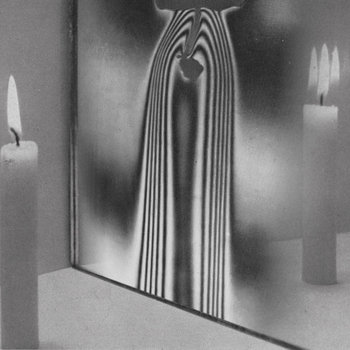
Lawrence: Where does the title of the album come from? Does it somehow relate to the music?
Sam: I was thinking a lot about the notion of language and vocabulary, and some of the processes I was using. It felt like I was developing a vocabulary, developing a language—attempts at language—always formulating and never quite arriving at a totally concretized idea. This coincided with the fact that a lot of the music is informed by, and even the track title is informed by, a long-standing meditation practice. A handful of the titles came from a particularly long duration of sitting, which also informs the titles themselves. When you do so much sitting on a cushion, staring at a wall with your eyes open, you are confronting so many habits of mind—the things that you think you have solidly codified about an experience, or about yourself, or about whatever it is—and then it's releasing from that grip and the grasping for a totally defined approach or outlook.
The name was initially one of the track titles. After this long sitting period, I had jotted down about half of the track titles from that immediate experience after that meditation. Language at an Angle was one of them. I'm looking at this thing one way, but maybe you look at it in other ways.
Lawrence: Not to minimize anybody else's contribution, but the interplay with Sam Yulsman’s piano seems to be a hallmark of this recording—an important part of this album.
Sam: I agree. Similarly to how I was talking about my approach, some of the more extended things I do with the pedal steel, he would hear something and be like, “Oh yeah, this is not a place where I play a melodic line. I'm going to do harmonic overtones with the piano open.” I don't know another word for it other than sensitivity. Touch is critical to this album—when it's really rough and jagged and gritty, that's just as important as these moments that are tender and require a soft touch. I want all those living together.
Lawrence: It seems a little audacious that you chose to mix the record yourself.
Sam: Well, money's always tight, so there's that. But when it comes to mixing, there were other decisions I was making that maybe fall more into the realm of sound design. Working with stereo imaging and different things: I'll take a bass clarinet line and run it through a micro-cassette recorder, then pitch that down 12 semitones, and all of a sudden, the bass clarinet is this garbled mess of gritty, crunchy textures. And I want to put that in the back right ear at a low level. It just comes back to sensitivity—what kind of sound world could this be? And I have my insecurities about my mixing. I just taught myself over the years. But I taught myself how to figure it out to the point where it works for me.
Lawrence: Tell me a little bit about Philadelphia. Is there something cooking there? And do you think the change of place changed the music at all?
Sam: I can't claim to be a lifelong Philadelphian—I've been here three years, so my answers certainly don't sum up everything. I think it often gets thought of as a rock town, but it also has a crazy deep lineage. Marshall Allen still lives a few miles north of me and plays all the time. There's just a rich history of jazz and Black music here.
Lawrence: There was this little-known guy named John Coltrane, I think, that came from there?
Sam: Just a little speck of dust in the history of music. (laughter)
Things can happen pretty quickly and easily here—a show at a bookstore after a few weeks' notice, different kinds of artists on the same bill. There's a tremendous spirit of people making art and music and culture, doing so in defiance of, like, “I don't need New York to validate me.” There's no big prize at the end of all this.
It's hard to pinpoint Philadelphia as the reason this music came about the way it did, but it's also not not a reason. Something I definitely have here is cheaper rent and more space. I get to actually have a studio space in my home that I can go into and just play. All those little things are really important to feeling unencumbered in making the music.
Check out more like this:
 Lawrence Peryer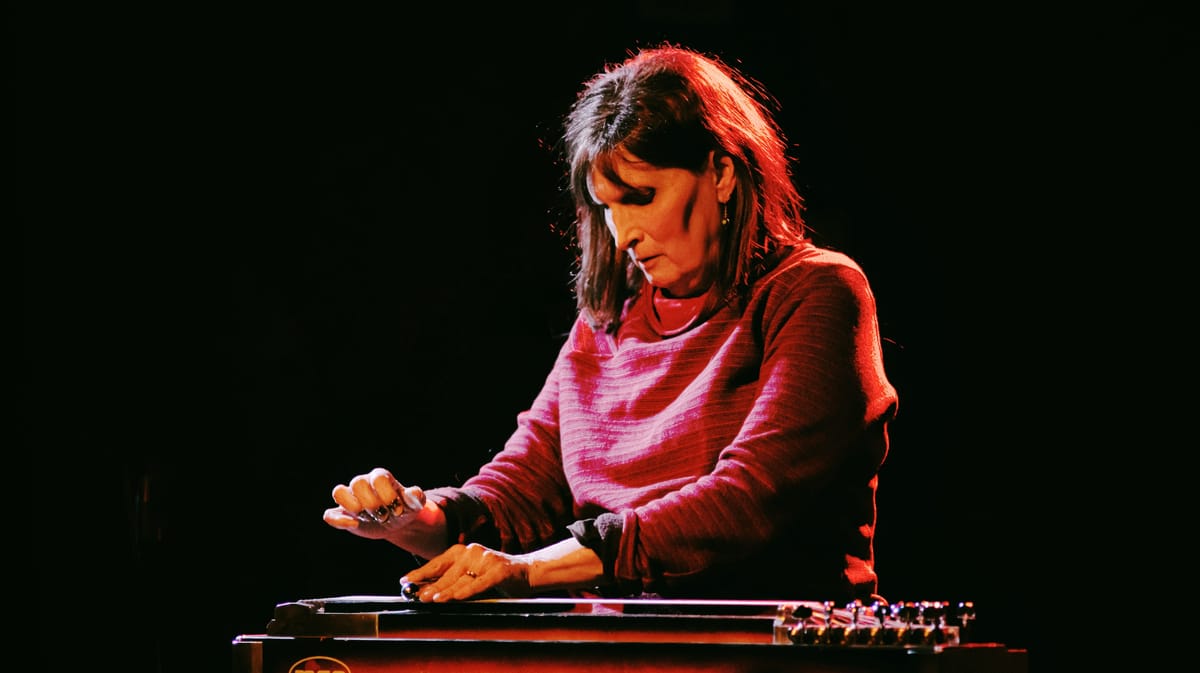
 Sam Bradley


Comments