


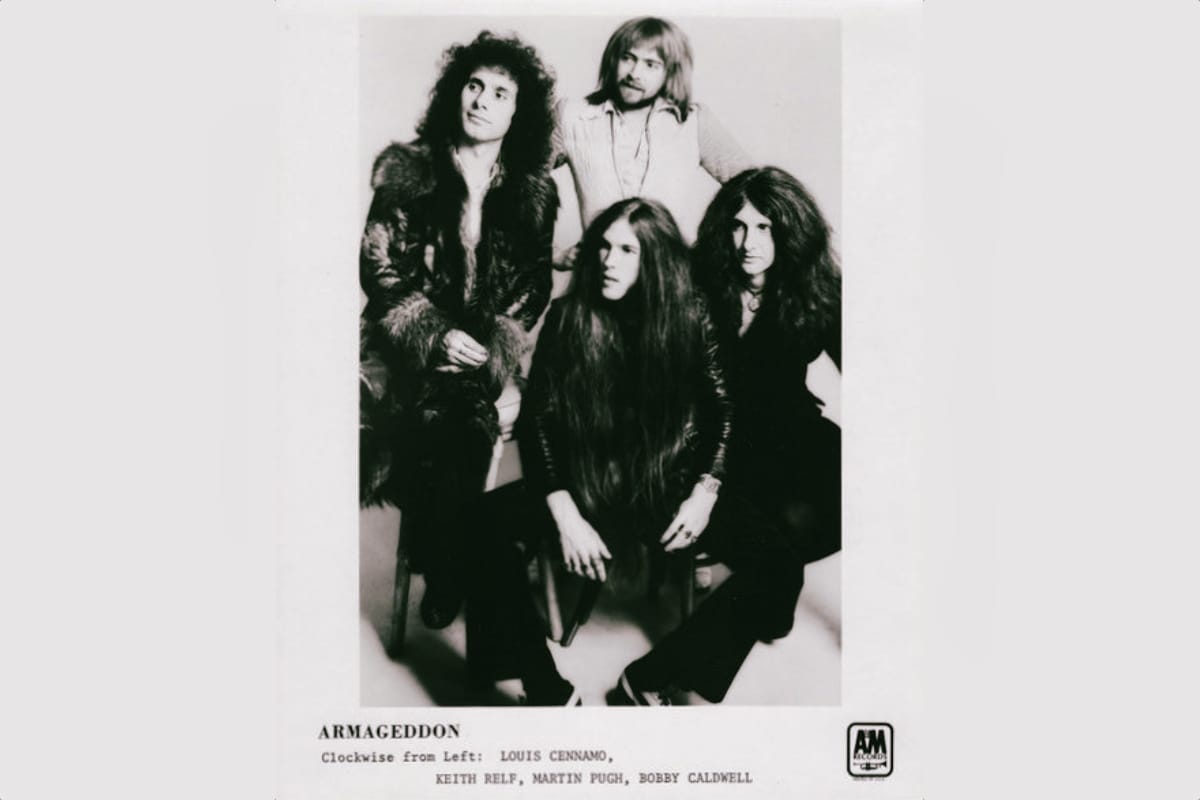
Armageddon was one of those groups that could have only come together in the 1970s. Formed in the wake of the dissolution of Steamhammer, the band was founded by that group's guitarist, Martin Pugh, along with the band's late-period bassist Louis Cennamo and two other musicians of great repute. By 1974, the foursome of Pugh, Cennamo, Yardbirds singer Keith Relf, and former Captain Beyond drummer Bobby Caldwell had come together as Armageddon.
The band recorded but one album, a self-titled LP released in 1975. An opportunity for a high-profile tour arose and just as quickly evaporated, and mere months later, Relf was dead, accidentally electrocuted in his basement studio. Armageddon never reunited, and though the band's album had earned positive critical notices and worldwide distribution, it soon went out of print. And Armageddon would remain unavailable for many years: other than select CD-era reissues in Germany, Japan, and the UK, the hard rock quartet's sole release had largely gone unheard, undiscovered by modern-day listeners.
But in December 2025, Deko Entertainment released a new vinyl reissue of Armageddon. Pressed on red vinyl in a limited run of 500 copies, this new authorized release was brought to market with the enthusiastic cooperation of the band's surviving members. I spoke with guitarist Martin Pugh about the band's roots in Steamhammer, the making of the album, and the (now sold-out) vinyl reissue.
Bill Kopp: Louis Cennamo joined Steamhammer for what would become the band's last album, 1972's Speech. Soon after that album, you launched Armageddon with him, Keith Relf, and Bobby Caldwell. Backing up a bit, how did you initially connect with Louis and Keith?
Martin Pugh: Speech was a great departure from other Steamhammer albums we had done. When we started recording that, Kieran [White, guitarist] left because of 'musical differences.' [New drummer] Mick [Bradley], Louis, and I started to get into more out-there, jazzier sounds, trying to feel our way into the next era of our music.
After an initial week of recording, Louis suggested that Keith could come in. I think Keith came over to see us and said, "Yeah, I can help you produce this album." He was such a genuine, loving person to have done all that in the past and to turn up in that way. I was very impressed and quickly became very good friends with him.
Bill: How did Bobby Caldwell end up getting involved?
Martin: Keith had some contacts, especially with A&M Records. So we decided one day we would just jump and see if the net appeared.
We landed in Hollywood. We went to A&M Records, and Bob Garcia greeted us with open arms. He gave us the Charlie Chaplin soundstage, a great-sounding room. We started to play, and the drummer started having problems; he decided he couldn't hang with it.
So I called Aynsley Dunbar, who I had known from England; he had actually tried to get me to join his band, Retaliation. I said, "You know what we're doing; we'd love you to come down." And he said, "Man, I wish you'd called me earlier, but I've just signed a deal with a band called Journey." But he said, "Anyway, here's the number of a guy in L.A. who you might want to call." And it was Bobby.
I called Bobby; he came down, and we kind of auditioned him, but it was just a no-brainer. After we played three or four songs, it just fit right in. We were playing "Buzzard," which is obviously not in a 4/4 time signature. A lot of drummers had been playing it in four, but Bobby just hit it straight off; he was right there in the pocket.
We carried on rehearsing at the soundstage at A&M, and after a short time, Bob Garcia came in one day with Jerry Moss. They stood at the back of the soundstage listening for probably four minutes, and then they walked out. And we were like, "Oh, dear. I guess we've offended somebody with our playing!" And then Bob came back in and said, "Jerry wants to see you in his office." We went in there, and he said, "We would like you to join A&M Records."
Bill: When Armageddon started, did you compose songs ahead of time, or did the songs grow out of improvisation as they had done in Steamhammer?
Martin: A little bit of both. I come up with things all the time in practice; I'd come up with something, and say, "Oh, that kind of sounds good." And then I'd throw it at the other band members. The beauty of that—as opposed to now, where you send files around and wait months to see if you got something right—is that you'd play it, and the drummer would go like this, and you'd go, "Oh, yeah; that's great." And then the bass player would do something. That's how it came about a lot of times. And Keith would have his book of lyrics; either he'd come up with fresh lyrics, or he would take something out of the book.
Bill: "Buzzard" makes me think of the new wave of British heavy metal, something that wouldn't come along until five or six years later. The song sounds well ahead of its time. Who are some of the guitarists who inspired the approach that you were using in those days?
Martin: Earlier on, it would have been the three Kings [Albert, B.B., and Freddie]. With Steamhammer, I was fortunate enough to back Freddie King on two UK tours. So that's an early influence of mine. Even earlier than that, it would be skiffle groups, Lonnie Donegan, the Shadows, the Ventures.
There are so many great guitar players. And I've always liked the gypsy violin sound and the way it flows and sings. I've always tried to get the guitar to do a little bit more of that. For the "Buzzard" riff, in practicing, I would do a lot of paradiddles—a drumming technique—with my pick: up strokes, down strokes. And the riff came out of that. I started playing it one day; it became like a guitar exercise. Steamhammer started playing it in a little different manner, and then it followed us over to the States with Armageddon.
Bill: Was "Basking in the White of the Midnight Sun"—the epic tune on Armageddon—written as a multi-suite piece, or was it a series of pieces that you decided to stitch together?
Martin: I think it was written as a piece. The last part ["Basking in the White of the Midnight Sun (Reprise)"] was a vehicle for Keith's harmonica and my guitar to interact. We might have come up with that part after we had been practicing at A&M, when we went to England to record at Olympic. We went to Clearwell Castle for a couple of weeks; we all lived there, and we had a basement set up with all the gear.
Bill: Regarding the mix on the album, Keith's vocals are—to put it diplomatically—not as out front as I might have expected. Why did it happen that way?
Martin: I think it's probably a mistake that occurred when we were mixing the album. We elected not to have a producer, which in hindsight may have been a problem. But we were bullheaded and strong; it was like, "We're not having anybody come in here and tell us." From my point of view now, if you've got the right producer, he can tell you, "That is not working; what you just did is not working." It's maybe harder to tell yourself that.
We mixed it at Olympic. When you're mixing, you try to listen through various speaker combinations, and at some point you've got to say, "Let's go with that." But yeah, I agree with you.
Bill: Was Armageddon's deal with A&M a one-album contract from the get-go, or was it a case of, "Do one and see how it goes"?
Martin: It was a one-album deal, but open-ended.
Also, when the album was just peaking—"Silver Tightrope" was definitely in the charts in the Midwest and doing really well—we were due to go out and open up for Eric Clapton on his 461 Ocean Boulevard tour. It was initially set up by Jerry Weintraub, who was a big manager at the time. He put us on that tour; we were rehearsed and ready to go. And then at the last minute, we were told we weren't going to be on that tour. Nobody ever told us why.
In the end, we only played two nights in Los Angeles at the Starwood Club. They were the only live gigs that Armageddon ever played.
Bill: Only two total!? I understand that the tour didn't happen, but why were there no other gigs beyond those two?
Martin: Because the tour was planned. When a tour falls through, then you've got to recalibrate. It just didn't ever happen; that was the time we should have gone out and started touring the States like everybody else. And I think it could have been a much bigger album. A&M made it quite clear that they were behind us for the long haul. Unfortunately, Keith's demise didn't allow that to happen.
Bill: There are multiple guitar parts on the album; interesting things are going on all over the songs. Even though you only did the two gigs, how did you pull that off live with just you on guitar? I would have thought that if you were going to do it live and have the music sound anything like the record, you'd have to bring along another guitarist.
Martin: Right. For one song, we had put together a backing track playing the arpeggiated riff, syncing it up. That's easy these days. One night, it worked a charm. The second night, it got a little bit backward, but we ended up finding our way with it. The other songs were heavy enough that we could get away with one guitar.
Bill: How did this new reissue come about after all these years?
Martin: The story is that my wife Linda and I had been talking about it all year: "It's the 50th anniversary. All these other bands are putting things out. I wish we could do an Armageddon reissue." And then about three months ago, I found out that Deko Entertainment had applied to Universal Music Group at the beginning of the year. Louis had said something to Linda on Facebook, and then I inquired about it, and they were like, "Oh, yeah, this is coming out." It had taken quite a long time for them to put all the ducks in line.
I got in touch with Deko, and they sent me 100 copies to sign. It was amazing; it's like a dream come true. I couldn't ask for more. I told Charlie [Wooton] at Deko, "Thank you so much for doing that. We've been under the radar with that album, so for some people to suddenly think it was worthwhile to do that, it's just great."
Check out more like this:
 Bill Kopp
 Lawrence Peryer


Comments