


Once you catch the krautrock bug, you typically carry it for the rest of your life. That's the conclusion I've arrived at through self-examination and by observing friends who've been fans of krautrock's canonical groups (Can, Neu!, Faust, Kraftwerk, Tangerine Dream, etc.) for decades. And once you absorb those marquee artists, you often dig deeper and discover more obscure iconoclasts who are just as interesting, e.g., Wolfgang Dauner's Et Cetera, Seesselberg, Ibliss, and many others.
To their credit, the most creative young Germans of krautrock's golden era—the late '60s to the mid-70s—determined that they didn't want to associate with music from the country's Nazi-plagued past. They also realized that they couldn't fruitfully replicate the blues-rooted rock of their Anglo-American contemporaries, so they started from scratch and built new sonic beasts of unprecedented inventiveness. From Neu!'s metronomic motorik trance-outs to Kraftwerk's ring-modulated-flute-powered eruptions to Can's radical inversions of funk, psychedelia, dub, and ‘world’ music to Faust's Dadaist twists on rock tropes to Popol Vuh's sanctified drones, krautrockers offered countless spores of inspiration to future generations of adventurous instrumentalists. Today, German underground rock and electronic music from the late '60s and '70s possess a mythical aura, thanks partially to books such as Julian Cope's Krautrocksampler and the Freeman brothers' The Crack in the Cosmic Egg, as well as to the Nurse With Wound List—and due to the music's unique greatness, of course. These German bands blueprinted sonic mutations that sparked the imaginations of thousands of disciples, most of whom haven't improved on the originals' idiosyncratic genius. Nevertheless, even the work of krautrock epigones sounds inherently interesting.
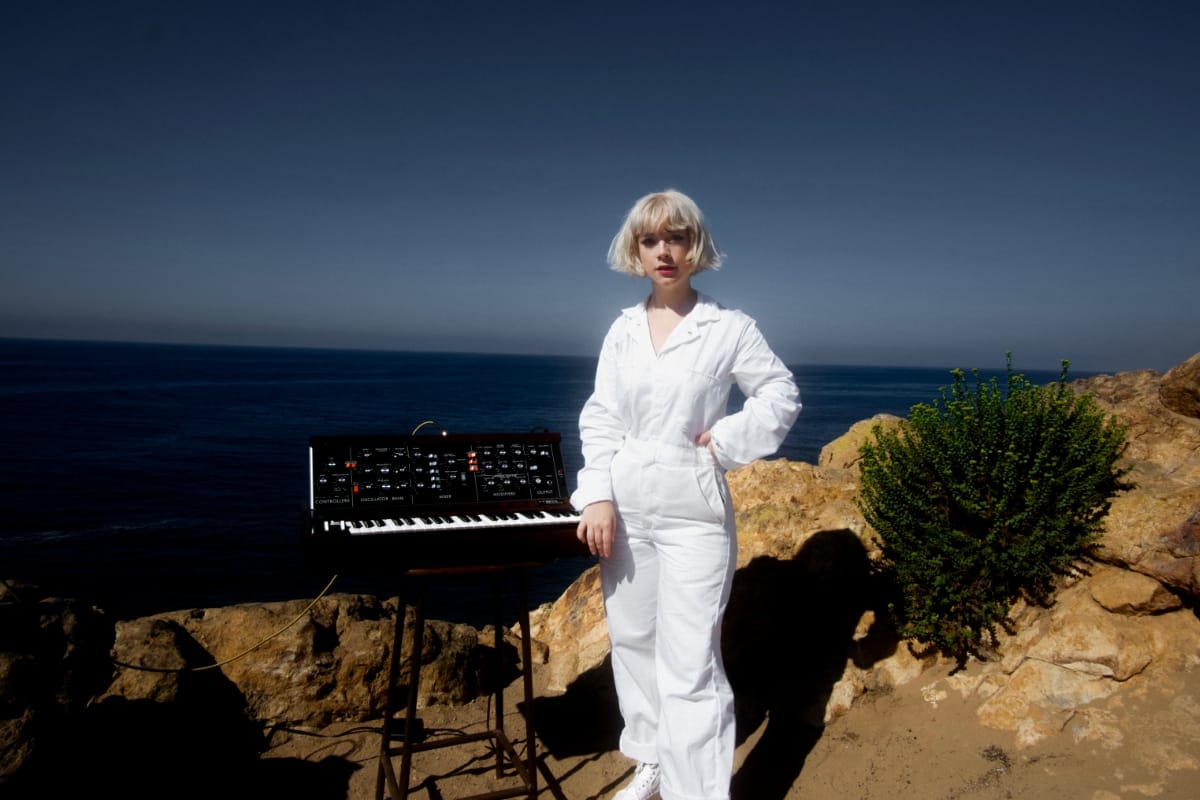
One young krautrock acolyte who recently snagged my attention is Danz CM, aka Danielle Johnson. The LA-based musician/vocalist began her recording career in 2010 under the Computer Magic alias and issued several synth-pop releases that highlight her brash yet elegant vocal arrangements and richly textured melodies. Reference points include Buffalo Daughter, Solex, and the Space Lady. Changing her handle to Danz CM, Johnson put out Berlin Tokyo Shopping Mall Elevator in 2023, a brilliant mélange of minimal wave and exotica-tinged library music, with nascent hints of krautrock.

Danz's krautrock obsession really blooms on the new album, LÄRM! (out now on her own Channel 9 Records). In a press release, she explained that the title represents "the noise/media we consume daily, fed to us through an algorithm created by a room full of business executives for the sole purpose of making money, from what news you engage with, to what memes you send to your friends. You consume and become desensitized in the process because it's all so absurd, and eventually you question whether your own thoughts are even yours or a product of the algorithm designed to keep you engaged. But when you think too much, when you break free from the Matrix, the rose-colored glasses fall off. It's very inspired by The Matrix and They Live, distractions keep people from questioning underlying systems of control."
Whereas a lot of neo-krautrock favors driving motorik pulses, LÄRM! is a subtler affair. Johnson's melodic touch is deft, more Cluster ca. Zuckerzeit than Can ca. Monster Movie. Occasionally enhanced by her frostily beautiful vocals, these songs glow and percolate in an idealized 1970s Berlin of the mind. LÄRM! ends abruptly with its most intriguing cut—tantalizing!
In the email interview below, Danz talks about her initial musical inspirations, growing up in upstate NY, synthesizers, her new album and how her love of krautrock shaped it, and the Synth History magazine and podcast, which prove that she's become one of today's foremost chroniclers of electronic music.
Dave Segal: What initially sparked your desire to create music? What has kept you going over the years, and what are your main goals, musically and journalistically speaking? Do you have an overarching philosophy behind your creative output?
Danz CM: I grew up being obsessed with music. As a kid, I'd listen to it all the time, except when I was sleeping, although I probably even fell asleep listening to music. I'd listen to music waking up, getting ready for school. On the school bus, I'd have headphones on. In class, one earbud in. My parents weren't interested in music, so I'm not sure where it came from. I think it was kind of an escape for me. I always wanted to leave the small town I grew up in since as long as I can remember, and music made the world seem so big. When I was in my early 20s, I started dabbling with Ableton, without any kind of plan, and discovered I had relative pitch, i.e., could make music by ear. I just assumed my whole life that anyone could hear music in their head and make it. And when I discovered that might be something special, I just kept making music.
What has kept me going, I guess, like with any art, is that within me is an inherent need and desire to create. I just have to do it.
Dave: In what part of upstate New York did you grow up? Did that environment inspire you, creatively or otherwise?
Danz CM: I grew up in the Catskill Mountains. My parents divorced when I was 1. My dad lived in Woodridge, and my mom and stepdad lived nearby (in Woodridge), and eventually they moved to Rock Hill, NY. My dad lived on the grounds of an old ski resort that went out of business in the early '90s, just after I was born, called ‘The Big Vanilla at Davos.’ He used to turn on the snow machines and run the lifts, but when the ski area shut down, he became a caretaker for the company that owned the nearby condos. He'd plow and sand the roads, fix the pipes when they froze in the winter, mow the lawns. I could see the big, abandoned ski lodge from his house; it was a five-minute walk, and I would sneak into it all the time as a kid. In the '90s, most of the resorts in the Borscht Belt went out of business or slowly declined and became dilapidated.
On snow days at school, I'd sit in my dad's truck as he plowed the roads. He is a very salt-of-the-earth kind of guy, had chickens and a cow, also loved to drink and party. My mom became a social worker—you can understand why they divorced (laughs). My mom and my stepdad's relationship was pretty tumultuous. I moved in and out with my mom about six or seven times. I think living in a small town, combined with having a chaotic childhood, definitely shaped who I am, and escaping through music and the arts as a kid led me to where I am now. Had I grown up in LA in the entertainment industry with support and connections, I'm not sure I'd be as attracted to the arts, and I definitely would not have as much drive. Although a career in music would have definitely been easier. (laughs)
Dave: Please discuss your favorite synths and what factors led you to use them in your music.
Danz: My go-tos right now are my Minimoog; it's a classic synth and sounds good on everything, so I put it on everything. The Prophet-6, I have the desktop module. It's been my go-to for chords since I got it. The Omnichord is an old standby for me. I send it through effects pedals like an MXR Carbon Copy Analog Delay and overdrive, plus an amp, and it sounds like a guitar. My favorite synths differ from the ones I have, though. For example, I love the Elka Synthex and the [Yamaha] CS-80, but they're like $20k, so I have to go use them at the Vintage Synthesizer Museum!
Dave: I'm wondering how your preference for analog synths developed. Maybe I shouldn't be, but it does surprise me when young musicians go this route.
Danz: It developed gradually over time as I got more into hardware synths. I prefer vinyl to MP3, Super 8 to digital film, practical effects to CGI, a real book to a Kindle. The love of analog synths, I think, is parallel to my love of analog media, in general.
Dave: Do you listen to library music at all? I ask because tracks such as "Little Trees (Wunder-Baum)" and "Birds of Paradise" have that vibe about them.
Danz: A lot of the songs on Berlin Tokyo Shopping Mall Elevator were songs I created to score my Synth History podcast episode on oscillators, so mostly as background. The additional songs on that album were "extras" that didn't quite fit on their own album. "Little Trees," I wrote on tour in Europe. I was enamored with all the different scents written on the trees in other languages. I remember driving endless miles on the Autobahn while the trees would wobble from the road. "Birds of Paradise," I wrote mainly with Mellotron. I wanted to make a song that would sound like it's playing in a hotel lobby or elevator on an island somewhere.
Dave: What triggered your interest in German rock and electronic music from the '70s? What qualities about it drew you in, and what was your gateway record/song?
Danz: Kraftwerk, of course, was the trigger and gateway, and from there I discovered Can, Neu!, Cluster, Harmonia, Amon Düül II, etc.
There are a lot of qualities I love about early electronic music in Germany, but I think my favorite is the improvisational aspect—this idea of simple melodies being built upon, with slight changes throughout and a driving beat. With synth pop/indie pop, you have to think about the ‘pop’ element to some degree, about song structures and so on, but I didn't want to think about any of that, so krautrock was a big inspiration for that reason. I'm a perfectionist and tend to overthink when it comes to my production and songwriting. Absurdity of Human Existence and Davos, for example, I spent hours upon hours perfecting each song.
I had just finished another synth-pop album (that will come out next year) that I worked extremely hard on, and I wanted to give my mind a break. So with LÄRM!, I just let it all flow out without a goal in mind, and in turn, that made it more raw and unrefined. I made a simple drum beat and built upon it with synth improvisations, sent it all through a tape machine, played guitar, which I'm not the best at, but got the job done, and that's it. Used the same instruments throughout, which is what made a lot of the albums in the '70s sound cohesive.
[For the cover], I painted a milk carton and scanned it, as I wanted it to look like a product, to be something you consume, inspired by [the LP covers of] Can's Ege Bamyasi and Harmonia's Musik von Harmonia. Got really into painting, and the back cover is a painting of mountains. It was a great artistic release and an album I made for myself, if that makes sense.
Dave: It seems like there's a new tonal vocabulary evident on LÄRM! Did you use different gear for it? If so, which instruments?
Danz: I used a Moog Minimoog, Moog Grandmother, Casiotone 403, Epiphone Les Paul with some effects—MXR analog delay, chorus, overdrive, Omnichord, Elka Drummer One, and a Teac A-7300 tape machine. Used the same instruments throughout, which is something I don't normally do. Sent everything through my stereo chain, which consists of Neve 1073lb mic pres, API 550a EQs, Chandler TG Opto compressors. My intent was to make it sound warm and like it came from the '70s.
Dave: Can you elaborate on what you mean by calling LÄRM! "a medieval album"?
Danz: LÄRM! was going to be an instrumental album, but I decided to put lyrics on a couple of songs. I didn't know what the lyrics would be, but I became somewhat obsessed with the Viking Age around the same time of making it. I listened to a 10-hour-long, two-part podcast episode called Twilight of the Æsir from Dan Carlin on a long drive, and couldn't get that time period out of my head. I began to associate LÄRM! with that headspace, so that's what all the lyrics are based on. "Lärm I (Hey Angel)" for example, is about being trapped in a castle dungeon and hoping an angel will lead the way out. "Lärm II (Valhalla)" is about how empires rise and fall, religions turn to myths, everyone turns to dust over time.
Dave: Have you heard Conrad Schnitzler and Deutsche Wertarbeit? Some of the tracks on LÄRM! remind me of their late-'70s/early-'80s work.
Danz: I haven't, but I will now go and check it out!
Dave: Please talk about the genesis of Synth History. It seems like a prodigious (albeit fun) undertaking, but maybe it somehow helps you as a musician, in that it exposes you to revelatory concepts of which you may not have been aware. Have you gleaned anything from your interviews that you've applied to your own music-making?
Danz: Synth History started as a side project during the pandemic. I'd post about synths on my own Instagram account, but no one seemed to care or interact, which frustrated me, so I started an Instagram account where I'd post exclusively about synths. I'd post vintage videos featuring synths, retro advertisements, excerpts of interviews from Keyboard Magazine, performances, etc., just to nerd out about them with other people.
I get obsessed with things, and synths became a special interest, and whatever I learned or thought was cool, I'd post about. There are hundreds of accounts like this now on social media that post retro videos with synths, but back in 2019, Synth History was the only one, and it grew like crazy. Eventually, I started a website for it and started to email musicians and do my own interviews. I'd compile those interviews into tangible form, a zine, so it would exist on its own in the ‘real world’ if the internet were to cease to exist. From there, it just kind of snowballed. Now there's a podcast, a screening series, a minidoc series, my friends help out, and we hold events. It feels like it was all an accident, but there's a tremendous amount of work that goes into it all.
I'm not sure if I could pinpoint anything specific I've learned from the interviews that I've applied to my own music-making, although as a human being, I think subconsciously you're always learning from everything you do.
Dave: What are the most interesting things you've learned from your interviewees?
Danz: A lot of musicians have the same advice when it comes to overcoming writer's block—which is, "just write!"
Dave: What's the most shocking thing that you learned from your Synth History interview subjects?
Danz: The bigger the artist is, the more down-to-earth they usually are. At least the ones I've spoken to. Maybe it's because they've already made it and don't have anything to prove. There are some smaller artists I've interviewed who surprisingly seem disinterested, and I'm thinking, “Why did you agree to do this interview in the first place?” (laughs) Maybe their manager made them do it. But yeah, all the most successful artists I've spoken with have always seemed very kind, respectful, down to earth, and actually interested and engaged. They say "don't meet your heroes," but I've never felt that way—at least not yet.
Check out more like this:
 Carolyn Zaldivar Snow
 Michael Donaldson


Comments