


The streets of Patricia Brennan's hometown, the Port of Veracruz, exposed the budding musician to Mexican marimba music and Afro-Cuban rhythms alongside her engineer parents' love of classic rock and Brazilian bossa nova. Then came the alternative rock of her teenage years, which introduced her to repetitive forms and unconventional structures. All of these elements converged in Brennan's choice to master the vibraphone, where rigorous systems meet intuitive expression. She then studied classical percussion at the Curtis Institute of Music in Philadelphia, eventually performing with Yo-Yo Ma and the Philadelphia Orchestra.
Brennan's 2024 album Breaking Stretch earned her Album of the Year and Vibraphonist of the Year in the DownBeat Critics Poll, the top spot on the Francis Davis Jazz Poll, and Album and Musician of the Year from El Intruso's survey of international music journalists. The record appeared on best-of-year lists from The New York Times, NPR Music, Bandcamp, and more than 30 other outlets. Rather than repeating that formula, Brennan rocketed toward a more ambitious follow-up. Of The Near And Far, released by Pyroclastic Records, trades Breaking Stretch's folkloric rhythms and septet format for a ten-piece ensemble that combines a jazz quintet, a string quartet, and an electronic musician. The shift, along with the album's themes, reflects Brennan's dual passions for contemporary chamber music and amateur astronomy.
The album's compositional system emerged from Brennan's telescope observations during summer retreats to Branford, Connecticut, where she escapes the city's light pollution. "If you really look closely, everything can be connected through geometrical shapes," she explains. "I became curious as to how I could translate that into music in the same way that I've translated numbers into rhythmic structures in the past." She superimposed the circle of fifths over constellations visible from the Northern Hemisphere, generating pitch collections from the points where stars aligned with specific notes. The mythologies surrounding those constellations and their astronomical properties provided emotional and conceptual frameworks for pieces built from those raw materials.
Lawrence Peryer recently hosted Patricia Brennan on The Tonearm Podcast, where she discussed the mechanics of her constellation system, the connections she traces between astronomy and music as time machines, and how her background in everything from orchestral percussion to Radiohead informs the unusual instrumentation and dense polymeric layers of Of The Near And Far.
Listen to the entire conversation in the audio player below. The transcript has been edited for length, clarity, and flow.
Lawrence Peryer: I wanted to start by asking you about the music you were exposed to early in your life. My understanding is that your parents both had a lot of music in their lives, but it was different music.
Patricia Brennan: My parents are engineers, but they're avid lovers of music, all kinds of music. My mom's a little more of a rocker—Jimi Hendrix, Led Zeppelin, Cream. My dad's into Latin influences, Brazilian music like Elis Regina, Jobim, and Fania All-Stars. My grandmother, my dad's mom, was a concert pianist, so she used to practice in our house.
The town is also very musically oriented. Veracruz is one of the oldest cities on the mainland where the Spanish came in. There's Afro-Cuban influence. We have our own music, which is a mixture of African, native Mexican, and Spanish flamenco. All of this was part of my upbringing, and I have no memory that doesn't include music.
Lawrence: What is it about the vibraphone that attracted you initially?
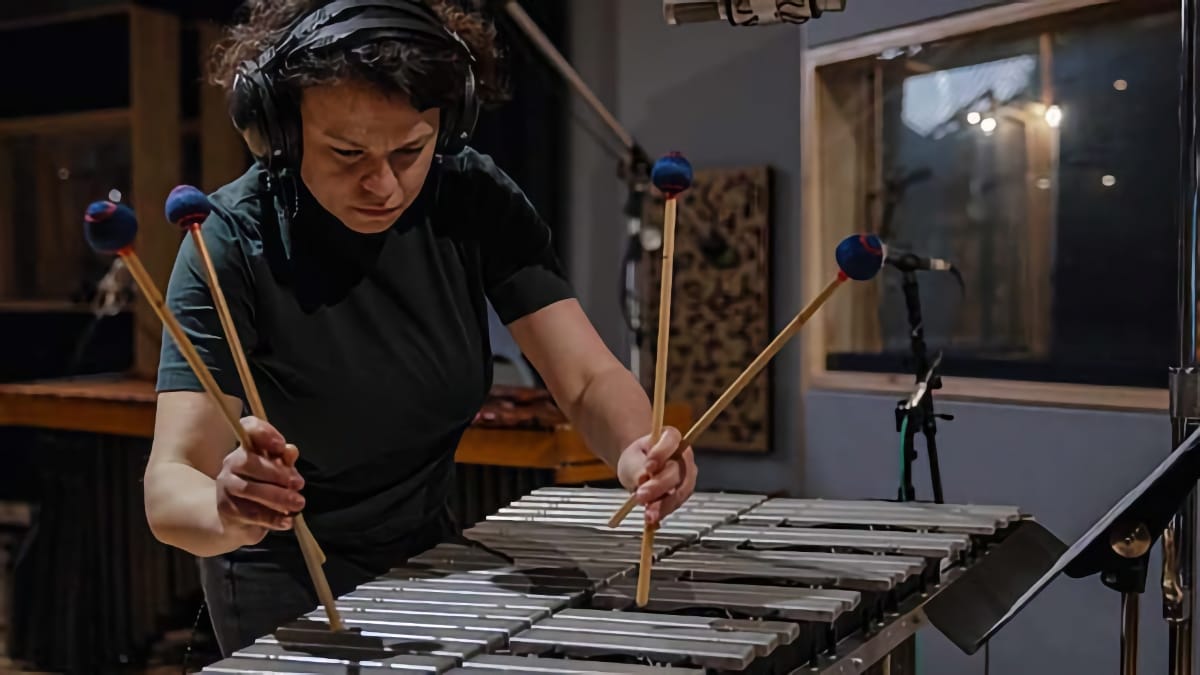
Patricia: I grew up seeing mallet percussion very young. I was always attracted to the vibraphone because it combined two things I love: the harmony and melody of the piano, and the percussive feel of hitting something you get from drumming. Vibraphone and mallet percussion kind of have the best of both worlds.
Lawrence: What about your shift from the precision that's involved in orchestral work to the more openness of improvised music?
Patricia: I always had an itch for improvisation. Before I moved to the States, I got this orchestra job. My position was fifth percussionist, assistant timpanist. Basically, I'm the last percussionist on the line that plays whatever is left—all the toys, like triangle, cymbal, and mallet parts. A lot of the times I was just sitting around, counting measures. I started to really struggle with a lack of that music-making feeling, that connection to music.
A lot of it came from a classical marimbist named Keiko Abe. She's a Japanese marimbist who basically changed the world of classical marimba. One of the main things she does is write her own music, and she improvises her own language during her concerts. For me, I was like, "I want to be like her."
I used to see things as black and white, like classical music lacks freedom, and improvised music is full of freedom. But eventually I started to see more of the common denominators between both.
Lawrence: Is harmony the common denominator?
Patricia: Absolutely. Harmony is one of them. If you really just take a specific example of what jazz harmony is, you can find it in a Bach prelude. But then it's kind of beyond that. It's the freedom of interpretation. Take a really good classical interpreter like Glenn Gould. Glenn Gould was an improviser at heart, playing a through-composed piece. Nobody sounds like Glenn Gould playing Bach because he was playing beyond the notes. He was interpreting the sheet music from a composer-improviser mindset.
Lawrence: Could you explain the system that you refer to and that you employ for this new record, Of The Near And Far?
Patricia: I guess in a nutshell, I'm an amateur astronomer, and I've always been fascinated by the science behind what's beyond. Something that I noticed was just the shapes in the sky, since I was very little. I was like, I see a bunch of triangles everywhere. Everything is connected by a triangle, no matter how I see it.
I noticed, okay, the constellations have a very symmetrical shape. I'm curious whether this symmetry and balance can translate into musical symmetry and balance. That's how this whole thing started: let me find a symmetrical shape in music. The circle of fifths is very symmetrical, a scientific formula in a sense, because you can figure out so many things from the circle of fifths.
It was almost like an experiment: What if I superimpose a constellation over the circle of fifths and see what points get triggered? By points, I mean, if a star aligned with one of the letters of the circle of fifths, okay, that's a pitch that I'm going to consider.
Curiously enough, I think the first one that I did was actually the first track on the record, "Antlia." The combination that I got was literally an E-flat major seven sharp eleven chord. Those were the pitches I got: E-flat, G, B-flat, D, and A. To me, it was like, "Well, this is crazy!" (laughter)
It was in the summer, and my husband and I usually go to a place in Connecticut where I can see the sky, and I bring my telescope. It was just out of my true curiosity. I feel like musicians, we are scientists, too. We're constantly discovering, researching, and trying to find another angle to the twelve notes we deal with every day.
Now I do want to clarify, because I think sometimes in the album's booklet it sounds very intellectual. But for me, this was just a starting point. It was a way to get raw material that would be uninfluenced by any preconceived scale or key signature. I wanted to find another way to get pure collections of pitches determined by the system. I didn't have anything to do with it. I didn't decide it was going to be an E-flat major seven chord. That's literally what I got.
Lawrence: You mentioned the scientific aspect of astronomy, and something that struck me was the romantic or philosophical aspect of astronomy—you're basically looking at the past. You're seeing light that has been traveling here longer than we've existed.
Patricia: Yeah, like billions of years. I mean, that is one of my favorite things: it's a time machine. Looking through the lens, I think this past summer, for the first time, I actually saw the Andromeda Galaxy. It was like, "Oh my God, I'm seeing something that happened many, many, many, many years ago now from this spot on our planet." That's one of the wildest things, which is what makes me want to keep observing. It's a glimpse into the past, and I get to travel in that time machine whenever I look through the lens.
Lawrence: It's interesting, Patricia, because I talk a lot about the time machine aspect of music. All of my records are time machines. It seems you've found one as well. I'm curious how you connect the temporal dimensions of astronomy and music? Could you talk about those symmetries?
Patricia: There's definitely the scientific part of it, which is what I got from the system, the exact science behind the universe. I think of math a lot. This is another thing that I use a lot for writing music. My parents are both engineers, so math was always a way to explain almost everything. My parents would always be like, "You can explain everything with math," and sometimes we have to create new math to explain something we can't yet explain.
The universe is an extension of that, where everything can be explained down to numbers. Numbers, to me, are the key common denominator. Numbers are rhythm to me—it's all rhythm. A lot of the rhythmic structures in my pieces and my compositions come from numerical combinations.
Time and rhythm in music are basically ways of measuring sound in space. It's a system that we use to measure the length of a sound in space. How is that different from thinking as an astrophysicist, to measuring sound in space? It's the same thing.
Another thing that comes to mind is that, back in the day, math, geometry, music, and astronomy were taught together because there were so many common denominators among them.
Pitch in music could also be measured. I remember taking a class in my master's called the Psychology of Music because I was always attracted to the idea: why do we feel sad every time we hear a minor chord? Yes, it's almost like the Pavlovian effect, where we are so used to seeing a sad scene in a movie that comes with a sad sound. Immediately, we make that connection.
But I started to dig down into that too, where it really comes down to the frequencies of each note and how those frequencies resonate with our body. The scientific aspect has to do with that resonance, that particular hertz frequency that that pitch or that combination of pitches has.
I was always really into creating that scientific explanation for why we feel or think these things in music, which we tend to overlook as, "Oh, it's just the magic of music." I'm not saying that magic in music doesn't exist. Absolutely, there are those things that you just can't explain.
Lawrence: I would argue there are lots of those similar things in math as well. You look at something like the golden ratio.
Patricia: How do you explain that? How do you find the golden ratio basically in everything in the universe? This is beyond us, and we can't explain it. Absolutely, and that's where the philosophical and theological aspect of music, of astronomy, of just our way of understanding our place in the universe comes into play.
This record kind of has a bit of both, focusing on some of the scientific aspects. But also, like a song like "Aquarius," I was dealing with something personal that, in a sense, I imagine could be the emotions Ganymede felt when he was kidnapped by Zeus and was basically destined for eternity to serve the gods. I was trying to connect to that feeling of impotence, when you feel like you can't do anything about it, but then at the same time, you still have to stay hopeful. You have to be resilient.
That piece kind of embodied those emotions, even though it came from a scientific design of getting pitches from a constellation. It's a little bit of both in how I see music, but also in this record, how I wrote those pieces.
Lawrence: It's fascinating to observe how you are not only influenced by your parents' musical influences, but also by the engineering and artistic sides.
Patricia: I mean, music is a vehicle of expression, and what am I trying to express? I'm trying to express my perception of the world and my experience, and I'm also using it to figure some things out. The engineering, all that stuff, is part of who I am. To me, it would be almost unnatural not to reflect those things in my music.
Lawrence: Have you spent any time listening to the astronomical recordings that NASA and radio telescopes have made of the sounds of the universe?
Patricia: Yes. Actually, there is the sound of a black hole on the intro of "When You Stare Into the Abyss." I think the first time I got fascinated with this was when I watched the movie Contact. Later on, you learn that all these things are not exactly right. You don't just put on headphones and listen to the universe, because there's no sound in it. You have to find a way to translate those radio waves into sound. But I thought the movie was still awesome. That's one of the things that fascinated me: What does the universe sound like?
Lawrence: Tell me about some of the other influences in this music that might not be obvious—like Radiohead, Soundgarden, and things like that. How do these show up?
Patricia: Radiohead became popular in Mexico when I was about 14 or 15 years old. There was something existential about listening to that music, where those questions of who I am, what I am doing here, where am I going, and what's my purpose in life would arise.
There are some compositional elements. Songs like "No Surprises" have this vibe where you're riding along the highway, and there's no beginning, there's no end. But during that ride, there are all these elements that keep you engaged through the whole song. I was always drawn to how they could do that with very simple elements.
For example, a song like "Aquarius" kind of has that vibe where you start already on the road, and then the road just ends. But the song continues beyond silence. "Aquarius" has a very steady drumbeat for the first half or more. It's a very simple form, also harmonically—it's all triads, like G minor, E-flat, and so on. However, the melody is so different, which makes it a little more complex.
Lawrence: Would you tell me how your process and system manifested on "Andromeda"? It feels like there's so much substance in that piece.
Patricia: My mom is a super fan of Jimi Hendrix, and something I remember a lot from watching him play was the rebel spirit of his music and this sense of just pushing the boundaries and not letting anybody tell you you can't do it. There's that spirit behind that piece.
That piece is loaded with a lot of things. It's a combination of the notes that I got from the system. I got quite a few pitches from that. Then the other aspect was the Greek myth of Andromeda, which is pretty intense. The third element was the fact that the Andromeda Galaxy and our Milky Way Galaxy are going to collide in 4.5 billion years. That collision is imminent.
For example, the ending of "Andromeda," where the music almost feels like it clashes and bursts into a million pieces, is imagery that represents that collision. I wanted the piece to be anxious, tense, and kind of have this rebellious spirit.
That dictated the dense rhythms and layers I used compositionally—almost everybody is playing at all times, the whole time. Towards the end of the piece, one of the electronic layers is literally chatter, like people talking. That was contributing to the story of those movies where you can hear radio stations in space. We're in space, and you hear the ghost of humanity in the background.
Also, the time signature is basically a big five. Sometimes I see people describe the time signatures, and they hear the other layers, like, "Oh, it's in seven," or "It's in four." It's actually in five, but there are multiple polymeric layers: just people playing in seven over the five, in three over the five, in four over the five.
I did that on purpose because to me, that density is kind of what I was envisioning of not only the emotions of the myth, the collision, and also the density that I got out of the system of the constellation. A lot of my writing in general is like that, where there is a purpose for everything, just like when you see a Pollock painting. It looks super dense, but when you really get deeper into it, when you hear his story and his explanation, then it makes a lot of sense why all those things are happening at once.
Lawrence: Tell me about the instrumentation for this album. There's a simplistic framing, like, "Oh, it's a jazz quartet with some strings and some electronics." But that doesn't capture the way the strings are applied.
Patricia: My idea behind the instrumentation—especially coming from my septet record, which is very intense and kind of in-your-face—was to turn the page a little bit and do something different. This whole record, the essence, is inspired by my time as a classical percussionist and giving a nod to all those composers whose pieces I used to play, like Iannis Xenakis, Stockhausen, Edgard Varèse, David Lang, and Steve Mackey.
I wanted to connect with a type of instrumentation that's a bit more common in those circles. For example, they use electric guitar, vibraphone, strings, or electronic elements in a very active way. Also, the drums are interesting because I didn't just ask a drummer. I asked John Hollenbeck, a drummer with a background in percussion. He was also a classical percussionist. He knew about Steve Reich and Philip Glass. He can access both the jazz tradition, but he knows exactly what I'm trying to do here.
Now the string quartet. I didn't want to do the thing where the string quartet is just an addendum. I want to treat the ten people as indispensable elements of the compositional fabric. The quartet is indispensable to each of those pieces. If you take the quartet away in, for example, "Aquarius," the water is gone. They are the water in that piece.
The works for string quartet by Philip Glass were hugely influential for me, because it's more about creating a texture out of the four string instruments rather than the traditional way. Sometimes, each string member becomes a separate instrumentalist in the composition. The strings have two roles: adding to the rhythmic fabric, which is mostly violin one and two, and then viola and cello are adding to the electronic palette. I wrote for them in a way where if you don't pay attention, it might almost sound like an electronic layer, but it's a viola and the cello playing their pattern.
Lawrence: How do you know when to give yourself leeway with your compositional system? Because I would imagine there are times when the system needs help.
Patricia: A lot of the times it was a starting point. For example, "Antlia," the first track of the record, the whole piece is based on that one E-flat major seven sharp eleven chord. That's it. That's the only harmony I'm using there, technically. Sometimes you can be in one key center, you can be in one chord, but you can mess around with what I call gravitational centers within the chord—those overtones, but also even fundamental tone.
Instead of always gravitating towards E-flat, maybe I'm going to gravitate towards a D, maybe towards the A or the B-flat. It changes the perception. It creates the illusion that we're changing the harmony when we're not changing the harmony. That piece does a lot of that, where you do feel a harmonic movement, but it's still the same chord.
I messed around with that in that way, almost like deconstructing it. In that case, I made a conscious choice: I'm just going to limit myself to this chord. Because of that limitation, I was forced to come up with other ways to create nuance in the composition, mostly rhythmic, but also harmonically and melodically, as if seeing this one chord in a prismatic way.
That's an example of really adhering to the system. But then, otherwise, like "Lyra," I really took off from it, partially because that was written a little bit more traditionally, so there are more chord progressions, more counterpoint going on in the strings. I couldn't really limit myself to just the pitches that were in the series that I got.
Having said that, there's a step that I don't mention in the liner notes after the system. I basically try to decipher this information, like, okay, let me do composite scales out of those pitches. Let me do major-minor, all the different triads that I could get out of each single one of those pitches, and come up with different scales. Sometimes I took off a little more than other times, and sometimes I made a conscious decision to stick with it while using other elements to have freedom within that restriction.
Lawrence: Your previous album, Breaking Stretch, was such a well-received record. You don't seem like somebody who was frozen by all that acclaim. You immediately moved into something very ambitious and interesting. What's the experience like on the inside of all that adoration, and how does it impact you?
Patricia: I mean, one thing I would say is I didn't choose this path for the praise or all those things. That helps me a lot because I'm always curious about something, and I just want to write about it and explore it.
Having said that, I don't want to say that I completely ignore those things. I'm still pinching myself over how well that record was received and how grateful I am for all the people who paid attention to it. But at the end of the day, music is an endless road. My husband has a really cool saying, which I think he learned from a teacher: "Music is an ocean, and you're only given one spoon." It's like the universe.
If you're attending Big Ears 2026, be sure not to miss the Patricia Brennan Septet.
Check out more like this:
 Lawrence Peryer
 Lawrence Peryer


Comments