


"Who would even think about a harp? It's the most impractical thing you could ever imagine having any kind of relationship with." Zeena Parkins has been answering that question with her work for more than forty years. Born in Detroit and trained at Bard College, she moved to New York in 1984 and threw herself into its experimental music community. "I was incredibly shy," she has said. "I think that coupled well with being a workaholic. But looking at it from this point of view, I can see those things working together." The harp she brought to that scene was an acoustic instrument; what she built from it, over time, is something else entirely.
Parkins's electric harp sits at the center of her practice. She designed it herself; it was built in stages by a small number of builders and artists, with Douglas Henderson completing the current version in 2003. Unlike the acoustic harp, it has no pedals or levers. The player commits to a fixed tuning before each performance, then builds an evolving chain of effects around it. Her output incorporates field recordings, analog synthesizers, samplers, oscillators, and homemade instruments alongside the two harps. In Alex Ross's 1993 New York Times assessment, she had already "reinvented the harp." The decades since have included tours and recordings with Björk, a long-running collaboration with Ikue Mori as Phantom Orchard (which earned an honorary mention at the Prix Ars Electronica in 2004), and more than ten years touring and recording with Butch Morris in his landmark conductions. A 2019 Guggenheim Fellow, Parkins also received a BAFTA for best interactive media for the project Weightless Animals, with Kaffe Matthews and Mandy McIntosh.
Parkins developed as a composer through sustained work with choreographers. Her deepest partnerships date to the late 1980s: Jennifer Monson, Neil Greenberg, DD Dorvillier, John Jasperse, and Jennifer Lacey, among others. Three Bessie Awards followed. Film scores for Daria Martin, Abigail Child, Cynthia Madansky, and Isabella Rossellini developed in parallel. These works frequently incorporate elaborate speaker-diffusion systems, treating the movement of sound through space as an additional parameter alongside pitch and timbre. She has received commissions from the Whitney Museum, the Tate Modern, Bang on a Can, the Donaueschinger Musiktage, and the Sharjah Art Foundation. Parkins held the Darius Milhaud Chair in Composition at Mills College from 2019 until the school's closure, having taught in its Music Department since 2011. Lament for the Maker, her latest solo record at the time of this interview, takes that loss as its occasion.
Zeena Parkins appeared as a guest on a recent episode of The Tonearm Podcast. Host Lawrence Peryer and Parkins discussed the closure of Mills College and what it meant to her, the origins and ongoing development of her electric harp, her work for dance and how it shaped her thinking about spatial composition, and her upcoming performance at the 2026 edition of the Big Ears Festival.
You can listen to the entire conversation in the audio player below. The transcript has been edited for length, flow, and clarity.
Lawrence Peryer: I wanted to start by talking to you a little bit about Mills College. The situation with Mills has hit home for me in a slightly different way—my oldest son attends California College of the Arts, and they just announced they're closing. There's so much to say about both of these historic Bay Area institutions and the roles they played in twentieth-century and postwar creative fields. Could you talk about the personal nature of that loss for you as an artist and an educator?
Zeena Parkins: Well, first I also want to say that it wasn't just the twentieth century—it definitely moved into the first twenty years of the twenty-first century. I was always impressed by the stamp that all the arts institutions in the Bay Area left on the Bay Area. That includes the San Francisco Art Institute, the California College of the Arts, and Mills—they were a constant feeding into the cultural life and vitality of what was going on there. And I felt it in the time that I was at Mills, which was the last thirteen years, all in the twenty-first century.
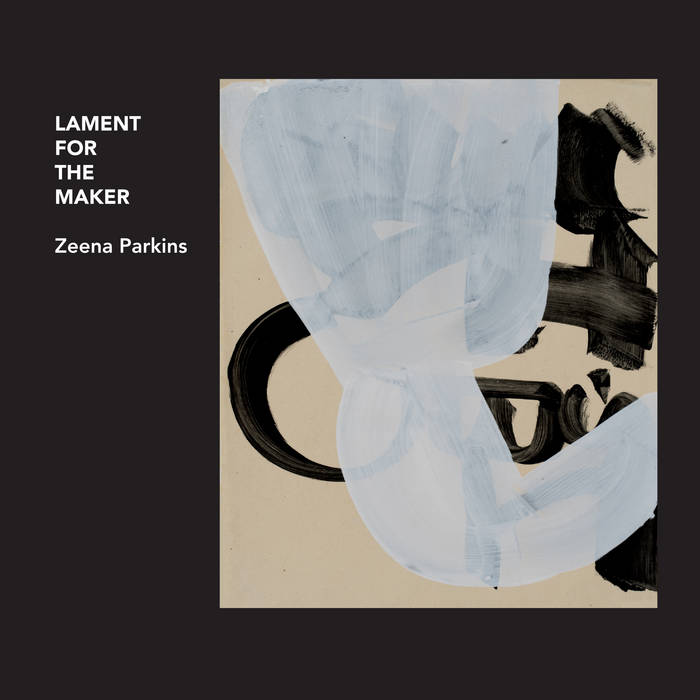
The ending of it is heartbreaking. I describe that in the solo record I just released, Lament for the Maker—this heartbreaking feeling of an ending. Some endings are hard.
Lawrence: This speaks to the fact that, for you, Mills was so much more than just a teaching gig. I'm curious about what you get from being a teacher, spiritually and artistically. What does it nourish for you?
Zeena: When I first started teaching, it was a gig. When I was offered a full-time teaching position—which, who in their right mind would turn down—I turned it down. That was the job at the School of the Museum of Fine Arts in Boston. I was just not ready to be a teacher, and I knew it. And of course, four months later, I got an email from Björk asking if I was interested in playing harp on some of her songs, which led to a three- or four-year collaboration, record-making, and touring. So I definitely made the right decision.
The funny thing is, I was teaching mostly in the graduate program at Mills, and I never went to graduate school. I had a very strained relationship with higher education—I'd never really been interested in it. I was fortunate enough to enter New York in the mid-eighties with an undergraduate degree from Bard, a BFA. And when I entered the scene at that point, I was immediately working with Pauline Oliveros, John Zorn, Elliott Sharp, Fred Frith, and Butch Morris. Why would I go to graduate school?
Lawrence: That is graduate school! (laughter)
Zeena: That is graduate school. And I took every advantage of having, at that moment, a skill set that all these incredible artists could use.
Lawrence: I love the idea of the elder role in our culture—the imparting of experience, the guidance, the mentorship. Could you take me back a little bit to you as a young person approaching Bard? What led you into that world?
Zeena: First of all, I grew up in Detroit. I didn't go to Bard right away—I went to the University of Michigan as a piano major. I actually went to a very important public high school called Cass Technical High School in downtown Detroit. You had to audition to get in, and they assigned orchestral instruments to all the pianists because they felt sorry for us, alone in our practice rooms. So I was assigned an instrument. I had nothing to do with the choice, but I went to room 101 annex on the first day of school, opened the door, and there were eight concert grand harps—and a woman named Velma Froude, a very old-fashioned but extraordinary pedagogue of classical harp training. I fell in love with the harp immediately. I was also dancing a lot and studying piano.
Things are very different now, but in those days, the University of Michigan was very much a Juilliard-wannabe kind of department. The world was closing in, not expanding. After two years, I was done. I ended up at Bard, which was great for letting me do what I wanted. Also, the incredible film department was hugely influential—experimental film was a major new batch of input that I had no idea about before.
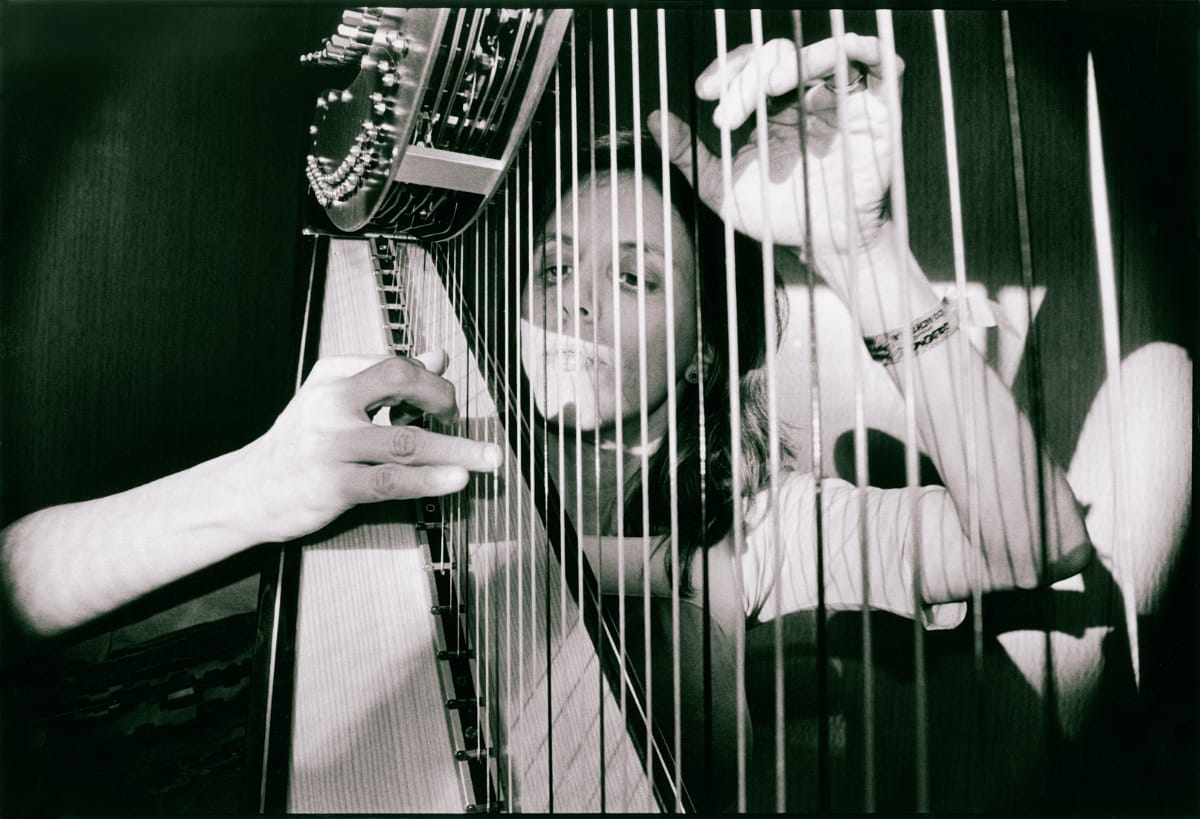
Lawrence: Your relationship with the electric harp is fascinating to me because there's nothing static about it. It seems like a very living, breathing, ongoing refinement. What's happening there?
Zeena: Okay, so you have to understand—I didn’t move to New York right after Bard. I wasn't quite sure how I was going to interface with New York, because I didn't have a harp. Long story short, I ended up joining a theater troupe—a kind of circus theater group—called the Janus Circus, which started as a school project with a friend of mine.
Lawrence: Sounds very Bard. (laughter)
Zeena: Very Bard. This troupe ended up going to Europe for six months to do theater performances for elementary schools in the Netherlands. My role was costume designer—and I was also a dancing bear who jumped through a ring of fire and played accordion. But there was also a circus band, and in that band was the drummer Chris Cutler. We became friends. At some point, in Ljubljana, on a walk, he said, "I'm looking for a harpist to do a project." He had no idea I played harp.
Lawrence: Wow.
Zeena: It's just one of those unexplainable things. That was a bit of a turning point. At first, I couldn’t really believe Chris was going to hire me to play harp on a project with Dagmar Krause, Robert Wyatt, and all these incredible people. But it happened. That was News from Babel, and we ended up making two records.
As soon as that European tour was over, I had all I needed to go back to playing harp. I ended up moving back to Detroit, finding a teacher—Marilyn Bartlett, an extraordinary harpist who was the harpist of the Detroit Symphony Orchestra. I studied two lessons a week with her, spent eight or nine months just playing constantly to get back to it. I ended up working at a company that published harp music, Lyra International, which also sold harps, including the Venus Harp. I worked during the day, and they would let me practice in their showroom in the evenings. Everything was lining up. Eventually, I got a pedal harp and started working with all the people I now work with.
In New York, I was very interested in using the harp as an improviser. I would bring my harps to all these various little tiny clubs in the East Village. What I noticed was that the harp is a quiet instrument, and I was often playing with electric guitarists, trombone players, or drummers, so you really couldn't hear it. It wasn't designed to hold its own against that kind of volume or dynamic. So I tried a bunch of different ways to make the harp louder—various little pickups and amplifications. It was all inadequate. The sound became tinny; none of the solutions were working.
When I joined Skeleton Crew with Tom Cora and Fred Frith, they really wanted me to play harp, but it was clear we weren't going to tour with an acoustic harp. It was with Tom that I figured out I needed to make an electric instrument. And in the mid- to late eighties, you couldn't just go buy an electric harp. There was no place to get one. So Tom and a friend banged out a prototype, and I started playing it. As primitive as that instrument was, this idea could work.
Then we went to Ken Parker, a guitar maker who recently passed away, who also made pickups. We came to him with the idea of making a real instrument, and he was totally into it. He made me my first real electric harp in twenty hours—we just went to his house in Connecticut and stayed while he worked on it. He would ask me questions, and I told him I wanted a whammy bar on it. And it was the right decision, obviously. He figured out how to put one on. That first one went through a number of changes, and it became my project from there: how do we make this a better instrument? What can I do with it? But that was the beginning, and it was made out of necessity. I needed to not be the softest person in the room.
Lawrence: Were there really no electric harps at that point?
Zeena: I'm sure I wasn't the first, but no. I think it was on the precipice of being a thing, but it wasn't quite there yet. Now you can get beautiful ones—Camac made one of the first beautiful electroacoustic harps, with real attention to quality. They endorsed me using their harp for all the Björk tours I did, and eventually they gifted me one. But at the time, we looked around, and we couldn't find one.
Lawrence: How do you view the limitations of the harp, and how do those limitations actually serve as catalysts? Most artists I speak with, regardless of their medium, are entranced by the idea of limitation. What limitations of the harp are actually exciting?
Zeena: The acoustic harp and my particular electric harp are very different beasts, for one thing. I've been entranced by what I would call certain impossibilities of the instrument: playing chromatically, because of the way the harp is designed; sustaining a tone, because you pluck it and then it decays unless you use a bow of some kind; doing any kind of smooth shifting from one pitch to another in a gliding way. These kinds of playing are not naturally available with an acoustic instrument. I've been intrigued by those limitations—digging into them to find out what it would mean to try to do something that isn’t easy, or perhaps even impossible, and asking what that would generate.
The electric harp is a whole different thing, because it doesn't have flexible tuning. There are no pedals, no levers to sharpen by a half step. It is what it is. You tune in the pitches, and that's your fixed tuning for a show. So you can focus on other things—textures, rhythms, whatever peculiar tuning you want to put into it, which will be your tuning for either a piece or a set. It becomes more like modular synthesis, almost: you put together different kinds of pedals that are going to change the sound, you see how those pedals interact, and you see how that affects the instrument. It becomes a completely different experience as a player.
And again, I had this instrument made and then had to figure out what it could do. One of the huge upgrades to the electric harp happened when a friend of mine, the sound artist Doug Henderson—not an instrument builder by trade, but someone who knows materials and is an excellent maker—suggested that adding ebony to one part of the harp would completely change what's possible. Ebony is an extremely hard wood, and that change was profound. Just understanding what a difference in material is going to make—not only its moisture content and all the things instrument builders think about, but also the ergonomics: how we had to alter the shape of the instrument to make sure I could get my hands in there and do what I need to do, making it as light as possible so I'm not hauling a ton of weight through the Frankfurt airport. Even a change in the type of wood opens up an entirely new playing experience and a whole new range of possibilities.
Lawrence: It seems endlessly fascinating.
Zeena: I'm enjoying it. (laughter) I think it's a magic instrument, the one that got made. Every time I think I've reached a limit, it's an interesting moment to see what happens on the other side of that limit.
I think of repertoire much more with my acoustic harp these days. The electric harp—I make pieces for it—but I think of it as an instrument for an improviser. And it's a very different outcome. I don't want to think about the repertoire of the electric harp because there's only one, so who's going to play it? But that's something I've been thinking about recently—the pieces I'm making that could possibly be played by others besides myself at some point.
Lawrence: I'm also intrigued by your compositional work for dance. How does composing for movement differ?
Zeena: When I came to New York, one of the first pieces I did with John Zorn was a game piece called "Dark"—a piece for dancers and musicians. We did it at the Sculpture Center at MoMA.
Lawrence: Not a bad early gig.
Zeena: One of my first! That's when I began to understand, “Oh, there is a really interesting scene of experimental movers.” Because I had danced, and I had also danced at Bard, I knew I wasn't going to be a professional dancer. But I was attracted to movement, and especially watching bodies move. I ended up falling in with a group of people who were improvising, and we started something at P.S. 122—which doesn't exist anymore—called Music Dance. It was an informal gathering on Saturday mornings where dancers and musicians would get together to improvise and talk about how we were communicating with each other. Not toward a performance, but as a kind of workshop. We did that for several years.
That was my entrée into understanding this community. I ended up working quite closely with several choreographers, and one of the most important was Jennifer Monson. When we started working together, we were both improvisers; eventually, she became a choreographer, and I became a composer. And remember, I hadn't really composed before I moved to New York, so all this was new. My training to become a composer came through this work with choreographers—first as an improviser, and then eventually as a composer setting material. There are topics for various pieces, and you work together to find the best solutions for those topics.
And it wouldn't have happened in some random way, with just any dancers or any choreographer—it's because of these particular people that I work with: Jennifer Lacey, Jennifer Monson, Neil Greenberg, Stéphane Dier. These were hugely important in helping me understand my own musical language and in supporting that. It was really in this dance world that I was able to understand how to be a composer. And eventually, my interest in watching dancers move and responding to that compositionally emerged as an interest in sound moving. So I also became interested in multi-speaker diffusion in the context of making compositions for dance. That became an important aspect of my work—and a particularly important aspect of my scores for dance.
Lawrence: What's the collaborative process like with a choreographer? Is it like film, where you watch the dance silently and then create a score?
Zeena: No, because we're making it together from scratch. I'm not adding music to something that's already been made. In film, you do more of that—you get the final edit and work from there. That's not how I worked with dance. We would go on residencies and really make it together. Try things, see what works, figure out the orchestration and goals, then work together to realize them. For me, it wouldn't have worked to make music for something already finished—I probably wouldn't have known what to do. I had to be in from the very beginning, understanding what I was making sound for, having time to experiment, having discussions, seeing what worked and what didn't.
And then the luxury of working with dance is that you get multiple performances. You don't have to make it perfect for this one performance, and that's it. By hearing something performed numerous times and seeing how it works, you understand something about the piece that you can't possibly understand from a rehearsal, and you can't possibly understand from just a single performance. That part of the process of making was hugely important.
Lawrence: How many performances does it usually take before you feel like it's locked?
Zeena: Usually, you get three or four performances—you get to see it—and then it goes on tour. By that point, it's probably pretty settled; we know what it is. And then you have your good days and your bad days.
Lawrence: This interview will be published right before this year’s Big Ears Festival. What can we expect from what you're presenting there?
Zeena: I'm doing Modesty of the Magic Thing with William Winant. I just love playing that piece so much. We premiered it on the West Coast at Other Minds Festival, and we premiered it on the East Coast at the Paula Cooper Gallery while they were showing Jay DeFeo's last ten years of work—paintings that had never been seen in New York before. The specific paintings or drawings referred to in the work weren't there, but there was an incredible synergy between everything in that room. We'll do it at Roulette just before Big Ears, and then take it to Big Ears. I'm super excited.
Lawrence: When I was preparing, I found there's so much work to reckon with. We didn't get to talk about Lace.
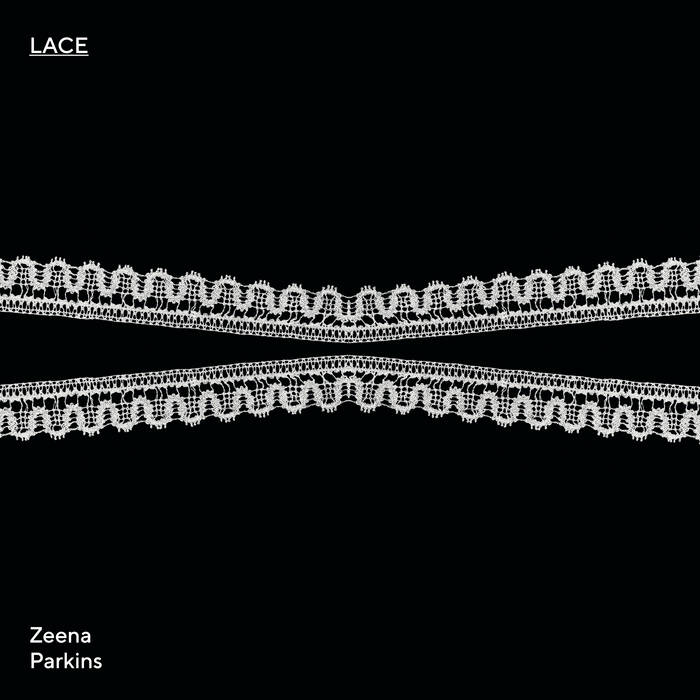
Zeena: I know. It's hard to pick what to focus on. The interesting thing about Lace is that it started again out of necessity—to have a score to use with a group of improvisers. I was invited to do something at the Merce Cunningham Dance Studio, and it wasn't going to be a piece for dancers. They were just presenting music in their studio—a series called Music Mondays—and I'd been invited to be part of it. My group was George Lewis, John King, and Fast Forward, the percussionist. And I was in a quandary about what to do for these incredible improvisers.
Because I had done a lot of sewing in the past, I had fabric scraps, and I happened to have five pieces of lace. I ended up—who knows why one gets an idea for something—slapping them on a board as if they were five short movements and making a set of conditions for reading them as an improviser. I had no idea if this was going to work. It happened to work, and it began a series of movements based on this idea—one that continues to this day, actually. When I say it worked, I mean it activated the improvisers to work together with something that had a kind of identity, a quality you could relate back to what the images were.
Lawrence: What are the artistic questions you're starting to ask yourself about what's next?
Zeena: Oh, I'm already in the midst of things. I'm working on a new acoustic harp project that uses a new system in Max, which I'll be improvising with. It's sort of an acoustic-electric project, and it will also have a visual component—something I've never done before. I want to record it by the end of this year. I'm also making a new electric harp record, inspired by some of the work of Daphne Oram, the electronic musician who worked at the BBC. And I'm writing a piece for my sisters, who are in the Eclipse Quartet in California—a piece for the Eclipse Quartet and acoustic harp in four channels. I have a lot on my plate—but that's what happens when you're not teaching.
Check out more like this:
 khagan aslanov
 Lawrence Peryer


Comments