


What is ambient? It doesn't matter. I might start making the argument for 'postmodern pastoral' as a listening genre (thank you, Ben Seretan, for that, and M. Sage for contributions in pastoral jazz), which is what happens when one leaves a city to return to the land. In this case, it is the two hilarious musicians behind Sunbeam Of No Illusion who spent time in Brooklyn, never crossing paths, then leaving for the Hudson Valley and crossing paths so hard we have a record. A very good record.
There's buddy comedy energy here. Seretan and John Thayer may be as privately prolific in output as Hall and Oates or Simon and Garfunkel. The friends have moved ten minutes apart, referencing one another as Whitman and Emerson. Seretan hammering on a Rhodes and Thayer tending to a series of racked hardware mishaps which provide the fuzz and pulses of this record. There may even be ghosts in the house.
Even as I edit this piece, for some reason, the grammatical suggestion for 'ambient' is to strike the word and use "the surroundings." As listeners, we are pulled through dense forests, Catskill foothill streams, and concrete reminders that humans will clear-cut wilderness and slather it in A-1 sauce—namely, a 1970s steakhouse that burned down in the Valley.
"There is no such thing as field recording," they proudly proclaim for Sunbeam Of No Illusion. This document is an exercise in minimalism. Here, the pair have learned that the greatest sculptor is restraint. It's Seretan leaning on the Rhodes pedal until the sound fades; it's Thayer with his borrowed-from-the-literary-realm missive, "murder your darlings."
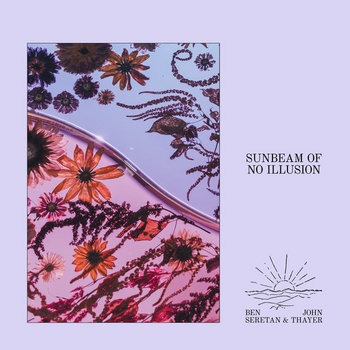
Carolyn Zaldivar Snow: So, who is the English major that wrote the liner notes? Who, in your opinion, is the Emerson and who is the Whitman of the pair?
Ben Seretan: It's kind of a cop-out answer, but I do feel like it changes based on what we're up to. I would never use the word "whimsical" to describe John, but in the studio, he moves so fluidly and is so quick with ideas that I feel like he's kind of like the studio Whitman. Probably in our daily life, John is the more studious and practiced of the two of us, and I'm more Dionysian in my day-to-day.
John Thayer: I think that's probably an apt description. I spend so much of my day in the studio that it's kind of like fish and water. It's like a natural habitat for me. That's where I feel most seamless and fluid in my life. The rest of life is a bit of a navigation. These were both really interesting, eccentric, creative guys who kind of broke the mold at a time when it was harder to do. I think Ben and I are both very interested in new ideas or learning about new things.
Carolyn: Let's talk about being out in the field. What draws you to a sound or a moment? You mention in your notes that all things are field recordings.
Ben: The first thing that comes to mind is hearing things that are novel or unexpected, at strange times or rare sounds. The defrosting happening right now in our part of the world makes the creek between my house and my neighbor’s go loud. You can measure how much melt is happening based on the decibels of the creek. I think it's so cool that it's a translation of a natural phenomenon; it's a rare thing. I got out of the car last night when we got back from this trip we were on and heard that, and was like, “Ah . . . information.”
That happened so often when we were making this record, where the [Lexicon] Prime Time unit would do something completely unexpected and create a rhythm that we hadn't anticipated. Or there'd be signal noise we, in a more traditional recording, might have spent hours trying to patch and eliminate, but here we amplified it and made it a featured thing. I think my ears just want to be tickled, you know.
Carolyn: When you got home, and you heard the creek, did you actually approach the creek to document that, or did you just kind of accept that sound in real time?
Ben: I accepted it, cherished it, and then let it pass, which I think is an important part of listening.
John: Yeah, not everything needs to be preserved. Sometimes I go through these field recordings, and if I don't say at the beginning of making it, “I am here today doing this,” I'm like, where the fuck is that? It's another river, it's another lake, you know, a shoreline.
I got to be pretty studious working as an engineer for other people. It forces me to be into my data and organized mind, because it can be so catastrophic if I’m not. And so I'm organized about my archive of field recordings, but I also subscribe to the rules of creativity that John Cage was a big proponent of. One of them is not to create and analyze simultaneously—they're separate processes. I think that is something that really played a role in our record—it would be like, “We’re gonna just roll.” You go to the patch bay, and you patch the wrong thing, and instead of being like, “Oh, I'm wrong, let me fix it,” you're like, “Well, this is the direction it's taken.” New ideas open up, and God, that's been so creatively satisfying for me. I've learned to be comfortable in that feeling of making a mistake and not being like, “You've been engineering for twenty years. Why don't you know how to patch the outs over ins, idiot?” It's a playful attitude to being in the zone in the moment of creation.

Carolyn: So here's a basic question: how long have you known each other? How did you meet?
Ben: We met because I was doing sound for John's partner, Lea Thomas, a great songwriter. She was performing at a venue where I occasionally did sound, and we just hit it off with the two of them. It turns out John had mastered one of my best friends' records, and we had a bunch of folks in common. At the time, John and Lea were maybe, like, ninety minutes from where I live now, and we hung out a few times. Then they moved ten minutes away, and we're now quite close in geography, so I see them a bunch.
John: Ben and I both lived in Brooklyn for many years, and we somehow never intersected there. Moving upstate, now living in the Catskill region, it's a smaller community. We play at this club called Avalon Lounge all the time, which I always describe as part community center, part venue. You show up for people's release shows, and you participate. Ben is definitely a community leader. Ben introduced me to a lot of people when I moved to the area, which I'm grateful for. I'm enjoying my small-town life right now.
Carolyn: I think your record also does a really good job of giving me a sonified story of your landscape and surroundings. I was thinking about the idea of a stone tape. It’s the concept that physical materials hold sounds, and that ghosts might actually just be signal flow. I was reminded of that as I listened to Sunbeam Of No Illusion.
Ben: I think about something similar all the time. [Guglielmo] Marconi, who invented radio technology, had this theory that sound never fully dissipated. It just got quieter and quieter, becoming infinitesimally closer to silence, but never fully dissipated. If you had instruments sensitive enough, you could actually go back in time through sound and hear what happened generations ago. I've always thought that was a cool explanation for ghostly presence and energy. I think about that sometimes, particularly when you walk into a space with a lot of history, it feels like something's happening. I imagine these vibrations settling in the corners.
Carolyn: Do you feel a connection to that history, or do you accept the space you work in as is, or does that add to it? I guess I'm hammering on the fact that you mentioned ghosts in your press release. I always think that's a fun thing to talk about, whether it's a metaphor or something you're actually experiencing.
John: I live in this old house from the 1800s, and I've been alone in it a few times. I'm always trying to be in conversation [with the ghosts], but they redid the shit out of this house—they really did a number on it before I moved in. Undoubtedly, energy is in the area. Not that a ghost has to be scary, but I've never felt anything malicious in the house. In fact, I feel very inspired where I live right now—creative and dialed in.
Ben: Some parts of the Hudson Valley have not rebounded from the ravages of the 20th century, yet, and that's where I see a lot of ghosts. I'll be out for a walk near my house or whatever, and you'll just stumble upon a stone wall that's ruined—who knows where it came from. It's not marked with a plaque or anything. So you can kind of only assume who put it there and what their life was like. I feel like that kind of thing happens all the time with 19th-century relics, which was the mood setting we did for this record. But then there’s also the 20th century. Right down the road from my house, there's a big empty parking lot where a steakhouse burned down in the 1970s. People have lived here for so long. I’m the steward at the moment of this place, and there will be many more after me, and many came before.
Carolyn: Which track do you feel most represents your collaboration and creative partnership with one another? What would be the calling card for that?
John: I would say "Valley Spirit," because Ben has such a wonderful sense of melody, and it's engaging without being showy. I play with so many great musicians, and sometimes they just can't turn it off. My background is in drums and percussion. I have a very remedial composition style, but it's very set. Ben has all that theory, but he's not bound by it. I like working with simple melodic fragments. I'm a real sucker for melody. I think it's absent in the genre if you want to call this an ambient record.
Ben: Carolyn, have you seen the clip of Angelo Badalamenti explaining how he composed “Laura Palmer’s Theme” for Twin Peaks?
Carolyn: No! Somehow, I feel like I have committed a crime.
Ben: It's one of the greatest videos I've ever seen. Basically, he's describing, “I was thinking this thing for Laura's theme,” and then David Lynch is over his shoulder, being like, “More! More!” And it's funny, because I do feel like we got into that dynamic a little bit.
Most of these songs started with me at John's Rhodes, playing something, looking for something, improvising. He is fond of giving one note—'nothing heroic.' I always want to make big resolutions and do things that are stirring. John is like, “No, tamp that down.” We found this useful middle ground where the melodies are simple, but they're honed. They're effective, and there's not a lot of ornamentation in the playing. It's calm and serene.
My piano playing has evolved to where I always have the sustain pedal on at all times when I'm playing in this way. What that does is also teach me a certain amount of patience. If you have the sustain on, you have to wait for the chords to die out naturally before you can make your next move. The harmonic sequence is informing you where to go and have it still sound good. With that approach, and then John's editorial production, we were able to really get into building the right support for these lines and chords.
It's funny that we called that one "Valley Spirit." I'm realizing how literal that title is, but it has this thing where the track actually has seasons, and as it moves, you can hear it change, and it has this really beautiful coda at the end. I just feel like we captured a time-lapse photograph of a whole year in our place with this track. I think that might be our closest approximation of the Hudson Valley.
Carolyn: Something I've been contemplating is, how do you know when it's safe to work with someone? When do you feel creatively comfortable to engage with someone over a long period of time, and trust that project with one another?
Ben: John and Lea were both so inviting as people. When I first met them, I felt I could trust them almost immediately. I've played guitar in Lea's live band as well. She's a great bandleader. John is very quick to try things in the studio; he's fluid and in his element, willing to try things as they happen, and also willing to kill things when they don’t. We have the safety net of just trying anything. This record leaped out of the collaboration.
John: I've worked with a lot of people as an engineer, a producer, a mix engineer, or all of the above. I'm more cautious about collaboration, because I know what it takes to get the record somewhere I'm proud of. I mean, we are in the music business, so to speak. We have to deliver a cohesive project that makes sense and is well thought out and all that stuff. Sometimes it just won’t land, and it has to live on a hard drive forever.
I think about all these things as I get older, because I've been in tons of bands full of conflict—and maybe the conflict fueled some sort of creativity. I'm too old to want to be in conflict with anybody at this point. That's not really the creative, fiery collaboration I'm looking for anymore. I tend to look for people in areas where I lack, and that is where I have put my energy. I love to work with virtuosic musicians, or people who have an incredible sense of melody, like Ben, who's a real polymath.
I’ve got a lot of friends upstate that I don't want to make records with, and that's not a diss on them. It's just to say that I'm not sure that would yield anything of fruition, and it would be like a big lift for me to try to get something to the finish line. Whereas this record, this is probably the least amount of time spent mixing, and certainly the least amount of time spent tracking that I've ever had on a record. Sometimes, a very unadulterated mix presents the song in its clearest light. It took me years to understand that.
Ben: John has also played drums in my rock band on quite a few occasions. We've gone the complete other direction in collaborations as well, and played, like, just the stupidest and noisiest stuff. I feel like we had to do some of that in order to get to this point. There is actually one moment on the record where John is literally playing no drums. Like, it's the sound of him not hitting a cymbal. The absence is, like, really profound.
John: I busted out these brushes to play, and I was just swishing them. They're made of grass bundles. I like to make natural elements part of my percussion rig. I have these shaker brushes that I made from just my garden. Lea grows these beautiful Japanese grasses, and at the end of the year, we trim them back to keep them warm in the winter. I bundled them up and turned them into drumsticks. We both just looked at each other as I was shaking these things, like, “That’s actually getting a lot of the cymbal.” That kind of thing—the willingness to be like, “Let's try it. If we don't like it tomorrow, we'll just get rid of it. Who cares?”


A selection of John Thayer's percussion devices.
Carolyn: I always love the debate about drums in ambient music, if you want to chime in.
John: I've been living through an existential crisis for almost a decade because I started playing drums when I was five. I'm 42. I've made ambient music for about ten years now. It took me a long time to understand ways to incorporate percussive ideas. It doesn't need to be a drum with a metal ring that's tuned with a drum key. There are a few times when I caught little loops with some of my delays, and they became the drum part, so to speak, of the song. It doesn't require a drum per se, but it gives you the chance to sink into tempo.
I think as human beings we relate to the repetitive nature, and that is essentially what the drum’s original point was—trance induction. People would just play drums in a ceremony. I do think our brains are wired to latch on when we hear the same thing over and over. So I’m all about using those techniques in ambient music.
I love Jon Hassell, and I think Hassell's music is often ambient, but also a world-infused sound. That's how I've made my peace with being a drummer—I've moved into the more percussive realm. “You don't have to play jazz drums on this ambient track, dude. You can just make some grass shakers and play those.”
Ben: You know, Music for Airports has hecka vibraphones on it. Vibraphones are fairly percussive. I think rhythm can be really enchanting and intoxicating. It's funny, my buddies The Early just put out a record on Island House Records. They did a show in our town recently, and drums are a big part of their sound. They’re often called ambient music, even though it is obviously jazz to my ears. I was thinking about that while listening to them. It's a duo, and they'll have drums in one groove and the guitar in another, and they're kind of competing for your ears' attention. It makes this beautiful, hypnotic stew. And yeah, I think drums do have a place in ambient music. That's it, I'm saying it.
John: That's the lead quote right there. There it is.
Carolyn: Done. Scratch this entire interview. If I could just get pictures of you guys posing in front of a couple of drum kits, I'll call this in.
Ben: But where would ambient be without gongs?
Carolyn: I mean, that's a good point. I'm letting my bias show, but I'm a little exhausted from the prevalence of modern sound baths.
John: I have friends who are like, “Don't say my music's ambient.” There's a group called StretchMetal that hosts an overnight drone sleepover, and they call it the Atmospheric Music Alliance. I think atmospheric music is a nice term; it's a little bit more broad and maybe a little less charged, but I just don't worry about that kind of stuff. As long as people are listening, I don't really care what they call it.
Carolyn: How do you know the work is done? When did you know it was okay to put this record to bed and say, “This is what we’re putting out into the world,” and stand by it?
John: I think that just comes with experience. I say to people all the time that a song can be many things, but it cannot be all things. You can't put your whole life in it. So the more focused an album can be, the better it is. The better it is for the listener and the artist to be in communion and conversation with each other, because they don't know your backstory. Maybe it doesn't matter. Maybe it does, but they're just going to hear the music first before they learn anything more about the record, you know.
As a writer, I'm sure you know "murder your darlings.” I say that to people all the time in the studio. I'm like, “That's cool. That's a good sound. That doesn't make the song better. So let's just put it over here.” I ask myself, ego aside, “Is it better now, or is it not? How do I feel as a listener, as an objective listener? Am I more moved or less moved?”
Ben: I'm interested in records serving as a docent of a time, a practice, a phenomenon—something along those lines. If you look at my catalog, even as a songwriter, I have a 24-hour record I made over three nights. I have an album that I made with a rock band in a very tight recording window, in like two and a half days in Italy. I like there to be somewhat arbitrary parameters to make it feel more like a snapshot, and there is an element of that in this project.
I realized something as John was addressing the question: I think that if you're doing work honestly, it tells you when it's ready. You understand when the different periods of the work are no longer useful to you. I'm almost nostalgic for when we had this project in its first stage, because by the time the record comes out, it’ll be fairly final, and it'll have a life as people continue to hear it. It'll be so altered in people's ears. When the actual plastic arrives, it will take on its own form.
Carolyn: Is there anything you wish somebody would ask you that they haven't?
Ben: You know this is a very minor thing, but I don't think anybody's asked us. The title of the first song is "++ (Double Positive)". Basically, John and I were talking shit on 1970s machismo sculptural minimalism, because that's in our world in the Hudson Valley. My wife is a sculptor, so she has a lot of opinions about macho sculptors. There's the Michael Heizer piece, Double Negative. Are you familiar with that piece?
Carolyn: I want to say I am, but I was thinking of the Low record, Double Negative.
Ben: For the Heizer piece, it's basically two giant holes on the ground. You have to travel seventy-five miles off-road to get there. It's a giant land art piece. I love Michael Heizer's work, but I have to admit it's easy to talk shit on. I think John and I were like, “We want to make something that's not two holes in the ground. We want to make something that's like the opposite of that. We don't want to make people travel or go through long lengths to get to the beautiful thing.” So the opposite of double negative is double positive.
Check out more like this:
 Lawrence Peryer
 Carolyn Zaldivar Snow


Comments