


Here's the life of Rex Brasher in brass tacks. Born in 1869 in Brooklyn, he had, by age eight, embarked on a self-imposed rivalry, resolving to surpass John James Audubon as the premier ornithologist and painter of birds of North America. He then set out on a long and winding journey across the States, funding his travels through hard labour, odd jobs, and gambling. Twice during that time, he destroyed his research and paintings because he deemed them imperfect. Eventually, he settled on a farm, where he completed his life's work: over 800 paintings of birds and botanical subjects, cementing his status as a pioneer of self-driven research and, perhaps unwittingly, documenting the march of climate change and habitat loss of the American bird. He died in 1960, on that farm, in relative solitude.
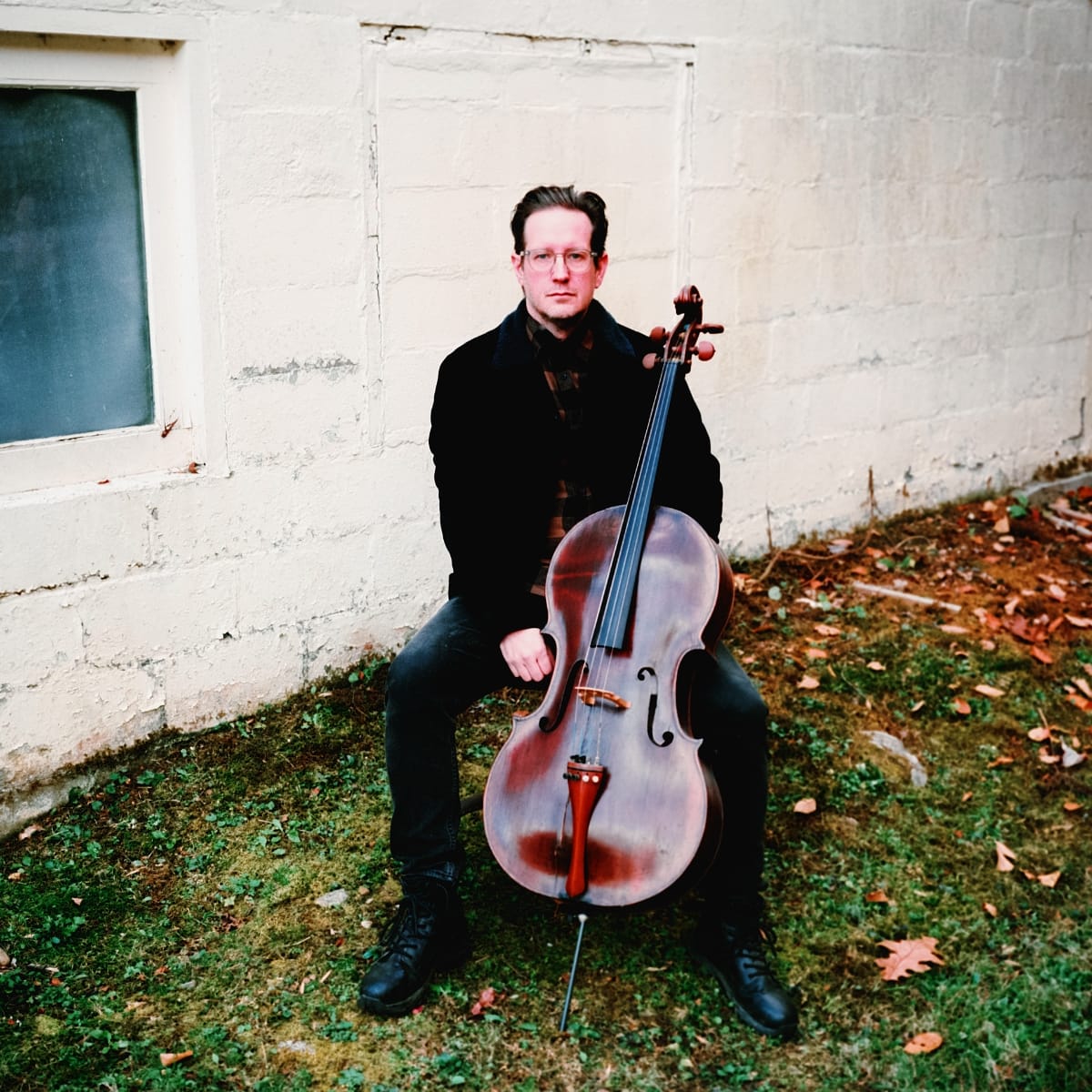
If all this sounds like a plot to a Modernist Gothic novel by Harry Crews or Cormac McCarthy, then it is only the first act, which culminates with the entrance of experimental cellist Christopher Hoffman, who, in 2023, abandoned New York City for a much more rustic stream of life, moving to Brasher's old home in Wassaic, NY, on the state line with Connecticut.
The composer, improviser, and filmmaker has spent his career on a through-line, both in the ubiquity of the mainstream as well as in the trenches of fringe art. He has led many variations of his groups, collaborated with Marianne Faithfull and Yoko Ono, re-arranged Mahler for a film by Martin Scorsese, and, in 2016, won a Pulitzer Prize alongside Henry Threadgill's Zooid ensemble. He's written, directed, and scored several short films, and his name figures in the liner notes of countless albums.
This all brings us to REX, the record Hoffman released earlier this month. A collection of short solo cello pieces that tip their hat to both Brasher and the avant-garde tradition, REX is a heart-rending showcase of dizzying virtuosity and improvisational brio, a learned compendium of Hoffman's own life's pursuit.
Khagan Aslanov: This album is your first truly solo undertaking. Why this particular moment?
Christopher Hoffman: I was spending a lot of time here by myself, practicing. It was a year into living here. I was checking out Brasher's artwork and thinking about him. And I kept thinking, well, he did all this incredible work on the property, maybe it was time for me to get myself together and make something as well. Making a solo record had been on my mind. I wanted something that was specific to me. All the pieces are constructed so I can play them live; I overdubbed them with certain fidelity in mind. There are obviously layers and many parts happening, but it is technically a solo record.
Arguably, a historic home isn't the only connective tissue between Hoffman and Brasher, and as these things usually go, the two may have more in common than first appears – after all, a naturalist is seeking, by the definition of the word, something that closely ties them with an improvisational composer.
But solitude in nature is never actual solitude, not in the common verity of what that may mean in the tech age. Rather, it is a chance to confer with the world as it was, even if that is really just a faded view. And so REX does feel like an extended reconciliation – of time, placement, and art. What Hoffman does here is take this uninterrupted flow of bucolic visuals and frequencies, pair it with Brasher's own legacy of naturalism, and from that aggregate, extracts a beatific collection of sound, as meditative as it can be disruptive.
Khagan: When you set out to make something like this, does a tangible finish line start forming at some point? How do you end a record like REX?
Christopher: It's practical. I'm thinking so much about Brasher, and already titling the pieces. Basically, when I have a big enough pool of material, then I start thinking about the pieces more critically. I'll focus in and change some things. I know I'll cut a few. It's always interesting how some pieces seem to connect best at the beginning of the process, but by the end, I'm more aligned with the other ones.
Khagan: And the pieces that don't make the cull? Do you come back to them? Do these progressions make their way into other projects, or do you just leave them?
Christopher: I usually leave them. Whether solo or in an ensemble, these pieces are heavily dependent on the time, people, and context they were made within. So I don't tend to pull old music into new projects. I doubt anything I did for REX would cross over well.
Brasher did end up usurping Audubon, at least in the clarity and pureness of his paintings, which, despite their flawed anatomy, captured birds in their natural poses, and not the performative 'operatic' slants that Audubon granted them.
On REX, Hoffman manages to strike a fault line right down the middle between these two approaches. There's an immaculate architectural touch that sits within these pieces, yet they aren't overly manicured or hermetic. The feral, unpredictable momentum of free-form music is plaited into their bones.
Khagan: How much of this work is composed, and how much is improvised?
Christopher: Most every piece has a melodic theme, but the rest of it is solos, so the bulk of the record is improvised. Whenever it sounds like there is an extended cello playing, that is all improvisation. And so it will sound different every time it's performed. You leave enough room so the pieces can shift into different directions, whether that's more aggression or something else.
Khagan: I imagine when you take this record on the road, you will be renting or borrowing cellos. It's a consistent frustration for musicians, I think, to adjust to any given instrument's kinks. To your own discerning ear, if it doesn't sound right, then it isn't.
Christopher: Renting acoustic cellos is always a game of roulette. It's a blessing when you get a very nice instrument. But most times, it's not optimal. You can have a moment of complaint, sure, but you don't communicate that to the audience. No one wants to hear an artist suffering on a shitty instrument (laughs).
Just as Brasher's daily existence and life's work represent a crucial presence in 20th-century Americana, so does Hoffman's record usher in that aesthetic into the next century. Despite all the looping, modular processing, and effects signals he puts through the cello, REX possesses an arresting pastoral spirit, and its pieces move with a distinctly non-sectarian parochial dignity.
Khagan: There's something quite beautiful about an album that is at least partially dedicated to the natural world that uses modern effects.
Christopher: Yes! A few people mentioned that they were surprised I didn't use bird sounds on the album, but come on, I can't do that! It's too on the nose. But there are some zones where you can hear birds, if you like.
Khagan: You can hear birds, if you like. That actually would be a great title for this article.
Christopher: Totally (laughs).
About a week before I spoke to Hoffman, I'd been reading a 1973 essay by Philip Roth, in which he elevates baseball to one of the greatest still-standing art forms of America, akin to literature, something that forges and scores a person's youthhood, and gives it tangible notation. It was an earnest, soulful, Whitman-esque thought.
But if you ask this humble listener, it is precisely avant-garde art like REX, art of this personal, boundless sort that stands as the last pursuit of the last American elegance.
Check out more like this:
 Lawrence Peryer
 Meredith Hobbs Coons


Comments