


Within the field of avant-garde music, particularly in New York City, the point of origin for Marija Kovačević, by now, is the stuff of legend. The story goes that around 2020, while working at the Brooklyn Music School, she came upon a storage closet filled with broken violins. Rather than simply shutting the door or attempting to repair them, she took the instruments home and began playing them as they were. This seemingly innocuous discovery would catalyze her entrance into experimentalism and begin a trajectory that would see these discarded instruments, resigned to abandonment, find new life. And what ultimately emerged from that snap decision has been a life's work in pursuing free-form sound, pushing past token margins, and thrusting string instruments into the darkest, most thrilling corners of improvised creativity.
But just to briefly pull back to the beginning: Kovačević was born in Serbia, in former Yugoslavia. She began playing the violin at seven, and was quickly admitted to a school for musically gifted children, which she describes as a "utopian little place," located in a remote spot outside Belgrade. That school would be the first crucible, where her formal education in string instruments started. She lived there until she reached university age. At 18, she was meant to attend a school in Salzburg, Austria, but ultimately decided to finish her studies in Belgrade. After graduation, she moved to New York:
"I was disappointed by the narrowness of classical music in my country. Anything that was studied post-1950's was not considered serious. We did cover Cage, Stravinsky, and a little bit of Stockhausen, but it was mostly Russian Classical, very traditional. As a teenager, I felt like there must be something else out there. I felt that any fulfillment I was going to get would happen if I went out there and played with different people. When an opportunity to travel came along, I decided to try it. I didn't come to New York with the intention of staying. I just wanted to see something else besides Europe."
She didn't play music immediately upon arrival. Rather, she took some time, working odd jobs, to discover who she actually was and whether the violin was something she truly wanted. Invariably, things felt off:
"I would wake up in the middle of the night. Expression is necessary for survival for me, in a sense. And so I started playing Argentine tango. I was a fan of Astor Piazzolla, of course. I played tango, dabbled in jazz, started playing in some orchestras, scratching the itch of playing contemporary music that I had missed out on."
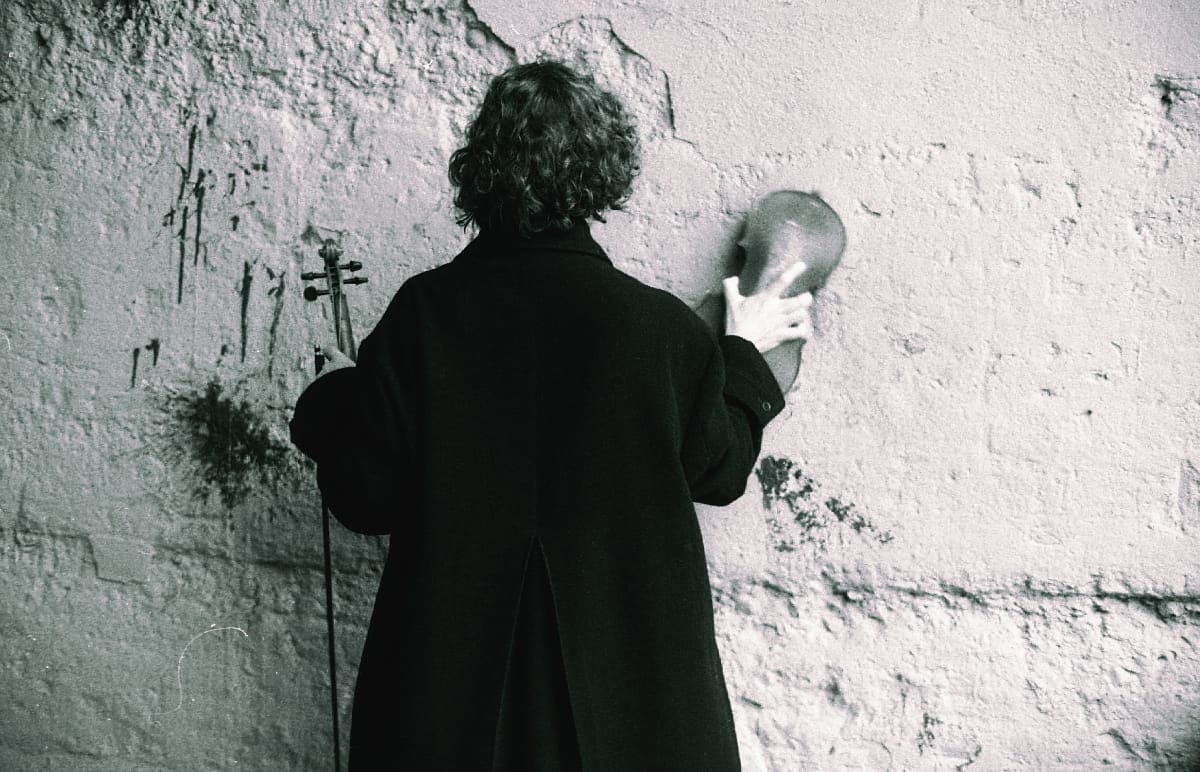
It was a life-changing point. Whatever inequity Kovačević had been feeling about the strictures of classical music started yielding ground to the boundless, the omnivorous, and the experimental. Eventually, as her path through New York's avant-garde community continued deepening, she found herself teaching at the Brooklyn Music School. And here we are.
It is of utmost importance in understanding Kovačević's approach to know that these broken violins aren't rehabilitated, at least not in the traditional sense. No dislocation is exactly the same as another, and each odd bent or missing part lends itself to a unique matrix of frequencies and tones. And so she plays them in whatever battered formation they come. That harnessing of all the buzzing, hollow, harsh, or thin notes is the foundation of Music for Broken Violins, Kovačević's series of tonal landscapes, which is now in its fourth volume.
Khagan Aslanov: I think it speaks to you as someone who needs to pursue art that you made something of your discovery, and didn't just ease into the life of a professor. Not to say that teaching isn't a great and noble pursuit, but the world would have missed out on this aesthetic moment. It's important.
Marija Kovačević: Thank you. I think so too. With that aspect of having to have a day job, I try to keep it as minimal as possible, to leave room to experiment and see where the violins are taking me. I started with one box of seven or eight, and now they're twenty-eight. I'm looking at boxes of them as we speak, and there are some I haven't met yet, so I'm excited to dive deeper into them.
Khagan: And when you came across that first batch, did you try to, if not fix, then prepare them in any way?
Marija: No. No alterations, except maybe if a string could be tuned and not be loose, I would just try to make it slightly tighter. They were all broken in different ways, and during COVID, I had all this time on my hands, so I started playing them. There was no plan or agenda. I recorded them because I wanted to capture that moment in time, as a reminder. Then I shut off my computer and didn't go back to it for months. And then, when I listened back, I thought: Wow! There was so much going on there!
For Kovačević, time is the great dismantler. Nothing is static in her world. The parts of her violins that are injured continue drifting and collapsing, altering both their pitch and tone, as well as their physical form. In ways, it both feeds into and complicates the fact that the music performed on them is improvisational. A temporal state hovers over Kovačević's gallery of wounded instruments – each performance becomes a singularity, and each day spent with one of the violins is tentatively the last in that particular state of performance and function. They are all like daguerreotypes of particular instants in their shared history.
Khagan: Do you have a favorite or primary one you use?
Marija: No. I look at some of them, ones I can barely play on anymore, and I think, "There you are, I remember you!" The reason I record them is because they change, always, and I try to capture them at that moment in time. They're very fragile, and everything you're doing is temporary. So it's always like you're letting go. They all are, in a way, my favorite. They each give you different things, sounds you never thought could be made on a string instrument. And then I re-use all their broken parts.
What Kovačević does stands as the obverse of academic playing – a pillar of improvisation. Left with violins that do not adhere to the hermetic, immaculate assemblage of a healthy instrument, all the classical training and elbow grease go out the window. What you are left with is sheer instinct, your honed ability acting as a guiding light, but never the actual impetus. It is a strangely pure platform from which free-form music can spring. In this way, her collection of fractured violins isn't just a pathway to singular sounds, but a depuritanizing force.
Khagan: As you play the violins and get to know each violin's particular kinks and frequencies, does your playing naturally leave improvisation and begin to move more towards composition?
Marija: That's a great question. I think it's a combination of both. You do get used to their languages, if I can call them that. I try to see if what I'm doing will work again today, or in a month. The truth is, you can get more comfortable to some extent, but because of their nature of breaking and changing, you're always on your toes. Sometimes, even during a gig, the violin would disintegrate in my hands. But I like that you can never truly get comfortable. It's the opposite of playing on a violin traditionally, where you put in the time and practice, and then you have this polished piece of repertoire you can play. But when you play on broken instruments, you have to abandon that mindset.
As these things usually go, Kovačević has encountered pushback against her pursuit; people have speculated that she breaks the violins herself, or that the soundscapes she makes are something entirely formless and needless. This hanging criticism is particularly virulent in the world of classical music and its listeners, a realm that has always prided itself on and isolated itself within rigid boundaries of technique and presentation. It's an old levelling that experimental musicians are used to by this point. The uninitiated tend to process this music under the assumption that avant-garde musicians work from the outside in—making odd sounds because of their inability to play properly. But a discerning ear can always tell when someone is, in fact, working from the inside out—pushing themselves out of traditional modalities to see what lies beneath the horizon, or simply because they're bored with standard notation.
"I can't remember exactly who told me this, but they told me, 'Don't worry, you're pissing off the right kind of people.' Not that this is my intent, but it's always amusing. When you play music for a long time, it inevitably comes through. It's human nature to find new curiosities. Without that, what are we even doing?"
Thankfully, Kovačević does not stand alone, whether in her field of study or with peers she collaborates with directly. One of her most exciting musical ventures has been with BUKA, a duo she forged with Aimée Niemann, a fellow violinist based out of Queens. The pair began their playing relationship around 2017, a few years before Kovačević stumbled upon her treasure trove. Yet, she was already starting to play around with structure and tunings, reaching for something new:
"We had this friendship where we always spoke about doing something. The first gig that we had, we used one loop pedal, and this violin I had made with a friend. We'd widened the pegs and the bridge to put cello strings on it. Because the cello strings are so thick, and the body of a violin is so small, it produced all these interesting harmonics. We were trying to shift what a violin could be, and we wanted to incorporate all these homemade instruments and different tunings. So we had the violins, the loop pedal, and a vacuum cleaner! (laughs)"
What BUKA ended up creating was a startling collection of drone-works, pulsing organisms of sound, minimal at the surface, yet packed with nuance and improvised exploration. Niemann's background as a choreographer and dancer also added graphic scores and gesticulation into their aesthetic. The pair named their works after seasons, and soon became synonymous with their marathon performances, once spending 24 hours straight playing Erik Satie's Vexations, at Canada 60 gallery in Tribeca.
Khagan: Just practically speaking, what does your mind and body go through during a 24-hour performance?
Marija: That's a great question that I, to this day, cannot answer clearly. We tried to prepare for it. I was thinking a lot about artists like Marina Abramović. We did our best, and I feel like the biggest take from the experience was realizing we are capable of more than we think. After the first 12 hours, I remember thinking, "We did it!" Then you realize you have 12 more hours to go. In those moments, you hit a crisis. But there were two of us; we energized each other. And the people coming in did too. There was a beautiful moment around 4 am, when the people coming in would stay for hours, drifting into sleep. Everyone was sitting on the floor, and we were in this delirious state. It was amazing. Then, of course, the sunrise. I'm still in disbelief we did it."
Khagan: I'll ask you a question that's usually on my mind when I speak to free-form musicians. If you were to play a show of Ornette Coleman pieces, would you, by the nature of Coleman's music, improvise freely? Or would you play his original improvisations note-for-note?
Marija: I don't know! I would be tempted to try both and then decide. I feel like you start by over-preparing, and learning note by note, then abandoning it halfway through. You gave me something to think about. Now I want this to happen!
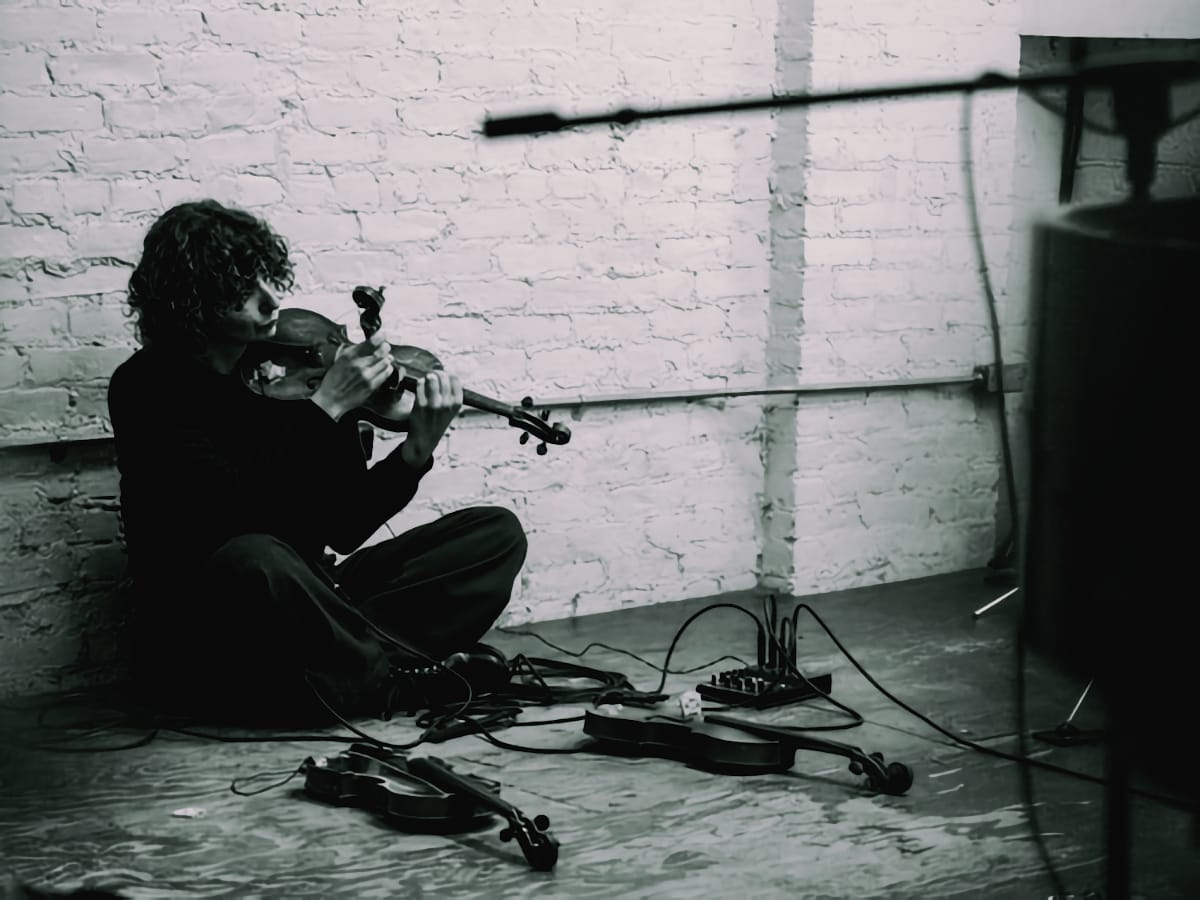
Through all of this, Kovačević continues teaching. Having young students learning the basics of her instrument has become an interesting stream that cuts down the middle-ground of her own classical upbringing and the fearless shapes she conjures today. As her students learn to grip the instrument and make natural mistakes, what she sees are strange, singular new ways of potential playing. And though at the outset, she teaches "proper" techniques, one can't help but hope that, in one way or another, Kovačević is edifying a new generation of avant-gardists.
Now joining the ranks of Relative Pitch Records, she also has several exciting new projects in the works. And though she was already an established player by the time she came upon that fateful box of broken violins, who could tell how much the world would have missed out on had Kovačević not resolved to take this lazaretto and transform it into something truly beautiful, coaxing new desolate and arresting sounds out of the depths of detritus.
Check out more like this:
 Lawrence Peryer
 khagan aslanov


Comments