


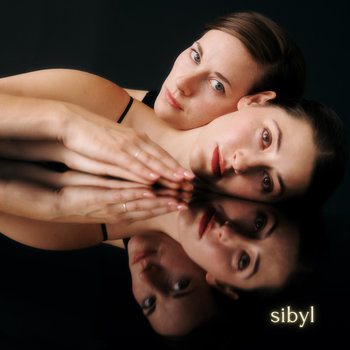
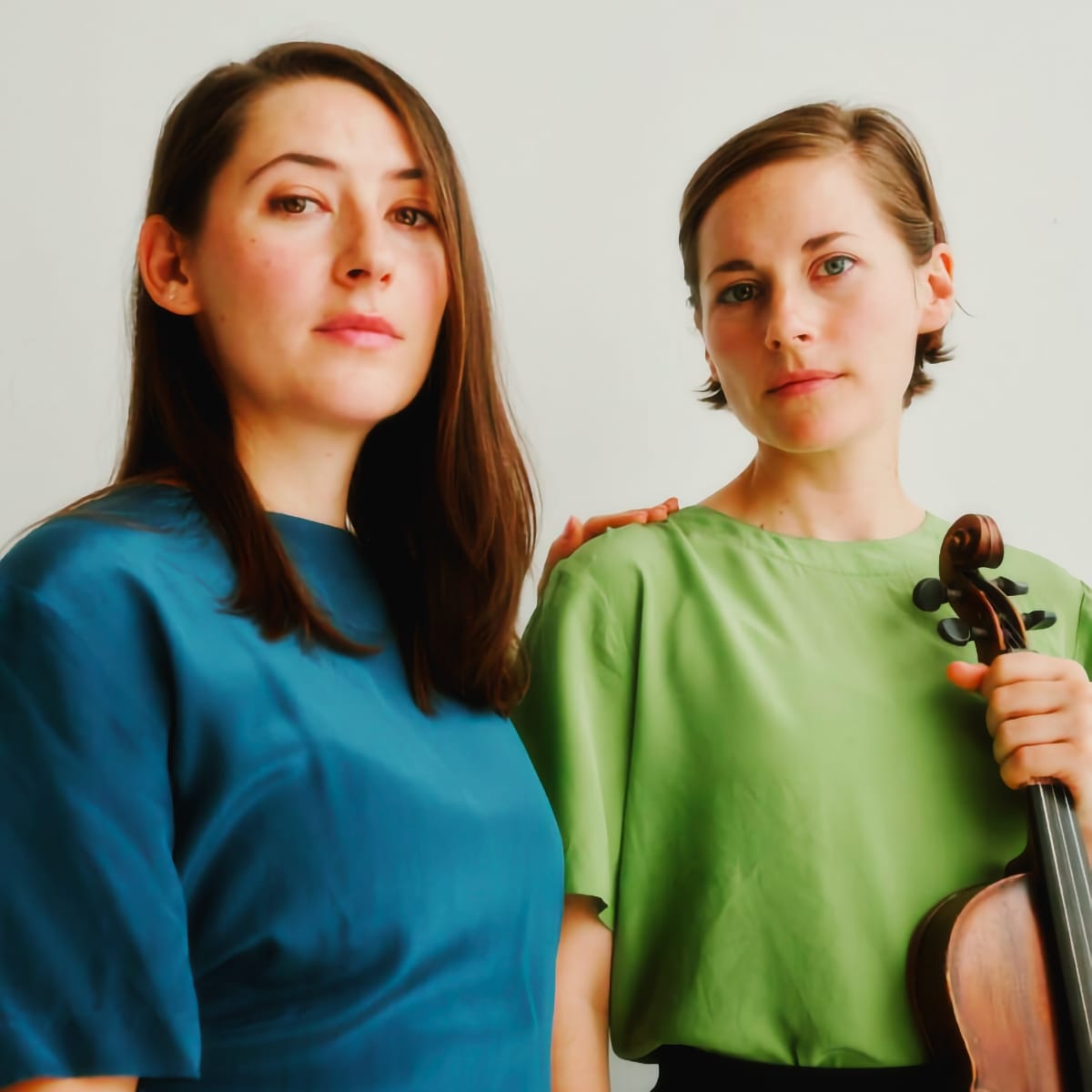
Though their debut album as the duo Sibyl was only just released into the world in February of this year, Chloe and Lily Holgate have been singing together their entire lives, often at the bidding of their loving parents—"Girls, sing for us!" they would say. That's just the kind of thing sisters do, especially when raised by parents who have forged careers in the world of musical theater. The two fondly recount their vocal origin story with joy and gratitude, knowing that the early coaxing they experienced together has allowed them to tap into a deeply attuned state only accessed through harmonizing together, something Chloe describes as a "grounding and magical experience."
On their self-titled album, they lean into their unique musical talents and shared lexicon, setting the poetry of Edna St. Vincent Millay and Emily Dickinson to music and offering up their own versions of the traditional ballads "Down in the Willow Garden" and "I'll Fly Away." The record is sparse and hypnotic, with Chloe tapping into her medieval choral training and Lily providing sporadic instrumentation with her viola or violin as the songs demand. They speculate that, perhaps, the ancient sibyls of Greece, the ones from which the duo takes its name, may have accessed the collective unconscious by singing in harmony as they do, and to hear the resonance they achieve together, often singing seconds—a more rarely used, somewhat spooky interval—it doesn't feel far-fetched.
The three of us spoke virtually, with each sister, at various times, deferring to the other to answer a question or to seek confirmation that they were both in agreement with the provided answer. Their mutual admiration was ever evident.
Meredith Hobbs Coons: So when I say vocal lineages, what does that conjure for you?
Chloe Holgate: I'm thinking about our family and how singing is an integral part of how we express ourselves. We've always sung, we started singing as little kids, from the songs our mom would sing us to sleep at night to the musicals that our parents loved and played for us on car trips, and the spirituals that we sang at our elementary school. Those were the beginnings of our lineage, which we're now carrying forward in the genesis of our own work.
Lily Holgate: Our parents are both singers, so they were always singing when we were growing up. It's this funny thing where, when you're around your family, you don't think twice about it until you have a friend present, and all of a sudden you're like, "God, we're weird." Our parents were also musical theater performers. So, you know, that's another type of vocal quality that we definitely absorbed. Another way I think about vocal lineages is thinking about music that influenced us, aside from the music that our parents introduced us to, but any artists that made an impact on us. We were introduced to Bobby McFerrin when we were really young, and he's such a vocal innovator. I think every artist takes little bits of what they hear and makes it their own, so I think that's another part of the lineage idea.
Meredith: I want to hear about some memories that stand out to you two.
Lily: Off the top of my head, just in terms of personal family stuff, our dad was constantly being like, "What's this from?" And then he'd sing a melody, and we'd have to be like, "That's from Oklahoma!" It kept musical threads constantly going through our heads.
Chloe: Yes, they were our story. We were not religious. We didn't have a lot of family around us growing up. We didn't really know my dad’s family because he's older and they live far away. Those musicals from his career and my mom’s were our heritage. It really felt like that. It was like, "This is very special to me. You need to know this. Girls, what's this from?"
Meredith: He was quizzing you?
Chloe: Oh, constantly. We would do a lot of road trips, so it was like a car game sometimes. Or if we were getting squirmy, I'm sure it was a way to get our attention. Our mom was in Les Miz, and I remember we lived in an apartment building that had this long hallway that was really echoey, and Lily and I loved the idea of being orphans—that was one of our play pretend games, to pretend we were orphans. We'd go out into the echoey hallway and sing that song, "Castle on a Cloud." We were just in a fantasy world all the time, I feel like. Don't you, Lil?
Lily: Totally. Our parents encouraged it. Not that long ago, our mom transferred all of our home videos onto DVD, and they were constantly like, "Girls, sing for us. Girls, perform for us." I can think, "Oh, that wasn't so great, actually." But also, on the other hand, it was just our family.
Chloe: That's what we do. And yeah, I feel like one of the songs that we learned in elementary school, that we were always performing for people, is "My Lord, What a Morning."
Lily: It's beautiful. Come on, Chlo!
Chloe: (laughter) It's beautiful. Anyway, those are some memories.
Meredith: So you've sung with a lot of other people—with your family growing up, with people professionally. Do you notice that there's something unique and special about singing with family, versus singing with other people that you're connected with?
Chloe: What's really important when you sing with other people is you don't want to just be listening to yourself. It's like, "I'm on top of my part, and I know what I'm doing. Now I can listen to what they're doing, so that I can tune perfectly to their lines so that the harmonies and the overtones really line up." Sometimes you just find people that really works with, but a lot of the time you don't.
Becoming a professional and singing with other people, I had thought that singing in harmony would always feel as good as it does when I sing with Lily. It's not. Everyone has a different voice. Everyone has different levels of presence and self-assuredness. When you're singing with someone who's insecure, it affects you. It affects how you sing. Lily and I have similar voices, so they blend well, but I also took for granted how we automatically do things together, like tuning and breathing. Sometimes I think what makes us so good at singing together is also what’s really hard about it, because we know each other so well that it's almost too much. Lily picks up on every little thing.
Lily: So, I'm not a professional singer. I’m a musician, a violinist, and I don't have the experience of singing with others in the way that Chloe does. Starting Sibyl has gotten me back into singing, which I hadn't done for a long time. The thing about siblings singing together is a real thing; people love it for a reason. We do have timbrally similar voices, and on top of that, our shared musical history, from our parents but also our own musical educations. That has influenced our musicality in ways we can’t even fully know. It's also what makes it insanely difficult to perform live, because of that intense sensitivity to each other. If I'm feeling very insecure, Chloe's aware of it. She can hear it in my voice. We just know each other a little too well, but that’s also what makes it special, vulnerable, and interesting.
Meredith: Do you find that you have certain harmonies that you fall into naturally that you then have to intentionally disrupt to stretch yourselves as a musical duo?
Lily: We've written this music that we've recorded onto this album, and I think Chloe and I both now want to push beyond what we've established harmonically, because our goal was just to see what we could do with the skills that we had: "Okay, we can sing together, and Lily plays viola and violin. Let's write something around that." I think we accomplished far more than we thought we could, but I also know that given those limitations, if we're setting a poem to music together, I absolutely fall into certain patterns. We also heavily favor singing seconds together, I think, because we can do it and we're like, "Oh, this is so satisfying" (laughter)
Chloe: It is definitely a harmonic theme of the album that we were instinctively drawn to. That tension of a second is really not traditional. If you're learning music theory in school, going into a second is not a harmony that you hear a lot. It's like thirds, sixths, fourths, but a second is a very strange thing to linger on as much as we do. I think it's really powerful; perhaps we've worn it out. As Lily said, we want to move past the musical language we’ve built, though I really love it and think there’s something unique and recognizable there.
Meredith: One influence that I get, and maybe it's because she's kind of having a moment right now, is Hildegard von Bingen.
Chloe: She is totally having a moment. The reason I'm in California is that I was just touring Hildegard von Bingen’s chants and teaching people how to sing and read the notation. I sing her music a lot, but she's also in the collective consciousness. There was an opera about her life that happened at a new music festival in New York this past month [Hildegard at the Prototype Festival]. It feels like there's this new interest in her music, which is very near and dear to my heart.
Lily got me a shirt that says "Hildegard von Bingen, Sibyl of the Rhine," because she had these visions. In the eleventh century, she was one of ten siblings, and at the time, you would just give your extra kids to the abbey to live there because you couldn't support them all. Maybe she was just a really smart, creative woman who heard a lot of music in the town—maybe she had ocular migraines—but she had these visions of vibrant colors and melodies. She didn't have any training to write it down, so she had scribes write down her music for her, and German chant music at that time had this advanced, detailed notation style. There are all these symbols that medieval scholars argue about today, but the group I sing with has interpreted them, and we sing her music.
It's ecstatic. It can be about God, but it's also about the idea of love. There's a lot of sensual imagery in her music. The harmonies she finds, the lilt of the melodies, are at another level. She was really a trailblazer in so many ways—and part of my vocal lineage, certainly. I've now been singing her music for maybe six years, but these chants are pages and pages long, and you sing them with other people. When you know your part well enough, you zoom out in this weird way where suddenly it's like this collective, you sing and breathe together. If you're all tuned in together, it is like a hive mind. You feel like you're going with the momentum of the group, almost like an Ouija board, where you're like, "I'm not moving it, but she says she's not moving it, but it's moving!" Singing these harmonies that Lily and I have created, and singing that kind of chant music, is a very grounding and magical experience.
Meredith: What about the foretelling aspect of sibyls?
Lily: There was something about the idea of women, these ancient figures, whether it was 'real' or not, tapping into something that could be listened to in a serious way. It's hard to be taken seriously as a woman, and so to kind of call back to these women who were these authorities, whether they were considered total eccentrics or not—that's its own thing. What they said was generally listened to. They were sought out.
I don't consider anything we sing to be singing about the future. No, that's not the point. It's more like we're harkening back to women who had voices. They used their voices and inspiration to tap into something.
People keep saying our music sounds ancient, and it's funny, because we're not going for that. The sparseness of two soprano voices catches your ear. And that's what these sibyls did. They shared messages that could be good or could be terrible.
Meredith: It makes me think of a current, of how all the water that has ever been around still exists in different forms. It just moves through the water cycle.
Lily: Also, Chloe talked about Von Bingen tapping into the collective consciousness—to use that idea creatively is so cool.
Chloe: You asked about foretelling, but I think how I feel when we sing—when we're in that sweet spot of ultimate focus and connection, and we're using our singing to get us into that state that I think the audience feels and shares—it almost feels like we're opening up a channel that has always been there and always will be. It's this timeless place. Maybe some of these ancient sibyls tapped into it the way we do when we're singing in harmony.
Lily: Yeah, when we can get into that sweet spot, as Chloe said, it's almost like accessing a flow state, and that's something that I want to feel more often. It's funny that sometimes it actually takes the high intensity of being in front of an audience to create that energy and focus. They're focused on us. We're focused on each other. We're creating the sound that's in the air.
Meredith: It's so interesting how the voice requires so much hydration and water, movement of water, and it's entering into people's ears through a channel of water: the middle ear fluid.
Chloe: So true. There's this water imagery, this current of sound, and then there's that kind of subconscious dreamlike imagery of water. I dream about water a lot.
Meredith: That's very interesting with the work that you do.
Chloe: This year, especially in the past few months, every dream I have, there is a massive body of water. It's like a group scene, and somehow we're all in water.
Lily: In Jungian psychology, isn't water in dreams representative of your unconscious?
Meredith: There is some witchery going on. How does setting poems to music play into this lineage that we're talking about?
Lily: We have mainly focused on Edna St. Vincent Millay and Emily Dickinson, and I've been a longtime lover of these two poets. Calling back to this sibyl idea, you could call Emily Dickinson a sibyl. She wrote like no one else. Her style is so unique, despite writing in strict form. There's something exciting about taking her work and setting it to music in a way that feels new, because most settings I've heard of her work are beautiful. I think she was a weird poet; she wrote in a weird way, and it's nice to present it in a way that feels a lot more eccentric.
Chloe: I think she was a weirdo. I think just like Hildegard von Bingen, being like "I saw flames," she was strange, and she must have had these waves of inspiration that, channeled through her human mind, came up with these incredible poems and heartbreaking images. Especially with the poem "I Felt a Cleaving in My Mind" that we did, I really feel like that music came from those words. The words led us there, and by setting them to music, I feel like we got to this deep understanding of what the poem was about and what she must have felt about it.
Lily: Definitely. I have no idea whether she would have approved of our musical setting, but I do feel that, through her isolation and almost monkishness, she tapped into her own kind of creativity. She was aware of her own soul and her own mortality at a very early age, and she wrote about that. A big part of our album is actually about mental well-being and struggling mentally. The way she puts that into her poetry is so profound. "I Felt a Cleaving in My Mind" is exactly that.
Meredith: I wonder if you're tapping into something in setting her poetry to music, too, because there was another recent example: Andrew Bird's and Phoebe Bridgers' "I Felt a Funeral, in My Brain."
Lily: Yeah, I discovered that maybe a year or two ago, and I was so excited to see that they did that.
Meredith: All of it is tying into this channeling and tapping into a collective unconscious.
Chloe: I feel like I've made some new connections between vocal lineage and these visionary women through time who were so isolated. At the time we were writing this music, we were really isolated. It was the pandemic. We were alone, in a kind of bubble, so it's funny to see other examples in current culture, like, "Oh, they set that to music just now, too?" We weren't influenced; these were things that just came to us, but it's all out there. We were all drawing from these sources of inspiration.
Meredith: Hildegard and Emily are like, "Hey guys!"
Chloe: Yeah, they're like, "You're not well!"
Check out more like this:
 Sam Bradley
 Meredith Hobbs Coons


Comments