


In his early thirties, Patrick Smith may already be Toronto's busiest man in jazz. He co-leads the Archives of Eternity, a free jazz collective that performs the music of Raphe Malik alongside vibraphonist Mark Hundevad and others from the city's improvised music scene. He fronts Pangaea, a fusion outfit whose orbit takes in Coltrane, the current wave of UK Jazz, and Neo-Soul in roughly equal measure. His chordless trio 3-Oh reimagines a repertoire spanning from Pharoah Sanders to Billie Eilish. He has appeared alongside Order of Canada recipient Dave Young, Juini Booth (who played bass for McCoy Tyner and Tony Williams), the Heavyweights Brass Band, and the Dan Pitt Quintet, among many others. Originally from Ottawa, Smith arrived in Toronto as a nineteen-year-old, earned his degree at the University of Toronto, and has studied under Canadian jazz luminaries Mike Murley, Kelly Jefferson, and Tony Malaby, as well as saxophonist Mark Shim in New York.
All of that breadth finds a natural home on Words Underlined, Smith's new trio record with guitarist Dan Pitt and drummer Lowell Whitty. Released in December 2025 as catalogue number 001 on Lit Soc Records—the new imprint from Toronto's beloved Sellers & Newell bookstore and venue—the album was recorded live off the floor in the store's intimate 600-square-foot space, which has hosted close to five hundred shows since owner Peter Sellers first opened the room to musicians in 2015. As Smith put it, "Playing Paul Motian tunes in a tiny bookstore instead of a bar or a traditional venue felt just right. The music is intimate in itself, and it was beautiful." The room's commitment to paying performers 100% of door proceeds has made it one of the city's most trusted platforms for adventurous music, and the label feels like a natural extension of that ethos. Lit Soc's first release and the store's approach share the same orientation: small-scale, thoughtful, and built on trust between collaborators.
Words Underlined interleaves five Smith-penned compositions with a set of solo and collective improvisations, covering territory from buoyant post-bop to questing ambience. Pitt, a subtle force in the Toronto scene through his own quintet and trio, approaches tone and texture with the rigor of someone who has spent years fine-tuning every dimension of his sound. Whitty, a founding member of the Heavyweights Brass Band, is a drummer whose unusually wide-ranging career—from Dixieland and New Orleans-lineage brass band music to freer, more open contexts—gives him a historical fluency that few players his age can match. The press release for the album puts it well: Words Underlined "finds a distinct sound amidst seemingly contradictory ingredients," embracing both experimentation and deep roots in tradition without treating either as a constraint.
Lawrence Peryer recently hosted Patrick Smith on The Tonearm Podcast. The pair discussed the formation of the trio, the particular challenges and rewards of working without a chordal instrument, the role mentorship has played in Smith's development, and his sense of where Toronto's jazz and improvised music scene sits in the broader landscape.
You can listen to the full conversation in the audio player below. The transcript has been edited for length, flow, and clarity.
Lawrence Peryer: What's the genesis story of the trio with guitarist Dan Pitt and drummer Lowell Whitty, and what's the attraction of that particular ensemble for you?
Patrick Smith: For me, the genesis was that Dan and I had had a similar trio years and years previous—saxophone, drums, and guitar, no bass. I'm quite a fan of the Paul Motian recordings without bass, with Bill Frisell and Joe Lovano, and the later ones with Jason Moran and Chris Potter. So initially, I put together a Paul Motian show, and we played some of that music.
Lowell Whitty had been on a previous release of mine, and I've worked with him quite a bit. I felt that early on in his career, he had opportunities to play more open, improvisatory music, whereas now that is less the direction his career has taken. But he really loves it, and I feel somewhat similar myself—at the onset of my career, I played a lot more of that music than I do now. My recorded output reflects heavily on that tradition coming out of Ornette Coleman, John Coltrane, and the free jazz movement of the sixties, but my day-to-day work, less so.
Dan is one of the few guitarists I have access to in Toronto who can effectively navigate the world without a bass player. A lot of people can't do it. He is truly a master of tone on the guitar. I had some sketches and old compositions that had never been recorded, and I thought they would work well in this format, so we did another show that included some of my material alongside the Motian stuff. It went well, and I felt we should record it. I think there have been too many times in my professional life over the last ten or twelve years—either my own project or somebody else's—where it lasts for a couple of years, there are a bunch of really great shows, and then it dissipates with no recorded output.
I'm fascinated by the trio format, even though it's very hard. I now have two releases with two different trios, and I really marvel at the great trios throughout music history. I keep coming back to it as both the most rewarding and the most challenging format for me.
Lawrence: Is the difficulty specific to the trio and the absence of a chordal instrument, or is it all trios?
Patrick: I think it's all trios. In some ways, even a duo is easier to navigate musically than a trio. In a quartet or a quintet, everybody has their own specific role, but in a trio, everybody has to inhabit a variety of roles to make it work, and navigating that on the fly can be hard.
Lawrence: That helps me understand why it works so well with Dan in particular—the way he plays, his use of electronics and texture. How important is that expanded palette in this context?
Patrick: It's important, for sure. I find that with a lot of guitar players, it's very hard to have a serious sound concept through pedals and through a clean tone. What attracts me to musicians is their tone. Dan has spent a long time really fine-tuning every aspect of his sound, so every tone he uses—through his pedals, through a straight tone—is incredibly well thought out. His rig is very small, but he really knows how to use those pedals.
On this recording in particular, the brilliant recording engineer Tom Upjohn suggested we bring both of Dan's Princeton Reverb amps. We recorded the guitar in stereo, and Tom brought a little chorus pedal so the two amps have a slight phase difference between them. It sounds unbelievable. I usually prefer piano in my bands, but Dan's mastery of tone on the guitar is unparalleled. It forces me to really think about my own sound, which in a more open context is everything.
Lawrence: And what about Lowell—is it fair to say this record is a chance for him to flex muscles he isn't always flexing?
Patrick: Yes. Lowell is more known as a guy who can play funk. He came up quite young in a fairly famous Toronto Dixieland band playing trad jazz—from about seventeen to twenty-two, he played and toured with a band called the Happy Pals. His understanding of that music, combined with his deep knowledge of the history of jazz drumming, makes him an intuitive drummer. His groove, his sense of pulse and swing, is unbelievable.
Particularly in the Heavyweights Brass Band, his drum feel sounds like those New Orleans drummers—he actually has it down. In any context Lowell plays in, there's just this sense of swing, regardless of what he's playing. He pushes and pulls tempos. On this record there's a tune that's basically metal, there's a tune that swings where I'm thinking about Lester Young, and then there's totally open stuff where Lowell is coloring—he's listened to all those Paul Motian records and understands how to get the overtones out of a cymbal properly, using his sense of pulse where there's no meter. I think it's brilliant.

Lawrence: To hear you speak about both of your bandmates, you're really talking about two people who have mastery over their instruments and tools. How do you fit into that?
Patrick: I think sometimes I wonder if I have focused too much on development as a saxophone player. I would consider myself a fairly serious technician on the horn—there's a lot of stuff I can execute—but oftentimes I have to remove myself from the saxophone player and access the musician. The whole history of the saxophone carries a lot of baggage. Trying to follow in the footsteps of people like Charlie Parker, Sonny Rollins, and John Coltrane, where so much is made of what they can execute at the pure instrumental level—sometimes, as saxophone players, we can get caught up in that.
When I hear the word "technician," I think of somebody with crazy chops—and I wouldn't describe any of us as having crazy chops. I think all of us have really delved into sound and tone in particular. All three of us are pretty neurotic about the gear we play. Lowell spends a lot of time thinking about what the right ride cymbal is for a recording, what the right snare is. Dan has a custom guitar—the one he's playing on this recording is my favorite of his, made for him by a luthier. And on my end, this marks the first recording where I switched from an old Conn American-type saxophone that I had played for eight years to a Selmer, which is the vintage saxophone most people play. When I got the rough mixes back, I felt I might not like this one as much, but the Selmer lets me be myself more quickly. I would describe all three of us as technicians of tone. Our primary focus is sound.
Lawrence: When you're writing for a trio like this, I'm assuming you have to think specifically about the format. Can you apply other parts of your songbook to it, or do you have to write for this format?
Patrick: I essentially applied other parts of my songbook to this format.
Lawrence: Oh, really?
Patrick: This record is a mix of compositions and improvisations. That's what I wanted this band to be. As a composer, I'm moving more toward thinking: I can write songs, and I can write compositions. If I write a song, I should be able to fit everything on one sheet and play it in a variety of contexts and instrumentations. I think of those late Johnny Cash records—there's one called My Mother's Hymn Book, where it's just Johnny Cash singing solo with guitar, playing songs out of his mother's hymn book. You could play them with any instrumentation, any arrangement, and they would still work. A lot of those Beatles tunes feel like that, and within the jazz context, if you play any of those Wayne Shorter tunes, you can play them as a duo and figure out a way to make them work, in addition to the way they were originally intended—in a quartet or quintet.
So I looked at some songs and compositions I hadn't yet recorded and thought, let's see if this works in this format. I said to the group in the session: When we go to do these improvised pieces, let's keep in mind the tunes we've already recorded. At the time, I was coming off an intense period of busyness—all three of us were. We rehearsed a couple of things before we started recording, but then we just started. I didn't think this record would turn out this good. I thought maybe I would get a single and could use the recordings to apply for a grant. We did this session at the bookstore and, because the room sounded good and the engineer knew what he was doing, it turned out well. I'm really proud of it.
Lawrence: Well, the playing must have been pretty good, too!
Patrick: The playing was pretty good, and I think because all of us were so tired, it was just: "Yeah, sure, whatever, it's fine." The looseness serves the record. Two of the four tunes are seven or eight years old, and the other two I had written in the last year. I was going through the old material, thinking, "I wish I had recorded this song," and then: why not try it in this format? These guys are good; we can figure it out. And they turned out great. I should probably be thinking about writing specifically for this format, but I also think part of the beauty and hardness of a trio is that, because there are fewer moving parts, you can make a wider variety of things work.
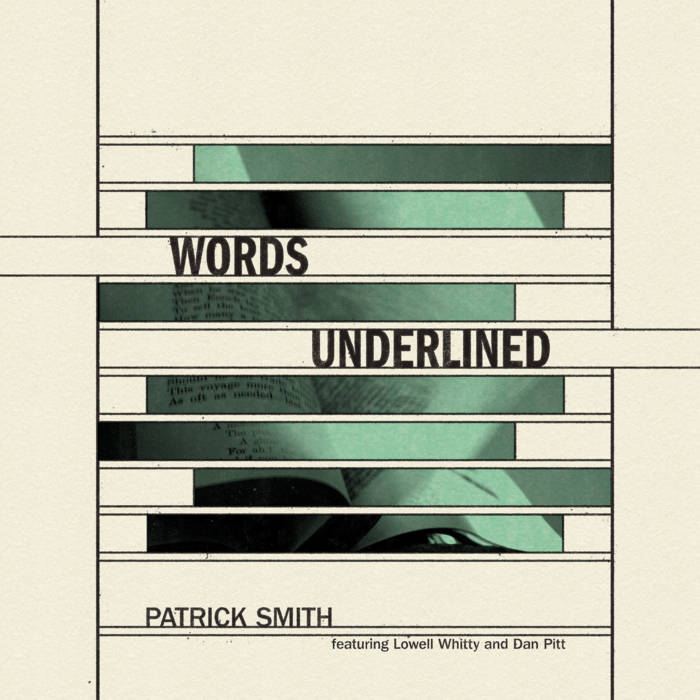
Lawrence: I'm curious how this project came to be catalogue number one on the Sellers & Newell label, Lit Soc Records.
Patrick: I think I just got to the edge of the process first. Peter [Sellers of Sellers & Newel Second Hand Books] was generous enough to lend us the space, and then, after a couple of people started recording there, he got the idea to start a record label. He was at the session, was blown away by it, and really wanted it out in the world. In some ways, I'm happier with how this sounds than things I did at really expensive studios, and as an independent artist partnering with Peter on a small label, it really gives me faith about the future of music in this day and age—and of creative instrumental music in particular.
Lawrence: Are there any overt ways that working on the trio project will now inform the quintet project you have in the works? Is there connective tissue through your work, or are these discrete projects?
Patrick: I think I do have some definitive themes in what I do as an artist. The main theme is that I really like music that breaks boundaries, combines elements in interesting ways, and pushes forward. In music, we have neoclassical things and avant-garde things—and bebop was avant-garde. I mean, Black Sabbath was avant-garde. I've always been more drawn to music that pushes in that direction. The records that really make me go, "wow," are the ones that push forward.
A great Dave Liebman quote he told me directly was: you want to be able to put your album on your shelf next to your heroes' albums, be proud of it, and think it does them justice. That has always stuck with me as a guiding light. Just trying to balance the full spectrum of human emotion within music and to have some honest expression. As it stands now, I have this collection of recordings that are very different in scope, but the thing that combines them is that they're different.
Lawrence: That also seems like a hallmark of the Toronto scene. You used the word "avant-garde," and that blending, that thirst for innovation, seems to mark Toronto. Maybe it's because so many working musicians have to play in other contexts that, when they come back, their music is just slightly left of center.
Patrick: I would describe it as such. I went to New York many times, and then shortly before Trump won that election, I went down to Nashville for a week and got to hang out a bit with Jeff Coffin and see the Nashville jazz scene. That's the only place in the US where I thought I would love to live, because it reminded me of Toronto but was smaller and had more touring opportunities with bigger-name artists. Everybody in that jazz scene was killing it, working in such a wide variety of contexts, and when they wrote original music, it reflected that. Nobody was trying to put each other in a box—everybody was cool with other people doing other stuff.
I think the reason I like Toronto is that I can show up to a straight-ahead jam session and nobody will be weird about the fact that I was coming from a rock gig. In general, people are pretty supportive. In New York, it really feels like you have to decide what type of jazz musician you are going to be. I've never fully lived there, but every single time I've been and hung with people there, it's just that there are so many musicians—and that's what makes New York great. You can spend an entire lifetime playing, for example, just the Latin jazz thing in New York, which is unbelievable—the level and the lineage of that music. Even within free jazz, there are so many different niche pockets. It's beautiful and crazy. But I like doing everything, which is why—and I think you're right—when I go to do my own thing, I bring all that working musician energy and those influences into what I do.

Lawrence: Can you tell me about the role mentorship has played in your development, and is there a lineage there you're conscious of?
Patrick: I think so. A lot of people—especially in Toronto, especially in the jazz world—complain about a lack of mentorship. For me, from about the time I was twenty-two until I was twenty-seven, I would go down to New York twice a year to see a teacher named Mark Shim. I probably only saw him seven or eight times in total, but each session was profound. I got to sit beside somebody who had played with Elvin Jones and Betty Carter as a young man and who now plays with Vijay Iyer and all these heroes of mine. The main lesson he really taught me about the saxophone is that it should be thought of as a rhythmic instrument, and a lot of people don't think of it as a rhythmic instrument. That level of precision in rhythmic articulation is the basis of all Black American music: push and pull, swing, rhythm.
I also like to use the term "jazz generations" to refer to eras of about five to seven years. Lowell is the jazz generation above me—I'm thirty, he's around thirty-five or thirty-six. When I moved to Toronto as a nineteen-year-old, he was already established and gigging. When you play with a drummer who has spent thousands of hours on the bandstand, it feels different. I think about that kind of mentorship a lot, especially when it comes to what I'm doing artistically and just continuing to do it.
I also spent a lot of time with Dave Liebman when he was at the University of Toronto. Even his books—Developing a Personal Saxophone Sound and his harmony book that breaks down what he and Steve Grossman were doing when they played with Elvin Jones and how they approached playing outside—are extraordinary. These exist in a post-Coltrane world, and so does the Eddie Harris book, which is also an extensive guide to playing and developing the saxophone. I've owned these for so many years and give them to students. I don't think we're at the end of what the saxophone can do at all, and a big part of that is people like Liebman—this relentless drive to educate people and push them.
I heard a quote from Jeff Coffin, who was told it by Sonny Rollins. Sonny was asked what advice he would have for younger musicians coming up today. Sonny responded, and I'm paraphrasing: "The forces that be have always tried to squash creativity, and it is up to the artist to push back against that." So, just continuing to create and do the thing is kind of an act of rebellion. I think about that a lot—I'd better keep going and keep treating this seriously, because I had these people who believed in me, who gave me the time of day when they didn't need to. Every single time I go to play, I think about that.
Check out more like this:
 Lawrence Peryer
 Lawrence Peryer


Comments