


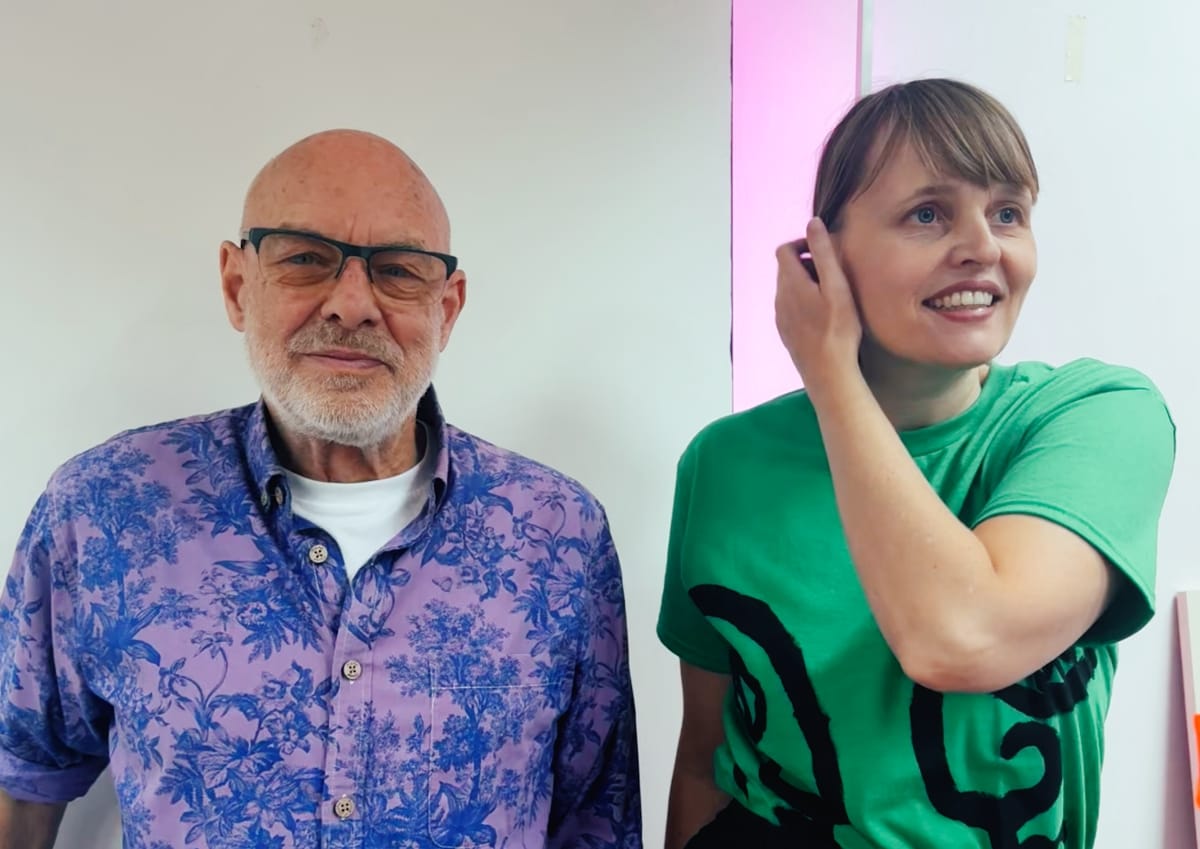
Celebrated Dutch author and visual artist Bette A. (Adriaanse) tackles big themes in her work, but she approaches her creative endeavors with whimsy, mystery, and a sense of wonder. Those qualities make her collaborations with Brian Eno an inspired series of endeavors. Eno is famous for his time in pioneering rock band Roxy Music, his musical collaboration with artists including David Bowie and Robert Fripp, and his high-profile production work for Talking Heads, DEVO, U2, and others.
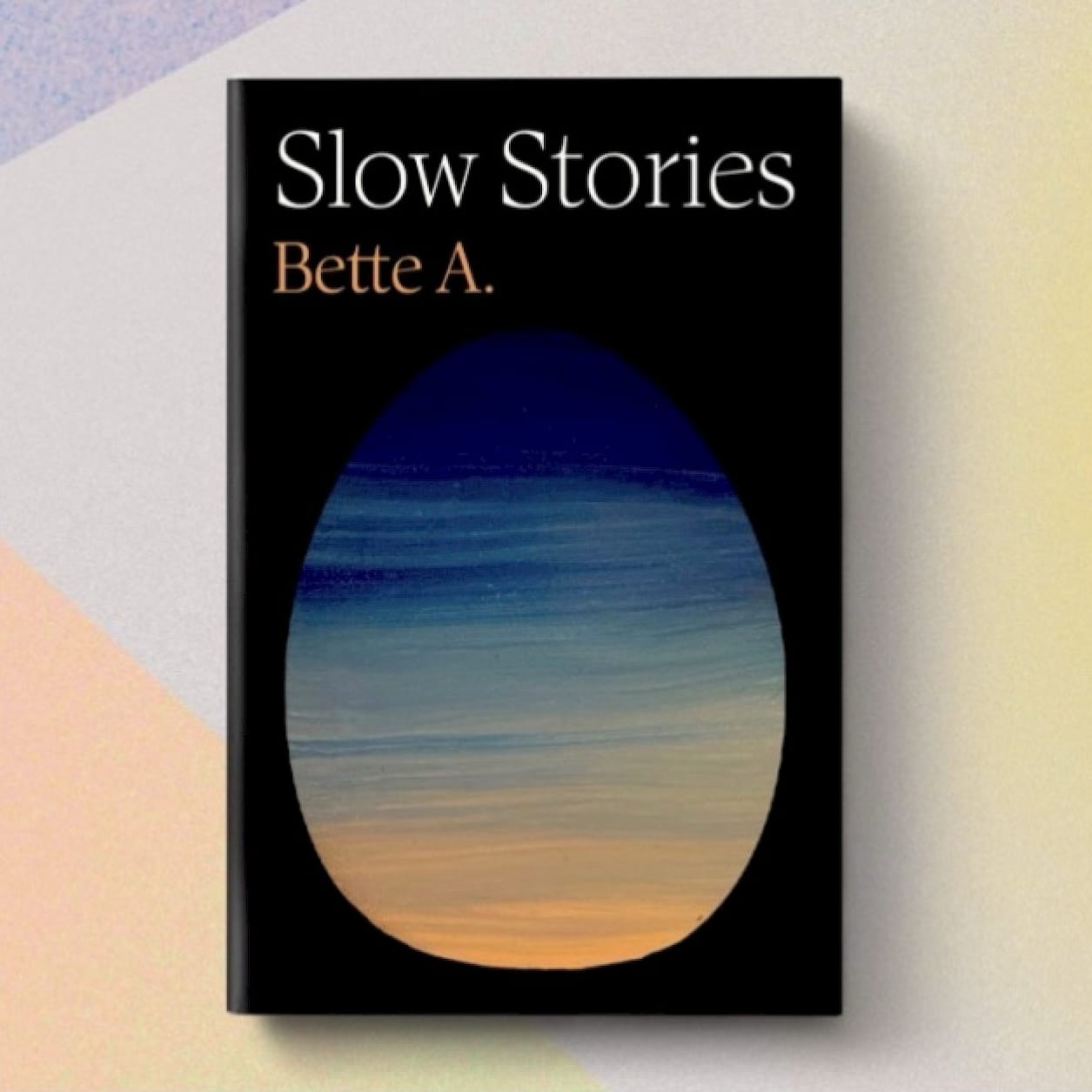
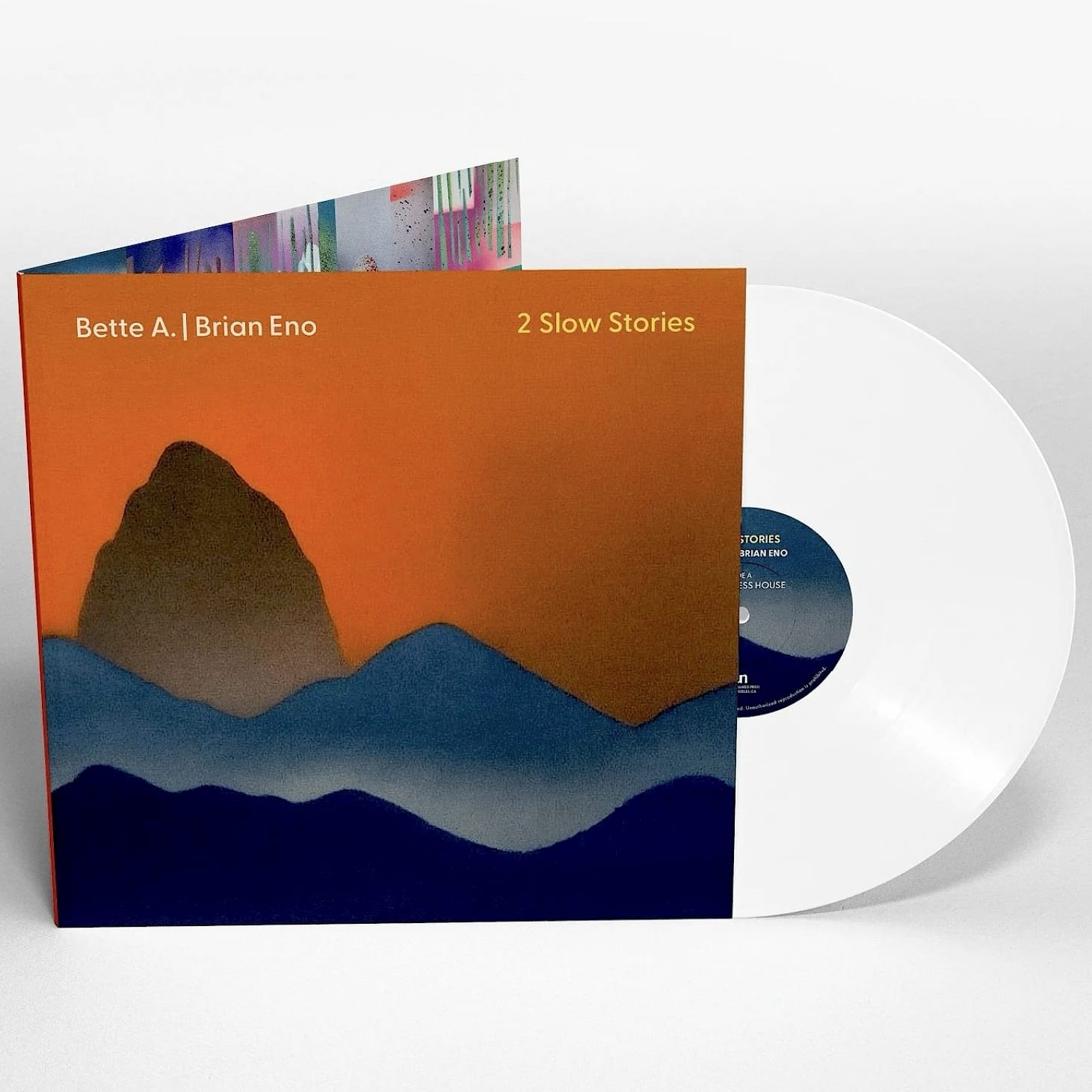
Perhaps Eno's greatest contributions, however, have been his groundbreaking work in ambient music. And it's within that idiom that he has co-created Slow Stories: A Collaboration of Storytelling, Music, and Art. The limited-edition work includes a book of sixteen impressionistic, thought-provoking short stories by Bette A. A companion vinyl record features the author reading two of the stories in a deliberate, extraordinarily slow manner, with Eno providing his trademark instrumental music as accompaniment. Slow Stories is the second collaborative project between the two artists.
Bill Kopp: Some of the stories in the book feel like descriptions of dreams. What inspires you to come up with these narratives?
Bette A.: Usually, I walk around with questions in my head like everyone else: "Why is this like this?" Or, "How can I deal with that thing?" Or, "Why do people act this way?" I don't usually have any answers. And if I do, they're not very good! But sometimes I get this very persistent image—like the man carrying the rock and the villagers telling him to put it down—and it connects to a feeling that I'm going through. Then I start to explore the image and trust it like a dream, trusting that there might be some meaning in it, that I might learn something that my rational brain hasn't been able to produce yet. Maybe there is something interesting there. And I just start exploring.
Bill: "The Endless House" is quite enigmatic. Are some of these stories riddles meant to be solved?
Bette: No, they're not meant to be solved. I really like it when people come up with their own answers to what they think it's about. It's often wildly different from what I thought it was about, or from each other.
A scientist said to me, "'The Other Village' is about science." She said, "It's about our desire to measure everything, and whether or not that impulse is always right." Another person told me, "This is about falling in love with someone else; it's a warning." And then another person told me, "This is about Trump's America, and it's a very political story."
I like that a lot when that happens, because it means that I have given enough room for people to have their own experience. And at the same time, I've given them enough to engage and to have some feelings about it, so it's not completely meaningless. So in that sense, it is a riddle to be solved, where everyone has their own answer.
Bill: Does the kind of storytelling in which you engage in Slow Stories connect with Dutch cultural traditions?
Bette: I do think there is something in it that is very Dutch, which is in my style: short sentences, directness, straightforwardness. We're not really people who are interested in decoration or flowery descriptions. If I describe a tree, I will just say, "a tree." And that's a very Dutch thing; I feel I've said enough. It's a tree. You get it.
Other languages and other cultures give more decorations, and they have beautiful ways to describe the different colors of the autumn forests. But the Dutch will just say "forest." And that's very Dutch about my work.
Bill: What made you choose the two stories for which you and Brian created audio versions?
Bette: With Brian's music, everything sounds great. So there is a lot of cushioning for the story, but we realized that it shouldn't be too dark. Some of my stories are very dark, and they don't have a happy ending. If you have that very pleasant experience of being carried along in your imagination, and then you end somewhere very dark, it works on the page. But it didn't work so much in this experience that we were trying to create. We tried a lot more of them, but we realized that for this to work, it should always sound nice.
And it shouldn't be too long, because the stories that we recorded are very short. And it already fills the entire record. The record has about 30 minutes. We wanted very short stories we could put in there, leaving enough room for the music. So I think those were the two conditions: Not too dark and not too long.
Bill: I will admit that when I started listening to the recording of "The Endless House," I couldn't get through it. I was in the wrong frame of mind: I was distracted, I was multitasking. I have since listened again with what I believe was the proper mindset, and I was able to experience it as you and Brian intended. Does the creation of the audio document feel like a radical endeavor, a radical statement to you?
Bette: Yes. And I love what you said, because I think this is so relatable. A lot of us have been in the position where we think, "Oh, I'm gonna read this book about meditation!" And then you flip through the pages to get to the good stuff. Then you realize, "Oh, I'm very much in a rat race mind state, and this is not what I'm supposed to be doing." But it takes a bit of effort to get there.
Especially since, for a couple of decades, we've been experiencing what it's like to live bombarded with information; it's doing something to us. I'm not going to pretend I understand what it does to our brains, but I do know I experience exactly what you do. Sometimes slowing down requires a little bit of a decision and a moment of discomfort before you can actually get into that mode. And that's the radical part: We really need this. I'm not talking specifically about our record; I am saying that we need these moments that help to slow down, engage with our inner selves, let our imagination roam.
I think the radical decision is on the part of the listener, too. It's radical in a society that asks a lot of us to say, "I'm going to do this right now, and I'm going to take half an hour, and I don't know if it will be useful, but I'm gonna try it." That's the radical part for me.
Bill: What kind of effect do you wish that your work will have upon the listener?
Bette: I'd like the listener to come out of it and think, "There's a whole world inside of me where it's nice to spend some time. And it's quite interesting there." I hope the stories and the records give a little leg up to get there.
Bill: What do you think it is about Eno's approach to music that complements what you are doing with storytelling?
Bette: He leaves so much room in his music for other things to happen. He is not scared of the silence or of the calm. He has a piece of software that lets him shuffle all the music in his archive and create stacked layers of tracks. He presses shuffle, and then the computer puts two, three, four, or five tracks on top of each other. And it almost always sounds good, because his music has so much room in there.
So if you add a story to it, it still doesn't feel full; it still leaves a lot of room. I think that's why his music works so well for this, and for film.
Bill: With this project completed, what's next for you?
Bette: I'm going to be completely honest with you because I don't know how else to answer.
I will always make art and do activism; I will continue doing these things. I feel that we are in such big shifts in the world that I'm in a period of reflecting on where my energy is best served. I'm involved in a lot of very progressive projects on equality, gender equality, open access, and school programs. But I'm starting to get a little bit concerned about the state of the world: Should the activism look different now? Should it become more towards protecting what we have and less towards being progressive and trying to get towards goals of equality and equal access?
So that's a very honest, slightly sad answer. And I don't have the answer yet. I know that I will always do these things. I have made art and written stories since I was very little. But I am trying to take the time and actually slow down to ask myself, "Is this trajectory that I'm on still valid?" Seeing some of the changes that we're in, as one small person in this eight billion people world, where do I want this small person to go?
Check out more like this:
 Lawrence Peryer
 Bill Kopp


Comments