


Coming out of a classical and jazz foundation, Bay Area-based composer and multi-instrumentalist Bayeté (Todd Cochran) created a pair of compelling albums in the early 1970s. While his later efforts—including work with Automatic Man and Carl Palmer—would continue his musical exploration, on 1972's Worlds Around the Sun and Seeking Other Beauty from 1973, he embarked upon a fascinating journey that drew upon jazz, funk, soul, and other forms to express a unique musical vision. Out of print for many years, Worlds Around the Sun received a curated reissue in 2014.
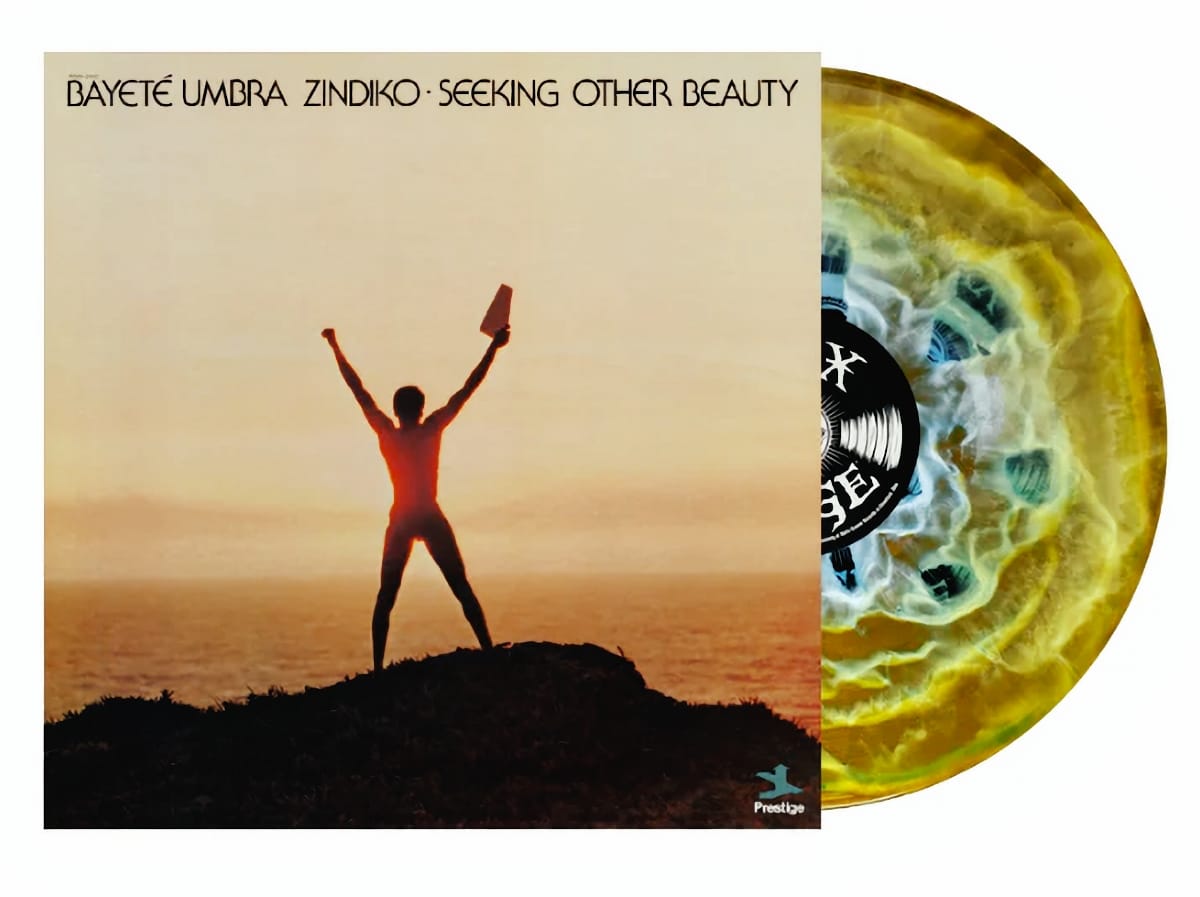
Now, in 2026, Bayeté's adventurous follow-up, Seeking Other Beauty, has been reissued on vinyl. Both as an exemplar of a time when boundary-smashing fusion was in its ascendancy and as a timeless work that pays creative dividends more than half a century after its creation, Seeking Other Beauty is a special record. I spoke with Bayeté about the context in which the album was created, the forces that influenced it, and how it fits into the larger picture.
Bill Kopp: You composed most of the music on Bobby Hutcherson's 1972 LP Head On. How did your time working with him inform your own creative path?
Todd Cochran (Bayeté): It was really quite something because I came into this world of jazz when I was very young. I started playing with John Handy when I was 16 or 17 years old, and I was writing for John. So my experience has always been intergenerational. Bobby was 10 to 12 years older than me, so that was a different type of dynamic. I was always learning, always with manuscript paper and pencil in hand, working with him and following his impulses. And it had a huge impact on me, because I saw how he processed information. I saw how he answered questions. And certainly, I saw that there were no boundaries to his creativity when he entered that state. So what I did was learn how to support that, and even how to introduce the setting that allowed that freedom to occur. That's one of those settings where language can even confuse what you’re trying to explain; sometimes it falls short because it changes all the time. It's completely fluid.
What I learned from him is about the state of improvisation. Those of us who think that we're free in our lives, free to express ourselves and to be who we are, I think we can attribute some of that to the fact that we're improvising as we go through our day. When we do that, it brings some mystery into the equation and the experience. And Bobby Hutcherson really helped me to understand that. He was a prestidigitator as well; he had sleight of hand. You would see things that you wouldn't hear, and then you would hear things that you didn't see. You would think that you were hearing more music than is actually there.
Bill: When you set out to make Seeking Other Beauty, how did your musical objectives differ from when you made Worlds Around the Sun just a year earlier?
Todd: My intention had shifted. My tools had changed. My philosophy was progressing, even though I don't think I even had a philosophy then. As a result, the progression between those two records is clearer. On Worlds Around the Sun, I wrote “Free Angela,” an homage to Angela Davis. Coming up in the environment I did in San Francisco, I was an accidental activist; I didn't plan to do it. It was just reality for me to speak on and reflect on what was occurring in the environment; that was what was relevant.
I had stepped away from working with the jazz masters like Rahsaan Roland Kirk and Woody Shaw. That was great, but I was feeling that pull to speak to my generation. Things had been excited within me about how people were taking the color of language and introducing that to a social context in a kind of cultural transference of awareness or consciousness. And out of it came this new music that was touching people in a very deep way.
I had several practices going on at the time. One of the main ones for me was the written word, poetry, what was being written, new ways of shaping ideas. There was also the presence of futurists, which we don't have anymore: people like Alvin Toffler, Buckminster Fuller, Samuel Delaney, and Octavia Butler. The futurists were taking us out of the context of the present; they created a collision of those things in a forward sense. And that really excited me because if you can move out of the past and out of the present, you can create a world and invite people to join you. And then some real storytelling can occur.
Bill: What were some of the musical forces that influenced you at that time?
Todd: I grew up in the church. My maternal grandmother was an evangelist and a minister; she had parishes in three cities at separate times in her life. I refer to my grandmother as a proto-feminist, but very deep into her evangelism. And you hear the church organ in Seeking Other Beauty. I've always been fascinated by the organ. Of course, I loved Jimmy Smith; not just Who's Afraid of Virginia Woolf?, but all of those records that he did with Grady Tate on drums and Kenny Burrell. I also loved Richard "Groove" Holmes; that's a kind of secular organ.
And then the other thing is that I was moving more toward electric. When I played with Rahsaan Roland Kirk, he said, "Man, this is cool. But you seem like you're trying to change the sound of my music." I was starting to get some rebuff, because that's where I was going: electric, with the Clavinet, the organ, the electric piano. This is before the electronics came in, before I ventured into becoming a synthesist and electronic musician.
Bill: One of the fascinating things about Seeking Other Beauty is the manner in which you electronically treat the instruments. The keyboards don't always come across with their native, unadorned sound. Were you attempting to redefine the character of those instruments?
Todd: I was going with it; I was hearing the possibilities. You could play a combination of notes, let's say fifths, on an acoustic guitar. But then, when you wind that up with the electric guitar through Marshall amps or whatever kind of processing, we're talking about something completely different. The elements of the sound interact with each other in that electric dimension, and that's completely different than what happens purely in the acoustic.
I've always been interested in harmonic languages. And that's something that came with classical training. And yes, I wanted to push the instruments to other places.
Bill: Some of the tracks on Seeking Other Beauty fade out, leaving the impression that the band is continuing to play out into infinity. Was that the case?
Todd: Yes, that's correct. I would think of it in terms of color, and then transitions of color, and putting that on a spectrum. And that spectrum is defined by what we hope to convey. We follow those variations, and it becomes very instinctual where you create those transitions and where something seems like it is continuing, and it goes on. If we think about it in terms of a new color—not just combinations of colors, but where it comes together to form a new color—I think it lands harder if it's set up more cleanly.
Bill: What kind of direction did you give the players with whom you were working?
Todd: I talked to the band members about what we were going to do. I would give ideas about the imaginary space that we were going to create, and then it became a matter of listening. And once that was absorbed, we played. Maybe there was some gesturing that went on as we went through it: a nod, or some kind of hand direction. But basically, it was just listening to each other intensely. And I think when that happens, we hold the dimensions of that atmosphere.
For instance, let's say that within a song it's sad, and then it becomes happy. Or it's sad throughout. We can convey that without words. Let's say there's a female who would go past the back of your house in a boat by herself, in and out of your view for months and months. You never got to interact with her at all, but you just saw her. To convey that space of seeing this person from a distance and never speaking with them and holding that space over time, that space, that's an art space.
I do know that we would go very deep. Deep listening and hearing each other as we formed the music.
Bill: Tell me how the album fits into the counterculture of the time and place in which it was made.
Todd: The first aspect of it would have to do with rhythm. Not just the rhythm in music, but rhythm in thought. Because certain concepts require repetition to achieve what they set out to do. If we see ourselves as part of that shifting landscape, how can we reiterate that thing which is commonplace amongst us? I'm not talking about tribalization; I'm talking about people coming into touch with their individualism, being able to express things that in a less tolerant environment would have to be repressed.
I must say that it had everything to do with the environment that I came up in and what I was attracted to. I have some deep bohemian roots, and there was a very strong collective within that. There was identity. It was a time of radical consciousness, but I think the underlying, less spoken theme was that our social and cultural concerns had to shift towards the truth that, individually, we have to find a way to live without worry and be free. And that's where our creative instincts are stimulated. I think it was our shared creativity that brought the movement of the civil rights era to a head.
The central theme that I always saw is "one love and one heart." That's it. If there's something occurring that's in violation of the human spirit anywhere on the planet, we have a responsibility to respond to that. I answered that call, and I have been answering that call. It is more intense and less intense at times, but I'm absolutely listening.
Check out more like this:
 Andrew Hamlin
 Bill Kopp


Comments