


There's something of a communicative quality to Gregory Uhlmann's Extra Stars. That is, communicative in a nonlinear and, more literally, a nonvocal way—as this is an instrumental record—but a way that's naturally rhythmic. It’s like noticing two birds talking to each other without understanding a bit of what they say. Each tune brings a new theme to that conversation, while nodding to what was said before.
The LA-based multi-instrumentalist and composer, known for his work in projects like SML, Perfume Genius, and Hand Habits, develops a new method of guitar expression across the record's 14 tracks. The press release describes the record as "a vividly escapist, panoramic menagerie of sound," pushing the boundaries not only of guitar music but also of the larger world of synth-y, nomadic soundscapes. Uhlmann found a heavy dose of inspiration while stargazing in the Northern California desert, recognizable in both the album's title and its shimmering natural curiosity.
The beginning of "Lucia" sounds like the gears of a grandfather clock spinning and working together. The song, featuring guest Alabaster DePlume, builds over three and a half minutes to a naturally resonant chorus of horns, winds, and human voice. It is a shift from the more crystalline, synth-heavy tracks that precede and follow it. "Days" opens with a reverb-soaked picking pattern that consciously morphs into a cinematic, floaty peak. There are moments of sonic world-building and exploration that feel, at times, akin to a great video game soundtrack. Perhaps I draw that comparison due to the intersection of Extra Stars' human musicianship and its glitchy, near-synthetic textures. Based on our conversation, I am not the first to make that observation.
I spoke with Gregory about Extra Stars, his musical community of collaborators in Los Angeles, and how these pieces began to take the shape of a record after five years of creating. This conversation has been edited for clarity and length.
Sam Bradley: What were the early things that drew you to making music, and what is your relationship with that same stuff today?
Gregory Uhlmann: I started playing piano, as a lot of kids do, and was kind of semi-interested in that. I had started writing little pieces that way, but what really got me excited was when my brother started playing guitar and writing songs. After that, I started playing bass, then guitar. We'd play together, a lot of classic rock to start, but we would write songs together too. I started getting more interested in blues and jazz, and it took off from there when I was in high school, when I ended up finding friends in Chicago who were also into it.
Sam: Did you go to school for music then?
Gregory: I went to college for music, yeah, at CalArts, which is in the suburbs of Los Angeles. I hadn't ever been here, so it was a bit of a curveball. I really connected with the school, its legacy, and the teachers there. That's what brought me out to LA, which was not really on my radar before.
Sam: Did you feel any sort of shift between the Chicago and LA music scenes and the sort of interactions you were having there?
Gregory: That's been a fascinating question for me, too. I'm always asking my Chicago friends questions, trying to get the pulse on what's happening there. There is some kind of vastness to the music scene [in LA] that was pretty overwhelming at first. There are so many different paths you can take here: people doing film scoring or pop stuff, improvising, or playing in rock bands that tour. It definitely took me a second to find my footing and find what I was interested in. The funny thing is, I feel like it really started to click for me during this influx of Chicago people into LA. I mean, I have so many LA musician friends that I love playing with, but there was a moment where I noticed this blending of the two cities. There was this unique feeling, these old connections and relationships with guys like Jeff Parker or with Josh Johnson. Those guys moved here a little bit after I did, and those relationships just kind of bloomed. There was this feeling of Chicago people sort of finding each other in a new city.
Sam: I read about how collaboration impacted the record. How did the creative process of Extra Stars differ from full band works?
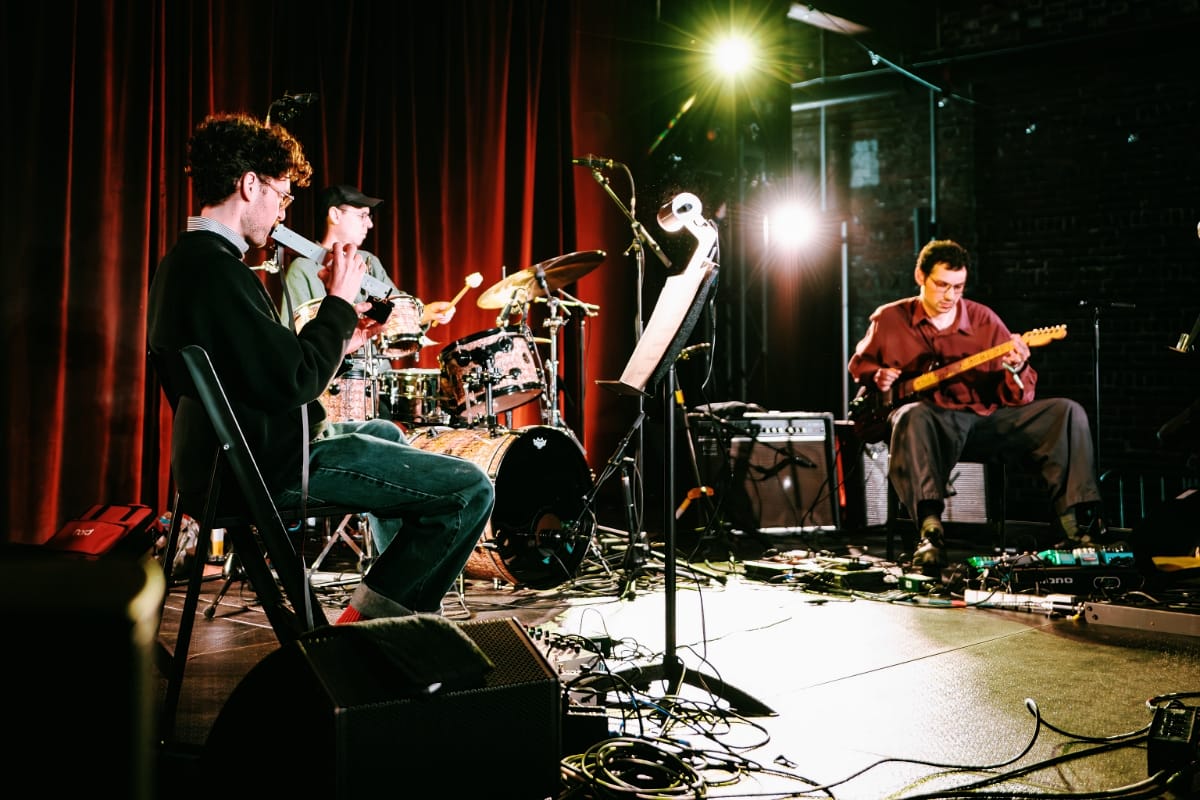
Gregory: This one was different for me in that way, because I was essentially just in my little room making things. Eventually, I'd be like, "Oh, this is sort of an idea that has a framework,” and after realizing that, I would invite someone into that world. With SML, or some other projects I'm involved in, it is purely a collaboration, and the ideas that initially spark it are generated from a full group dynamic.
So that was a different challenge for me; it felt new. It was also exciting to have the responsibility of making a world for each person. I basically would begin to realize how someone would fit into each thing I was working on. For the song "Back Scratch," I realized, “This really sounds like something that I could hear Booker [Stardrum] on." Yeah, it was pretty different because I had to make a framework before extending the invitation.
Sam: It does feel like each piece has their own little atmosphere. Did that feel like a conscious thing while working on the record?
Gregory: This is a record made over many years—probably five years. It was not even done with this idea that I'm actively making a record. It was pretty spread out, almost more like a collection that I sort of put together.
I mean, it started to make sense as I edited out different pieces. Yeah, each piece does have its own little world, and I was kind of struggling to figure out how it all fit together. Actually, one record that sort of put it into context for me was this Yasuaki Shimizu record called Music for Commercials. There's a similarity there in that it's just a bunch of different pieces he wrote that were compiled into a record. I love that record, and I guess it gave me permission to combine all these ideas in little worlds. It feels like you're just hopping along in these different pieces as opposed to following and seeing through a single path.
Sam: That makes sense to me. I was curious about whether it felt more linear or scattered to you, which you touched on.
Gregory: It's definitely kind of scattered, but there are a few pieces where the material is recycled and used as connective tissue. I think "View Above" and "View Below" are good examples. I use the same sample, and I would recycle and reinterpret material throughout. I guess that was a little bit of a thread.
Sam: While listening, I kept going back to this idea of communication in nature. Do either of those terms mean anything? Does nature play a role in your creative process at all? The two tracks I'd noted were "Burnt Toast" and "Voice Exchange."
Gregory: It's interesting with those two pieces, because there are definitely field recordings incorporated into the record, but not in those two pieces. It's more like "Lucia," which has ocean sounds, and some other tracks have samples of birds and other natural sounds. It has a voice, but it's not using words.
The interesting part about using these sounds that are not instrument-derived was bringing the outside world into this compositional world. I think a lot of that stemmed from the ability to make instruments out of sounds that I was finding. For the "Voice Exchange" piece, that was my friend Tasha’s voice, and I think I played that one on a keyboard using the sample. There are also instances of playing a bird sound on a guitar through a MIDI pickup. Finding that was definitely a big part of the exploration of getting different sounds out of our instruments and reinterpreting them. Expanding the sound world in that way became a focal point of the compositional process.
Sam: Can you tell me a little bit about using MIDI with the guitar and that process?
Gregory: It was something I was always interested in. I got a Roland GR-09, and I was playing around with that. That was my first introduction to trying guitar MIDI-related stuff. I struggled to find something that felt authentic and exciting within that particular unit. I started to question whether I was that interested in it. I got a Blackbox sampler, and I found that you can use either a guitar synth or a desktop unit to sample from any sampler you have. You can make a sample out of anything you want and play it as an instrument on guitar instead of the stock trumpet sound or something.
I really love it when people find cool ways to use those things, and there have been a lot of interesting examples of that, especially recently. But the dedicated sampler really opened up that world for me.
Sam: Generally speaking, since it's a common topic of conversation now, how do you feel about incorporating tech in music? Do you have reservations about certain things?
Gregory: I feel like I'm just quite slow at it, honestly. Using something different like Ableton, learning it a little bit, and using samplers has all been a very slow process. I think when you can find what is musical about technology and what can be applied in a way that feels like it's expanding what you're already doing, that's exciting. I've been hesitant to use a computer on stage; I haven't really done that. I think anything that's expanding your palette in a way that is still connected to your voice is really interesting. Any piece of technology takes a lot of time to get into and learn, to feel like you’re not just pressing a button and playing the default setting on it. But that's the same with any guitar pedal. It just takes time to learn and find the thing about it that you can control and channel what you're trying to say within the instrument.
Sam: Sort of off topic, but are you into video games at all? There were a lot of moments where I made comparisons to soundtracks of some great world-building or exploratory games.
Gregory: It's interesting because in almost every interview I've done, someone has mentioned that. I totally hear that, and I didn't until after I started releasing the music. I think it's in there, I mean, I was pretty glued to my Game Boy growing up. I'm not like a heavy-duty gamer, but I do enjoy them. I have a Nintendo Switch, and I play some games. I enjoy some of the shorter, puzzle-like games. There's this one called Hoa, it's almost like a neat Miyazaki-esque world. There's this game called Inside I enjoyed. Then, like, more standard ones. Zelda and that stuff.
I think part of it is my experiences with games, and then part of it is the music I'm interested in that sounds similarly derived from an expansive game-like world. Some different Japanese artists that I enjoy have used a Casio keyboard and some of those gamey-sounding computer keyboards. That influence definitely kind of snuck in; as you mentioned, within this album, there are a lot of references to the outside world and nature. It was very place-oriented in certain songs.
Sam: What about the name Extra Stars?
Gregory: I've been taking some trips to the Bishop area of California, and there's amazing hiking and hot springs around there. There's the Ancient Bristlecone Forest. You know, I grew up in Chicago, and I live in LA, and have pretty much been in a city my whole life. So when I went out there, the sky was super dark, really clear, and filled to the brim with stars in a way I'd never seen before. It was an overwhelming feeling. So the album is inspired by that area and making trips out there.
Sam: Is there anything in particular you hope people take away from the record after that first listen?
Gregory: I guess my hope for it, and I think for a lot of music I make, is that it just becomes a companion to the person in a way. Whether it's walking outside and listening to it or making dinner, I like the idea of it being there. It's a very environmental record to me. My desire in making a record like that is for it to become your little friend. It's like a companion and a backdrop to different experiences.
Check out more like this:
 Mariam Abdel-Razek
 Lawrence Peryer


Comments