


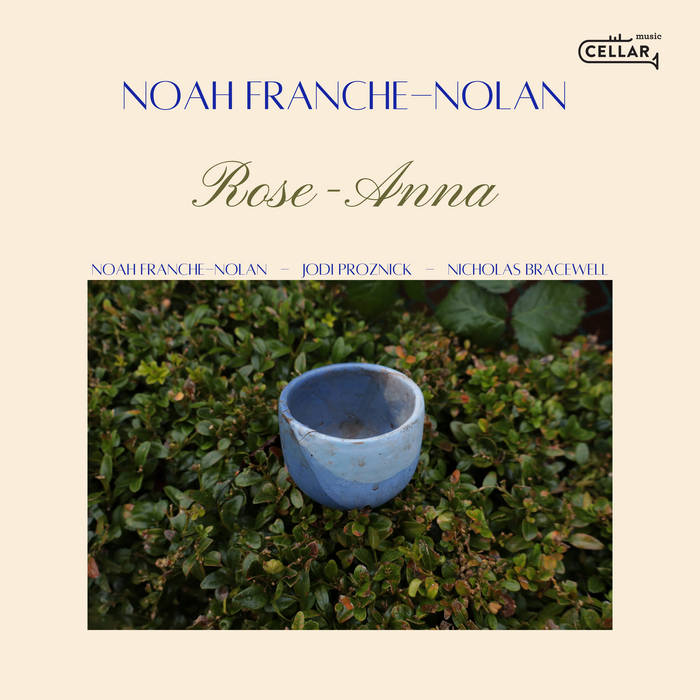
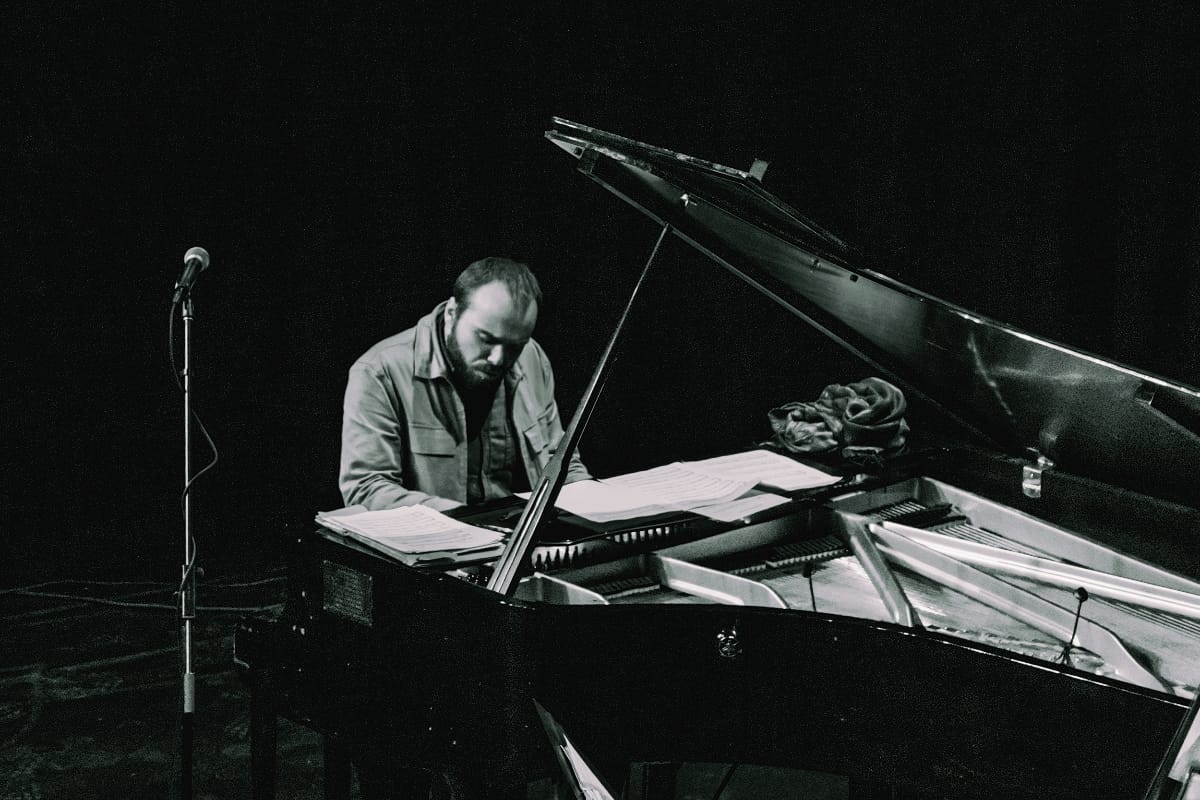
Earlier last year, Vancouver pianist and composer Noah Franche-Nolan released an album with Arid Landscapes, his duo with guitarist Dan Pitt, that wove textural electronics into the phraseology of experimental jazz. With Rose-Anna, recently released on Cellar Music, the JUNO-nominated musician sets aside those otherworldly sonics to lead his trio through a different kind of exploration. Joined by bassist Jodi Proznick and drummer Nicholas Bracewell, Franche-Nolan sticks primarily to piano (departing only twice for the organ), and yet the record covers considerable ground. The eleven tracks span agile, groove-driven pieces and forlorn miniatures, secular hymns, and freeform forays.
The album takes its title from Franche-Nolan's Acadian great-grandmother, Rose-Anna Chassée, a church organist from Grand Falls, New Brunswick. That lineage surfaces throughout, not just in the two tracks on which Franche-Nolan plays the organ himself, but also in the thematic preoccupations with spirituality, family, and home. The opening track, "Sublimation I," sets the tone: meditative and minimalistic, with a glimmer of the ecclesiastical, it slowly ascends over the rest of the compositions. The concept of sublimation (both the scientific process of transformation from solid to gas without passing through liquid, and the psychological redirection of negative feelings into positive ones) recurs three times, marking a conceptual throughline about change and transcendence.
Individual compositions reveal the breadth of Franche-Nolan's artistic practice and the varied sources that feed his work. "Haxan" originated as part of a live score he created with violinist Meredith Bates for the 1922 silent film of the same name, commissioned by Vancouver's independent theater The Cinematheque. "Nasz Dom," which means "our home" in Polish, is dedicated to his partner, Caroline Smolski. "Hawks" may showcase propulsive post-bop playing, but its title points to political actors who favor aggression in diplomatic matters. "Prayer" draws connections to Alice Coltrane's organ style, referencing both North American liturgical sounds and the drone-anchored melodies of her 1970s work. This interdisciplinary reach extends beyond Rose-Anna: Franche-Nolan has composed scores for Talha Jalal's documentary Rite of Passage, which debuted at the NYC Docs Festival in 2023, and for Vancouver playwright Shelby Satterthwaite's play Light Rapid Transit.
Lawrence Peryer recently hosted Noah Franche-Nolan for a conversation on The Tonearm Podcast. Among the topics discussed were Franche-Nolan's family heritage, the organ's role in connecting to his musical lineage, the function of music in spiritual practice, and the distinctive qualities of the piano tuner Bruno Hubert.
You can listen to the entire conversation in the audio player below. The transcript has been edited for length, clarity, and flow.
Lawrence Peryer: My understanding is that you've named your new album, Rose-Anna, after your great-grandmother. I'm wondering if you could tell me a little bit about her and her story, and what about her inspired you to name it after her.
Noah Franche-Nolan: So my great-grandmother, Rose-Anna, was a church organist in her hometown, and she carried music in her life with my great-grandfather as well. My grandmother told me they would get together and play after the Sunday church services. He would pull out the violin, and she would play on the piano at home. And so for that reason, I incorporated some tracks with the organ on my record—for this very reason—to sort of connect with my musical heritage.
My grandmother is an incredible pianist. She can sing basically any piece by Beethoven or Bach back to you. I have memories of just sort of playing some Bach pieces at her place, and she would sing me back the corrections when I made mistakes. On my dad's side, it's Polish heritage, and my grandfather would play polkas with his other brothers. And so I wanted to honor the musical heritage.
The main concept behind the album isn't clearly stated—and that's intentional. The main concept is that there's wisdom that's passed down from one generation to another. And I believe that, for me, part of that wisdom has come through the music that's been passed down to me. So that's the reason why I named this record after my great-grandmother.
Lawrence: Was the use of the organ on a few tracks an intentional sort of homage versus just responding to what you felt the composition needed?
Noah: I mean, it certainly was the latter as well. You know, I can't imagine "Sublimation I" without it. That said, I do play "Sublimation I" on the piano when I'm playing in a venue that doesn't have an organ. But I think certain tracks truly suit the organ—"Prayer," for example. All of these tracks, I've played them on the piano when the trio toured right before we made the record, and when we've played in different venues.
But there's something special about tapping into the organ, getting that texture, that sound, and also the implications of that instrument. The organ sort of alludes to some kind of spiritual contemplation. It's often used in that kind of context, and I think that's important.
Lawrence: It's interesting to hear that you play "Prayer" on the piano. In the recording, the organ seems integral—even in the way it's miked and in the percussive nature of the key clacks. I would love to hear it on piano.
So tell me about the various concepts of sublimation and how that theme manifests across the record. At what point in the composition or recording process did that reveal itself as an organizing principle?
Noah: To give you a bit of a backdrop, the original piece that I wrote was what became "Sublimation II." From there, I decided to create variations of that, which gave me 'number one' and 'number three.' I would say that it became clear about a month before the recording session. If I go back to that time, that was approximately a year ago. We recorded the record on January 3rd or 4th, 2025.
I had compiled some new compositions, brought them all together, and, around that time, some things had happened in my family. There was some loss that gave me perspective on what this music was leading towards. With "Sublimation," the intention behind that piece was that, throughout whatever struggles you're going through, you can carry forward and find some kind of hope.
And so I realized I could frame these compositions as an emotional or spiritual transformation. The title alludes to that—'sublimation' is about transformation, really. It's really that wisdom that's shared through your family members and through your loved ones that sort of feeds or provides the energy for that transformation, for that hope, on many scales.
There was a lot going on last year. I remember touring the music before we recorded. That was the week the president of the United States was elected, and so there was a lot of talk. I remember going into the tour thinking: how can we make something of this moment and help people feel some hope, or just energize or activate them in some way?
I mean, [in Canada] we're not in the United States, but of course, we're neighbors, and we feel what's going on and are impacted by it. So there was that backdrop as well—not just the internal struggles, but also the external struggles of our society or our community. That was all influencing the framing of the music.
Lawrence: Have you always been comfortable with talking about, or expressing through the music, what's going on emotionally and spiritually? Is that something that's always been part of your practice, or is that something that's newfound to you?
Noah: It's always been at the core of why I make music. I think that music moves people. I can look back on the first time I heard Coltrane's A Love Supreme—that was a very special moment.
I think music is meant to move people in various ways. And so I've always been aware of that, and that's why I was drawn to it from a very young age. I've developed a relationship with that ability to tap into these deeper emotions. So I'm more aware of what's actually going on, and yet, when I'm writing the music, it just comes out, and often I look back and make a bit of sense of it.
I think I've become more comfortable engaging with this side of music-making, but I'm aware it's always been a core element of why I make music.
Lawrence: I'm curious about when you have a composition that has maybe a specific inspiration or a backstory, which several of the tracks, if not all of them, do to one extent or another. Do you typically start with the extra-musical concept you want to write a composition for, or does the music come first and then the framing emerges? And by the way, I acknowledge it may not be a binary.
Noah: I'm aware of certain things that I'm feeling or thinking about, but ultimately, the music comes first. And music is subjective. You can make sense of a piece of art in your twenties and then, in your forties, interpret it completely differently. And that's one of the reasons why I haven't been explicit about the intention behind the record, in the liner notes or even the title track. Nobody would ever know the record was named after my great-grandmother unless they read into it online.
So the music comes first. I understand it as it develops, and the period of development is a long period. There's the composition, but then the rehearsal and the performance of the music, and by the time we're recording, the piece feels different. My trio plays the music. We interpret it, find spontaneous moments within the piece, develop an understanding of it, and then something comes out of it. So I guess there's a mix of the inspiration that came before I wrote the music and how I interpret it as I name the piece or speak about it. And I'm sure that, in 20, 40 years, I'll think of it differently.
Lawrence: I'd like to go back to "Prayer" for a moment. The material I read on this, there's an open acknowledgement of the Alice Coltrane influence—her organ style and the drone-anchored quality. That's a very specific lineage to draw from.
You've said a couple of times now that there's been this dichotomy between being overt in some of your intention and also not putting it out there—not necessarily hiding it, but it's not what you're leading with. "Prayer" seems to be one where it's all kind of out front: the title and the way it ties into such a spiritual predecessor in the music.
Noah: So in some ways it's inspired by the other band that I play with, which is Raagaverse, led by my friend Shruti Ramani. We always open our set with "Saajan," a piece she brought in. And we talk about how it's this meditative, prayer-like approach to starting the set. I was inspired by that and wanted to create something similar in my band, where we start our sets with something that grounds us in the music's intention.
I've been greatly inspired by the approach of Alice Coltrane, Pharoah Sanders, and John Coltrane, and by that lineage of musicians. And it's funny, because I'm not Christian. I work within a church—I serve as a music director—and so I've spent a lot of time in religious settings, and I've been greatly inspired by that. I see a lot of value in it.
I think there's something valuable in the place that music holds in our spiritual practices, whichever religion or approach you're taking, whatever it means to you. Music can create a trance-like state, and through it, we can reach another realm and feel connected. And I know that artists like Alice Coltrane certainly—her recordings and that whole lineage of musicians—they opened my mind to that.
Over the years, I've been fortunate to work in churches that let me express my own musical thoughts. I have worked in churches where things were much stricter, but I've also worked in great churches where I could improvise as people walked into the church. And so I've developed a strong understanding of the actual role that music plays in people's spiritual practices.
By the time I was 20, I understood that music needed to provide a space for people to connect their understanding of some greater force or sense of connection to the reality we live in. And through the many services I've played, I've gained an understanding of music's role in this, which directly informs my art. Music is a great way to connect with our spiritual practices, whatever they are.
Lawrence: It's interesting to hear you talk about your professional work in churches. I've talked to many jazz and creative music musicians who have gigs like that that have become gateways to exploring sacred or ancient music—even just providing these weekly opportunities for public improvisation, like you mentioned, at the beginning of a service or while people are entering.
Noah: Well, it can be humbling because it's a scenario where, in order to do your job well, you really must simply serve the music and the role that the music plays in this sort of social context. The music is there to serve people's prayer or contemplation. That's what it's there to do. You're not there to show off anything. You're there to support this congregation, to lift up the space so people feel they can reflect on certain things.
This goes directly to being a performer in a working-musician context. In a club where people are paying to hear you, ideally, you're there to serve the music. You're not there to show off. You're simply there to play the song, and in my case, convey some kind of feeling or message to the audience, whether it's spoken or unspoken. You're there to serve that purpose.
Lawrence: I'm really curious about when you write for film or theater. There's a predetermined narrative, if you will—a context you're working within. How, if at all, does that change your compositional thinking?
Noah: So there's a practical element to this, and it depends on what scenario you're in. For example, with the record, there are two pieces that come from music that I wrote for film. There's "Haxan," and there's "Union Town." I wrote that music for two films in two very different ways.
Häxan—the film was already made. It's an old black-and-white Danish silent film about witches. And I had been commissioned by The Cinematheque in Vancouver to write the full score—a live score—for a screening of the film. Of course, in that scenario, I had the final cut to work with. So I really got into the details there.
And I would say that, as much as we've been talking about emotional and thematic concepts, as a composer and as a working musician, I'm very practical and organized with how I do things. So before I start a project, I think about the timeline and how much music I need to write. I always think about form. I think about the time I have to express the idea, and how I will break it into sections to convey a developing, growing idea over that period. So there's a practical element to it, too.
Lawrence: What caused you to bring "Haxan" into the context of the new album and adapt it for the trio format?
Noah: Well, I really liked the theme. This is kind of funny, but my friend Shruti Ramani gave me this little percussion instrument for my birthday two years ago. I wrote the melody to "Haxan" on it and spent a lot of time with it. The theme that you hear on the record is the main theme for the film, and I really wanted it to feel organic, so I wanted it to come from my voice. I didn't write it at the piano at first—I wrote the melody on this little percussion instrument that only has eight pitches. So I thought that was an interesting setup to be working with.
I like playing strong themes, and I wanted to bring "Haxan" to the trio. I introduced that tune right when we went on tour before the record. It was perhaps a spontaneous decision, but I was very happy with it. I didn't have any problem with missing the strings or anything like that. It's a different beast. And you know, we see that in the history of jazz piano—many jazz standards come from themes from films as well. So there is that element to it.
Lawrence: Can you tell me about the role of Brentwood Presbyterian Church? What does it give you sonically or creatively that inspires you to work there?
Noah: So that's the church that I work for as a music director. First and foremost, it's very convenient because I can use that space for free to record my records. The acoustics in that space are really nice. It's not one of those churches with big concrete walls—everything is wooden. You can think of Rudy Van Gelder's studio as a similar sort of situation. The piano is also really nice, and it's tuned by Bruno Hubert, who's one of the best pianists in Canada, I would say—but also a great piano tuner. So I love that space. I'm comfortable within that space, and I've been lucky enough to be able to use it for recording.
Lawrence: I have to ask: what makes a great piano tuner?
Noah: As soon as I play a piano that's been tuned by Bruno, I know that it's been tuned by Bruno. There's actually a sound that comes from each piano he tunes. He has a particular temperament and is a very special person.
There's this smooth feeling to the action, and there's this resonance to the keys that no other piano tuner that I know of has sort of found. And if you spend time with Bruno and you talk to him about piano tuning, or just pianos in general, he talks about pianos as if they were these living, breathing organisms. He knows everything about the piano. He's taken my piano apart—I've got an upright. He's shown me how, when the wood expands slightly, it presses on one mechanism, changing the action. So he is very much aware of everything.
There's a funny story. When Keith Jarrett came to Vancouver, he heard Bruno play. He said that Bruno was one of his favorite pianists that he had heard in a while. So I really mean it when I say that Bruno is an incredibly special pianist.
Lawrence: Yeah, I can't imagine Keith Jarrett throws around compliments about piano players.
Noah: That's it. Yeah. (laughter)
Check out more like this:
 Lawrence Peryer
 Lawrence Peryer


Comments