


Just Mustard's third LP, We Were Just Here, is an album that induces wonder in many ways, and I'll name two. One way is through sound: the Dundalk, Ireland, band creates everything from low-rumbling, harmonized walls of sound to velocity-driven bass or guitar riffs that hold ample layers of texture and buoyancy, sometimes sounding symphonic and at other times electronic. All the while, composing songs that ponder the stars above with their post-punk futuristic vibe. Katie Ball's vocals fatefully find a linear path to deliver on this spaceship of distortion and disruption, sometimes perfectly in sync with the instruments, though often shaping a bright contrast of space through tempered and succinct melody. Her voice is like the point of origin in their songs, a place where the listeners feel safe from all the other moving parts. And every orchestrated part for Just Mustard feels so necessary for each other to exist and reach these wildly beautiful landscapes of sound. They move as one.
The second wonder is how they create the sounds through only a few instruments as they push their physical apparatus, i.e., guitars and bass, past the point of what sounds the instruments are known for. It makes me think of the action of holding a guitar, of hitting it, of strumming it, of plucking it, or of shoving it into an amplifier to make it angry. Mete Kalyoncuoğlu, Rob Clarke, and David Noonan seem endlessly curious about how they render sound from their instruments. How does a person hit or strum or pluck a guitar when it's pushed beyond sounding like the instrument that it is? It still has to be held like a guitar, but I can only imagine that it would change the rhythm of your body, arms, and fingers. Our bodies move to different sounds in different ways, and the band has a distinctive relationship with rhythm, harmonies, and melodies, one that they only know. We Were Just Here embodies Just Mustard's continual evolution. This album trembles and hums in composition and unfurls a soundscape, keenly shuttling to an unknown precipice.
Here is my conversation with Katie Ball and David Noonan. It’s been edited for length and clarity.
Jonah Evans: What are you guys up to today in Dundalk?
Katie Ball: I'm getting rid of a load of stuff, so doing a bit of decluttering. Went and bought a helmet for my bike.
David Noonan: Yeah. Just some wholesome, homely activities.
Jonah: Have you ever been tempted to move away from Dundalk?
Katie: We never attempted to leave. It just wasn't really a thing for us.
David: We started getting opportunities to tour abroad around 2019, and if you're touring, it's nice to come home to a place where you grew up and still have a lot of friends. It's nice to feel like you're actually going home after the tour.
I think we like having our own lives outside the band, and if we all moved to a city, we'd be like 24 hours a day, just a band, which suits some people. But I think for us, we're more like our meeting place is the band, and that's a good thing for us.
Jonah: I'm curious about your experiences with the DIY music scene.
Katie: It’s had an important influence on us. There are a lot of times when people are like, "Oh, we have to go to Dublin, and then we'll start a band." We started the band in Dundalk, and we released an album before even leaving Ireland to play a gig. So it was by ourselves. When I say by ourselves, it was with Pizza Pizza Records, but that was a label we set up with our friends and our manager, Joey.
David: Even on the live side of things, that influenced us as well. Growing up in Dundalk, I started playing gigs with different bands, just teenage bands. But the great thing was, it was teenagers putting on the shows. So it was like our friends were putting on the gigs, our friends were playing the gigs, and we were building a culture and a community we weren't necessarily aware of.
I think that's just following on from what people have done before you. A few friends were talking about it being like that. You look back on it, and there are a load of 15- 16-year-olds who were like, "Let's find a venue and create events for ourselves to play at," and not even really think that much about it, apart from just "we can do this." So other people have done this around the country. It's normal. But even just being a part of the culture of music in Ireland, I think, has been important.
Jonah: Tell me about your guys' relationship to electronic music and what electronic music means to you.
David: Being influenced by electronic music is probably where the band came from in a way. The majority of us got into electronic music at different stages before we started the band, and that was common ground. We were coming back to guitar music, and we were all into similar electronic music as well.
Katie: I think I was very inspired by the arrangements, and I've just felt like the arrangements in electronic music meant the possibilities were a bit endless when it came to putting a song together. And I found that inspiring when we were writing.
David: Yeah, we were definitely inspired by that, by electronic music in our songwriting.
Jonah: What conversations did you have about the kind of electronic sounds you wanted in your music?
David: Honest, we didn't talk about it in terms of how we're going to do this and translate it to our music. We just had conversations about music, and I think that informs your inclinations to what you come up with. It wasn't always, “Oh, let's try and do a thing. Let's try and make this kind of sound.” But sometimes it was that kind of thing. Like, “Rob, can you do a dubstep triplet bass line thing?” But it wouldn't be like, "How do we turn dubstep into band music?" We would just be like, "Oh, that's a reference" or whatever we could throw into the mix.
We’re also exploring the guitar. Electronic music is almost entirely rhythm-based a lot of the time, and that's what we were centering around. I was trying to find ways to make the guitar work with the emphasis on the bass drums and vocals rather than the guitars.
Jonah: Yeah, because when I watched some live videos of you guys, I saw someone hit the guitar and the sound that comes out of it—when you look at a guitar, you don't think about those sounds at all.
Katie: God bless pedals.
David: Sometimes you just hear a very specific or small thing in someone else's music, like, "Oh, that sound is cool. I wonder if I could do something like that?" And then you just figure it out. It's not that you're stealing, but are inspired by it. I feel like there's been lots of music where people are playing guitars in weird ways. A lot of that influences us. So, to us, it's not that weird.
Jonah: You've mentioned that with the approach of this album, you thought about looking at the studio as a creative instrument rather than a documentation tool. What does that mean to you, to use the studio as an instrument?
David: I suppose it's relative to how we've used it in the past, where we were just putting up microphones and trying to capture the sound as it was in the room. We weren’t really affecting the sound that much apart from vocal effects and stuff like that. This time, we manipulated stuff by recording it to tape, then reversing it, pitching it up or down, and resampling it back into the music, or using the outboard gear on the desk to create sounds that you can only make by stacking things in that order. So, just letting ourselves be free with the equipment that was there and letting it be a part of the process. We're exploring a bit more rather than just going in and being like, "This is what we're doing, and that's it."
Jonah: So you felt pretty playful, had a bit more freedom, and were more patient with yourselves. And patience with your curiosity as well.
David: Definitely, I think as much as you could when recording ten songs in eight or nine days. It was still a lot of just getting through it and trying to get it done. But within that, we tried to be a bit more open to following our instincts and seeing what worked in the moment, not what we planned.
Jonah: How do you guys feel about the record? Are you like, "Hell yeah, we did this!" Do you have a different sentiment than you did in your previous records?
Katie: Yeah, because we recorded it in October [2024], so we've been sitting with it for a while. Now that it's out, it's weird. It feels like an energy dump or something like that, at the moment. Right now, I'm excited to learn songs we've never played, like "Dandelion" or "Out of Heaven." We've only played "Dreamer" once, but I can't even remember playing it. I'm excited to learn those and start playing them live.
David: The ones you mentioned, Katie, I think are the ones that had the most amount of fluidity in the studio of changing parts or elements that were finished. There was some experimentation with those songs across the board because they were later in the process. They're the ones that we actually changed in the studio to some degree.
Jonah: "Dandelion" is interesting to me because I read in an interview that you're trying to push the sound of the guitar as far as it can go. And I hear strings on there. Are the strings some kind of guitar-synth pedal thing, or are they actually strings?
David: For the most part, it's all just pedals and a Fender six-string guitar. It's all distortion, reverb, pitch, and modulation. And then on the bass, a lot like sub-octave bass that sounds like 808 kicks or synthy kinda stuff. But, yeah, there are no synths on the album at all. It's all guitars, but some pedals have a synth element to them in a way that they have similar effects that you would have on a synthesizer or similar modulation effects. One of my pedals mimics a sequencer, and one of Mete's has a ring modulator and an LFO. So we have synth pedals, but no synths.
Jonah: Are you excited to play them live? I know you've spoken about evolving your live performance.
Katie: I'm just excited because I've never heard them over PA before. And you play the same songs for a while, and you're like, all right, I want to change it up a bit. Specifically, "Wednesday": I think we haven't played it in a while, and we want to clean the slate and not play the same songs we've been playing for the past couple of years. We want to look at our whole catalog and bring some stuff back.
David: I'm excited to play "Out of Heaven" because it has the most amount of space and tempo. It's got a similar structure to a couple of songs on [Just Mustard's first album] Wednesday, so I can see how that feels alongside older songs and the other new songs. It'll be really exciting, or it'll fall completely flat on its face live. The potential for it to be terrible is exciting because you actually have to balance that.
Jonah: You also talked about how you like making songs that are on the edge of falling apart. Something is exciting about that.
Katie: Yeah, the rhythms in "Out of Heaven" are crazy, and if anyone slips out, we're all fucked.
Jonah: When I listen to We Were Just Here, Katie’s vocals aren’t monotone; they're going in a lot of places, but they're staying on their own plane. And when I think about drumming and timing and also everything else that's going on, I'm like, “This is like a delicate process of coordination and spacing.”
Katie: It is. Some wacky ideas thrown together.
David: I don’t know why we are attracted to that, but that's definitely part of the thing we enjoy when we're writing: balancing these things that are precarious musical ideas to sit beside each other. It's almost like when you have ideas that you don't understand, and they work together, but you don't know why. That's more exciting than, “Oh, I've had this really cool idea,” like two plus two equals four. It's just more engaging when something works, but you don't know why, and you just lean into that thing.
When Katie puts vocals on music, either that she's written or that we've all written together, it's great when it's kind of you're like, “What?” You never expect what she comes out with, which is always really exciting. It never feels like it just falls out of the song. It's always a new melodic thing on top that completely recontextualizes what we were playing or whatever the part was.
Katie: I recycle vocal melodies a lot. A vocal melody might be from a completely different song that I was writing by myself, and I tried it over a new song to see what it sounds like, and it works somehow. But I don't know if I would've thought of that melody over that song without the other song existing before it, which . . .
David: That's happened a lot.
Katie: It happened with We Were Just Here as well. So yeah, I think just collecting vocal melodies myself for songs that'll never see the light of day has helped create the weirdness in the songs, and just not being scared to try something that is not what you'd usually do.
David: Sometimes you can psych yourself out of an idea. You're like, "Oh, that's too weird," before you do it. But you can't tell how it feels until you do it. So it's easy to psych yourself out of doing things that feel wrong at first. Don't criticize yourself until you've done it, and see what it is.
Jonah: This is like deep hole theory, but do you guys speak Irish?
David: A little bit. I'm trying to learn again. I learned it in school and stuff, but I never really used it. I've lost a lot of it.
Katie: I'm trying to learn.
Jonah: Thinking about Irish language phonetics, when you look at the words and then hear them, it reminds me a little bit of your music. There are these layers when you look at it, you're like, “Okay, it's supposed to sound like this, and it doesn't. It sounds like something else.”
Katie: Yeah. I think I'm definitely not scared to use Hiberno-English in my writing. Do you know what Hiberno-English is?
Jonah: No.
Katie: It's basically the Irish way of speaking English. A lot of it is derivative of the Irish language. So there are just things we'd say that wouldn't be grammatically correct in English, but I don't care about that because I'm not scared to use them in my writing at all. How we're speaking doesn't mean it's wrong, just because it's wrong to someone else.
David: I think it's really cool to play with language, and we're playing with the form of the sentence, starting from a place where the sentence is backwards, and then playing with that as well. I don't write many lyrics for the band, but I do sometimes, and I've been playing with the form of my own language lately.
Jonah: Do you have an example of the Hiberno-English, like a phrase or something?
David: Like in Irish, there's no word for yes or no. So it's like if someone says, "Are you doing something?" You'd be like, "I am" or "I'm not." That would be the direct translation. And then, if you ask an Irish person, “Are you going out?” Obviously, Irish people say yes, but most often they say, "I am going out," or "I am." So that's like a simple version of it. Endlessly fascinating because in different parts of the country, you have other ways of speaking Irish as well.
Jonah: That's cool. I like seeing how you guys create your music through the lens of language, spacing, and rhythms.
David: I started playing traditional Irish bodhrán even though I played guitar in the band. The bodhrán hand drum is the same physical movement as strumming a guitar. I think from playing the bodhrán, I got more patterns in my hand for playing guitar and then translating them into drums as well, like doing that 6/8, 4/4 with movements, like triplets inside four. I don't know how much it came across in the album, because it's just ideas in your head that you throw into a song, and they don't necessarily pop out. But there's definitely an influence from Irish trad there, as much as there can be in our music, or however small. Taking inspiration from one instrument and applying it to another, or just cross-referencing rhythms like that, can be fun, help you out, and sometimes lead to interesting things.
Check out more like this:
 Jonah Evans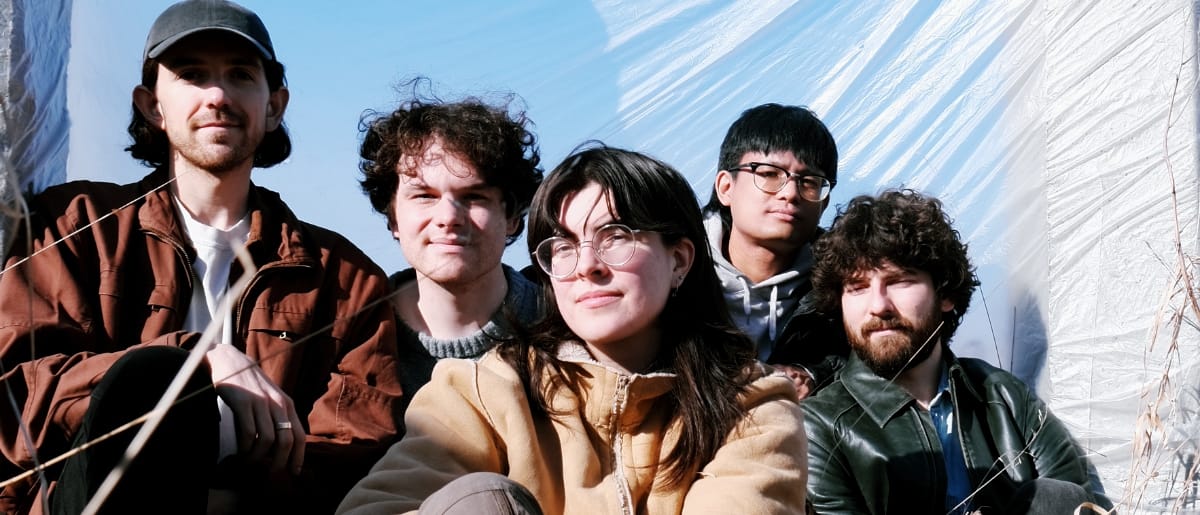
 Michael Donaldson


Comments