


Editor's Note: I asked The Tonearm's contributors for a paragraph or two about their favorite cultural moment of 2025, which I published in an early January installment of the Talk Of The Tonearm newsletter. What follows is one collaborative contribution to my request that went way too long and was way too thoughtful for the newsletter. I'm excited to finally present it here on its own.
Meredith Hobbs Coons and Carolyn Zaldivar Snow, the co-authors of this essay, both contribute to Tape Op magazine and The Tonearm—and we grew up in the 1990s. We existed in a pixie cut, sunflower decor-laden existence that brought us The WB (or, more importantly, Paula Cole's confident piano anthem "I Don't Want to Wait" as the stars of Dawson's Creek appear in soft focus at a 4:3 ratio) and Lilith Fair (also featuring Paula Cole, who, during that time, went on to face the gauntlet of late-night male-dominated commentary on having armpit hair). When we meet up virtually from our opposite coasts, it's fair to assume we greet one another with a hand on the heart and one hand on our sacred book, Jessica Hopper's The First Collection of Criticism by a Living Female Rock Critic, while Fiona Apple's Tidal swells in the background. So, of course, we had to select the 2025 documentary Lilith Fair: Building a Mystery, which originated from Hopper's 2019 Vanity Fair oral history on Lilith Fair (with Saha Geffen and Jenn Pelly), as our favorite cultural moment of the last year. Switching point of view in this short essay, we share our thoughts on this crucial feminist history, which captures a precious era of our respective lives.
Carolyn: The first thing really lodging itself in my nostalgic brain: maybe the 1990s were a good time for women. But I am feeling that frog-in-hot-water hellscape we are living in. [I am adding a real-time postscript here in mid-February because, as I reflect on my teenage years and the culture that shaped them, Congress is now reviewing the Epstein files. Feminist commentators have presented credible evidence that several of the people implicated helped shape much of the consumer culture aimed at young girls in the United States. It's a terrible thing to process in hindsight.]
I had a very emotional response to seeing women as stage crew at a major live event, swinging cables down with stealth confidence. I realized the significant alternative of what was being offered by Lilith, right down to Sarah holding a commanding presence at the helm of a profitable, somehow staunchly altruistic enterprise. Watching archived footage of Lilith pressers and the gamut of absurd questions from reporters who act as if they have never seen a woman in charge before, feels like a time-traveled mirror to Hillary Clinton's 2016 campaign. I cannot decide if things are better or worse for women. Watching the musicians of Lilith Fair take on the late-night talk show circuit pre-MeToo is a difficult journey through the bodily critiques and uncomfortable forced kisses and touches. It's a disorienting tour of feminist benchmarks coupled with puberty.
I'm going to zag, Meredith. I'm also noticing the state of the music industry since that time. The decline of physical media, complications from streaming, post-COVID live events. I was genuinely surprised by ticket capacities and combined audiences mentioned in the film. I would never have guessed that, in that era, Sarah McLachlan was more of a 3,000-capacity artist, and Tracy Chapman was the heavy hitter coming in. I had no idea Patti Smith participated in the test run for Lilith, but didn't go all out on the principle that her work would not be gendered.
I saw Patti Smith once live at Goucher College in Baltimore. A young man catcalled her from the audience, and I remember she very coolly responded, "Hey, however you need to see me." I like this statement because it flips the responsibility back to the viewer, not the artist. Even more so, it's dismissive in a bold way. Maybe that's what's happening here: "However, you need to see me."
Comedian Sandra Bernhard's "women of the canyon" comment was particularly punchy and accurate, even if disappointing. She raises a good observation as comedians often do– there was definitely a class and race connotation to early runs of the festival.
Meredith: That critique is super real—it was certainly very white—and something that we see Erykah Badu had worked to address with a festival highlighting Black women artists (the Sugar Water Festival, co-founded with Jill Scott and Queen Latifah in 2005), in that little clip at the end of the Lilith doc. There is still so much work to be done to integrate artists of color across so many genres—even now—not just country, as Beyoncé has made clear, but indie rock and pop, too. It was honestly encouraging to see that they responded to that critique in later runs of the festival.
Speaking of which, how do you feel about the claim at the end that the spirit of Lilith simply lives on in acts like Taylor Swift and boygenius? I could see what they were getting at, especially in relation to the artists comprising boygenius joining forces to create an indie musician supergroup of all (white) women, but it felt . . . well . . . not quite good enough for me?
Also, they dismissed the idea that reviving Lilith Fair would be worthwhile, as they had tried that in 2011 or so with little success, but I don't think the issue is a lack of interest at all. Rather, I think the entire touring model and associated costs have changed significantly, and I'm not sure attending big festivals of any kind is a major priority for struggling Americans at the moment, unless it's some nostalgia-fueled cash grab like When We Were Young, Presented by 7-Eleven. (Yes, I kept the sponsorship nod in there to be petty.)
I fully agree that it was incredible to see these women, Sarah McLachlan in particular, being unapologetic in their quest to build something financially, socially, and politically significant with Lilith Fair (and how about that double meaning with "fair" as in "festival," but also "equity!" I hadn't connected that, and I enjoyed it).
The fact that the tour provided so many opportunities for women to gain hands-on training as crew members was thrilling to learn as well. So many performers and/or productions tout themselves as progressive, and yet all of their tech people are white dudes?! Come on!
The most moving part of this documentary for me, though, was definitely Thao Nguyen's talking head—not only because I'm a huge Thao fan, but in that it articulated exactly how I had felt as a young kid torn between my comedy fandom and allegiance to these singer-songwriters I had admired so much at the time. Thao actually brought, at least, Jewel and Sheryl Crow on Song Exploder during her 2019 run as host, filling in for Hrishikesh Hirway, and that began my reclamation of these artists as essential to my musical identity before this doc ever aired. But back in the late '90s, with all the dumbass jokes, I ended up feeling very ashamed for having been interested in most of these artists. (Not Fiona Apple, though. Fiona forever! Since fifth grade, she has been my litmus test for whether people have good taste in music.)
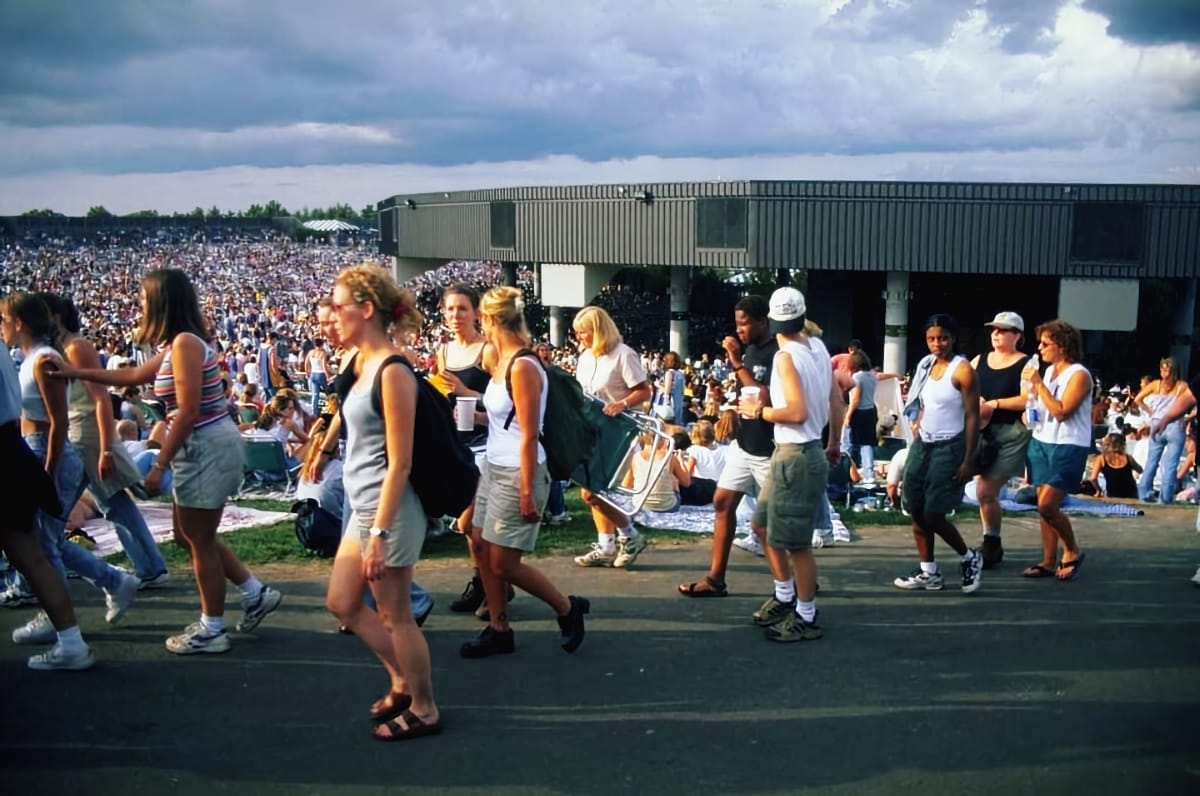
Carolyn: I like that you use the term "music identity." I hadn't considered the shame portion. I really took to Lisa Loeb growing up, and I do remember feeling some shame about that. I mean, I wore a Nine Inch Nails Downward Spiral shirt to school with cherry-red Doc Martens that I snuck into school in my JanSport. I grew up in an evangelical family, so everything felt scandalous and shame-addled. But my parents let me listen to Lisa Loeb. I think we all want to see ourselves reflected back, so in a small way, just being a girl with big glasses (Lisa) and in a big way, quietly recognizing that women can helm a major fucking music festival. The messaging in my household was "girls are elementary school teachers and mothers." The message pressed into my inner JanSport backpack was "women can shred." I kind of wish I had seen footage of the Lilith stage crew and road crew in the '90s. I slowly found my way into AV through theater tech and later spatial environments, but have always existed with an all-male crew. Even now.
As for Lilith living on in Swift and boygenius form? Is this where I admit Taylor doesn't resonate for me, but I can absolutely recognize the economic engine she is in the same way Lilith is—but back to that music identity, queer kid trying to see herself? Certainly boygenius for me. But what if I argue the spirit of Lilith can also exist in another cultural phenomenon like the film Bottoms? Or tipping the gender scale of law school and medical school?
Meredith: I like that! I think that's a Lilith-approved take for sure, that progress can come in many forms. And it feels important to have Lilith documented like this, to have this footage and interviews to point to as evidence of where we've been before people try to dismiss future efforts to include more women in events—or, hell, to center women in events. It can be done; it has been done.
Also, I changed my mind about the most moving part of the documentary. It wasn't any single part of the documentary—not Sinéad, not Sarah's composure during the press conferences, not even Thao—but the response to it. In my social media spheres, so many cool-ass women I've known throughout my life were all sharing heartfelt reactions to it, or reaching out to me to commiserate as I shared my fondness for it. It connected women and queer folks back when it happened, and through this documentary, it was able to do it again, at scale. You mentioned the return to physical media, and I want to end with this humble plea to the Lilith goddesses: release this on Blu-ray, DVD, VHS—whatever you can, please. I hope this can have a life beyond streaming, for posterity. (Also, I'm doing the Hulu boycott thing, and I want to watch it again.)
Check out more like this:
 Meredith Hobbs Coons
 Carolyn Zaldivar Snow


Comments