


Lawrence English has spent more than twenty years investigating how sound occupies the body. The Brisbane-based composer, curator, and artist constructs pieces that exist equally in physical space and in perceptual attention, and erase the line between acoustic and electronic sources. What remains is texture and presence, a sustained attention to how sounds behave when they encounter one another and to the spaces they inhabit.
Since 2000, English has directed Room40, the imprint that has become synonymous with adventurous experimental music from Australia and beyond. He has worked extensively with Merzbow, William Basinski, Jamie Stewart of Xiu Xiu, and Alessandro Cortini of Nine Inch Nails. His partnership with Stephen Vitiello extends back more than twenty years, yielding patient, exploratory recordings that treat sound as sculptural material. Vitiello, whose own projects include work with the late Pauline Oliveros and Ryuichi Sakamoto, shares English's commitment to restraint and spatial awareness.
Trinity, the pair's third album together, arrives with a structural twist. Each of the five tracks features a single guest: Chris Abrahams of The Necks on piano; Brendan Canty of Fugazi and The Messthetics on drums; improvising turntablist Marina Rosenfeld; multidisciplinary artist Aki Onda; and the late Steve Roden on electronics and what the credits call "mystery sounds." Roden died of early-onset Alzheimer's in 2023, making his contribution here a posthumous appearance. The album, released via American Dreams, extends the approach English and Vitiello developed on Acute Inbetweens (2011) and Fable (2014), but the addition of third voices pushes the record into the territory of 'surprise.' The guests work within the sonic world English and Vitiello establish, reshaping it from the inside.
Lawrence English was a recent guest on The Tonearm Podcast. In a delightfully wide-ranging conversation with host Lawrence Peryer, English discussed nostalgia and its relationship to possible futures, the practice of field recording and relational listening, collaboration as a willingness to be surprised, and how his work with Stephen Vitiello on Trinity renewed his faith in the unexpected.
You can listen to the full conversation in the audio player below. The transcript has been edited for length, flow, and clarity.
Lawrence Peryer: You're in my kind of environment. It looks like you're surrounded by ideas and inputs.
Lawrence English: Yeah, there's tsundoku, that Japanese word for collecting books that you don't necessarily get to. I'm very good at doing that. I was actually in Japan for a month. I've come back with many new piles, which means this thing is only going to get worse. But yes, I'm 100 percent with you. If there are no ideas, then there's nothing.
I also think you go through periods, particularly—and I'm sure you find the same thing—where you're in a delivery mode, where you're doing a lot of making and things are going out the door. But at a certain point, you need a moment to put things in. Otherwise, the river runs dry.
LP: What's the relationship between consuming ideas, especially reading, and musical output? Do you see that connection directly in your musical work?
LE: Look, I'm one of these people who cannot make work from nothing. I make sound work and music, but I don't necessarily think of myself as a musician. If you're going to pick a word, it would be composer.
There's a Japanese group called Tenniscoats. What I love about that band is that Saya and Takashi Ueno, as a duo, make the most beautiful, melodic, song-based work. But you can give them almost anything, a glass bottle and a fork, and somehow they will find this musical language out of that object. I do not have that. I cannot make work like that. For me, the boundary, if you like, or the frame, the vines, are actually what make the work.
Right now, I'm halfway through this new project, which has been underway for quite a while, but I've been spending a lot of time researching ideas about metabolic architecture from Japan. So I went to look at all of those buildings. And I'm thinking a lot about this idea of nostalgia as a problem, maybe, or as something that has become a site of crisis in the modern age.
LP: During the holidays, there are conflicting feelings about nostalgia that come up. Especially in America, our conception of the holiday season and of the Christmas holiday is essentially viewed as a mid-century phenomenon. All the Christmas films, everything from the thirties to the early fifties, are so deeply nostalgic for another time and for what Christmas was. And I can't put my finger on when that time actually existed. Like, when was Christmas this idealized thing? It's so strange.
LE: Well, sometimes they don't exist. I mean, there's another great Japanese word, natsukashii, which basically means a kind of longing for a time or place that perhaps you were never part of. I think there's a very clear delineation between that and the usual idea of nostalgia. Even the nostalgia's original use was in a medical context: the desire to return home. It was to do with people who had been at war or away, and this idea of a longing to return to a place that they knew already. That was the kind of tether, if you like, that tied someone to a place and a time.
What's interesting now about nostalgia is that there's this reconfiguration of it where it has become much more like what we would call natsukashii, this idea of something that never existed, really, but we're somehow presenting it as a thing that did. Mark Fisher really pioneered a lot of the thinking around some of these ideas. And it's partly come to mind because AI has really helped map the image of a kind of nostalgia.
I've sort of come up with this working term "acid nostalgia," which is a little bit of an odd term. The reason I've called it acid nostalgia is that, in this new version of nostalgia, it's like pouring acid on something. The thing can still be there, but it's heavily transformed and changed, and the detail of that thing, that memory, that attachment to that place, is gone.
There's an interesting idea to untangle there: decontouring the possibility of the future. I'm very interested in the idea of possible futures, and I think nostalgia now is about reducing the past and weaponizing it against the future. There's an attachment that almost weighs people down.
I made a record called Cruel Optimism, which was about Lauren Berlant's theory of cruel optimism. In some respects, it's the same thing. It's about maintaining bad attachments, or in this case, creating possibilities for bad attachments to be maintained. It's an interesting one. I'm still working through it, an active investigation, but I think there's something in this idea of decontouring the future, trying to reduce the detail and the nuance. And it carries through in many other areas, too, like civic infrastructure, the practicalities of how we plan the places we live, and even the way the internet operates now.
It's so much less than what it could be. And it seems we can't quite find our way back to making a progressive environment where anything is possible. It feels really restricted, heavy, and hard to maneuver, and there's not much room for people in it. Which is a curious thing.
LP: When you spoke about the initial meaning or use of nostalgia, it made sense to me. There's somebody in this crisis situation—you said, you know, in war—longing to be home. But now, in the present day, it feels like everything is being coded in nostalgia. I can't disentangle it from societal alienation, like widespread alienation. How can I be optimistic about the future when I see the news and check social media? All those things people have in their cultural stew right now feel profoundly unhealthy.
LE: It's increasingly difficult. The idea of a news cycle that has really shifted over the last two decades plays completely into that. You are never let off the hook. There's always another problem, always another thing, always another report about however many hundred days of the Ukrainian war or another healthcare disaster, or the government continues to be shut down.
There's never good news. And if there is, the good news is at a different scale. And actually, the problem for us is that we can't separate the scales anymore. We're somehow entangled in a geopolitical environment that, honestly, we as individuals have very little to do with. Yet we tether ourselves to these things, ballast ourselves on them, and travel with them, when actually what's really important is making a meal with your family. Or talking to your neighbor.
We don't all share the same views because community is not agreement. It's actually an active discussion. But what feels up close is all of this other stuff that is kind of the noise, if you like, in the system, not actually the communication.
LP: All those things are real experiences happening to real people. But to your point, they're disembodied people from a practical sense. I can imagine the experience, but here I am, a middle-aged white man in the Pacific Northwest of America. I'll have my own hardships, but I'm not going to have theirs. And it's very hard to metabolize that.
LE: Yeah, it is. It's one of those things where we can attach ourselves to the world. If we're going to talk about being present, maybe right now outside my window, you can hear a baby bird waiting to be fed by its mother. That is the world that we live in. (laughter) This is the relationship I should be having: looking out my window, seeing a noisy miner—that's what they're called, noisy miners—just basically begging to be fed. That's lived experience right there. It's this moment-to-moment thing that is really valuable and actually joyful.
I love looking out the window and seeing birds. We live in Brisbane, which is a kind of subtropical city. We are living with the world all the time, and sometimes, perhaps a little too closely. I just came back from a month away, and literally on the back of my house was a giant, three-meter-long python skin, and I thought, "Well, that's good to know that there's a python in the yard." (laughter)
It's quite interesting to have moments when you recognize that you are not alone, that you are sharing the space, and that the space should be shared. And we just need to find a way to reconcile the boundaries. Maybe you stay outside or on the ceiling. I'm happy with that, just not in the house, if you know what I mean. You've got to find comfortable boundaries, and it's an active discussion, but that's what keeps it interesting.
LP: I want to talk to you a little bit about your theories of collaboration. The pretense for us getting together was that I had received some information about Trinity, your new work, or your newest work with Stephen Vitiello.
I love the project's construct—bringing in a different collaborator for each track, but only one at a time. I talk to a lot of artists about the idea of constraints, systems, and prompts as a means to ringfence the work so that you have something to operate against or within. Was this construct a constraint that you both developed as a way to guide the project, or how did this all come about?
LE: I would say that any situation like that is simultaneously a constraint and this amazing floodgate opportunity. Because that's what's really interesting about collaboration. Obviously, collaboration takes many forms, and its operation varies from case to case. And it's down to personalities, and it's down to the way that we choose to negotiate with each other.
What I enjoy about collaboration is that ambiguity, that it's never really set. You can set up rules or structures or limitations, but inevitably, you will exceed them in a way that you don't expect. I mean, that's what I've found, at least. I have been very fortunate in my life as a maker to collaborate with people I have honestly found to be extraordinarily generous, porous, open, and fearless. And it's been really a constant learning curve for me.
Stephen and I have known each other now for more than twenty years, a long time, and I've had a great deal of respect for his work as an artist and a musician. So we've had a few exchanges already, and when you return to those exchanges, what's interesting, and actually what's a joy about them, is that you can begin to sort of feel at the edges.
Every collaboration is setting an environment that you're going to potentially live in together for a while. And at a certain point, you do want to kind of feel at the edges of that. And then in some ways, you reclaim more space. Potentially, it becomes like a reclaimed situation where you're building out these edges. And for Stephen and me, with this work, we'd already been developing some of the material together. We were talking about what the reclamation is here. What's the expansion into this other thing? Where's the edge?
I'd had this idea of impossible trios, which, for me, is actually a really practical thing. What was interesting was that when we started approaching people to ask for contributions, it worked in very different ways with different collaborators. Stephen was recording with Brendan [Canty], so there was a very direct connection there. Stephen had been with Steve [Roden] when they'd made that recording. I'd just been in Japan with Aki Onda, and I'd seen his bells because we were working on an exhibition of his that I curated in Melbourne. So there were very active connections going on.
What was wonderful about that interplay was that as soon as that person, that third voice, came into the piece, it completely changed the piece. Sometimes it wasn't radical. Sometimes it was very subtle, a detail, or another part of the piece that came to the surface that wasn't there before. But each one of them reshaped how the voices were articulated. It was like you suddenly have a soprano or a baritone in something that's been like an alto choir. There's a whole other register that opens up. And that register is complementary, sometimes overpowering, and sometimes just about reinforcement.
Actually, it was surprising in ways that I didn't expect. And that, for me, is one of those affirmations about why collaboration is still relevant for me. That was an active question, as much as this work with Stephen was, where I was thinking: Does collaboration still have a place? Do I still learn something? Does it still hold the chance to be surprised? Because, honestly, that's what I'm looking for. That's getting back to what we were talking about before, about the idea of ideas. I want to be surprised.
And the world is super surprising, and relationships are super surprising, and people are super surprising. You've just got to be there to let that surprise happen. And I think I had that really reinforced with Trinity, actually. I'm still a believer. (laughter)
LP: Temporality and time are the most obvious physical elements of music, but space and distance, and even spatiality, seem to play such a big role in your work. Part of that is the nature of ambient-inflected music. I wonder if you could talk a little more about how you view space.
LE: If I think about it through the lens of field recording, and this applies to composition as well, I draw this line between the idea of space and place. Space is the physical environment, if you like, the hard fixed architecture of the world. But what happens in that architecture is the stuff that I guess I've been talking about so far, this idea of the incidental things, the bird being fed outside the window. I look out the window now, and the tree is still there, the sky is blue, but that event has passed. Somehow, miraculously, the baby bird has been satiated.
But to recognize that there is this evolving, unfolding, multifarious narrative going on all of the time out there, that's place. And if I'm not here, you are not there. If you are not paying attention out the window, then you never see the birds. If you're not present, then you don't get that. You're not afforded the opportunity of that experience.
That's something I try to carry through in all my work. It's about being there. It's about being inside. If it's the case of a composition, it's about being inside the composition and also being available to it. Because there's a certain point at which you make work, or you build a relationship, and you begin to expect something from that relationship, or you begin to think that you know it. And you do, in a certain way—you do know it. But all it takes is the smallest repositioning of yourself, and sometimes in a really physical way.
A lot of my work is about iteration and this idea of construction and deconstruction, and erosion and things being worn down over time. And it is about this kind of compression, this weight of one thing being laid on the next. Sometimes the pieces are eighty or ninety layers deep. And do you hear layer eighty-nine? Maybe you never do. But when you take it out, you notice that there is something that changes in there, like that gauze-like blur. I think that's really important. It's certainly important to me because I experience it in the world every day.
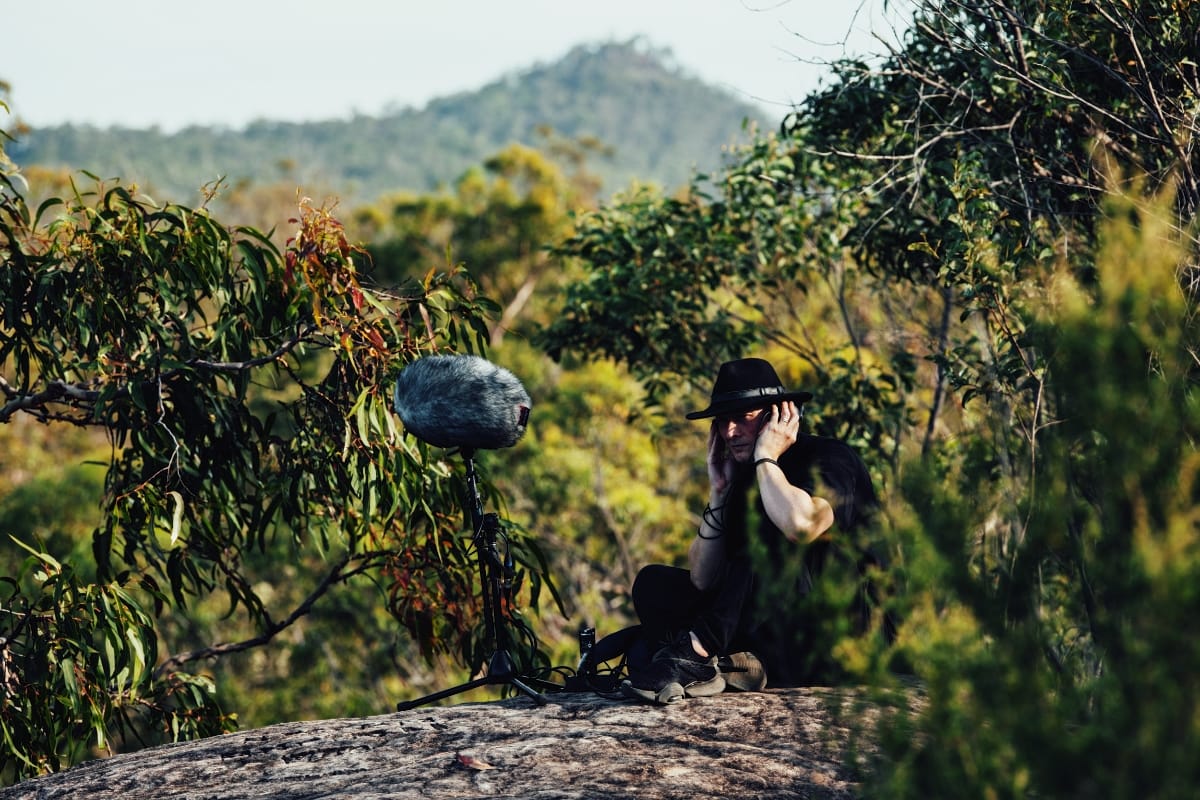
That's one of the things that actually keeps me with something like field recording as a practice: you are constantly piercing out into the world. You're reaching toward your listening and all the possible listenings in that moment. And sometimes you're fighting for that listening. You're really trying to hold that point of focus or attention. At other times, you are being pulled by these events. It's almost like a stream of consciousness of chaos.
I love that. You're just there. You're part of it, whether you're lucky or not. And if you try to fight it, that's where the frustration comes in. In the same ways as some of the other points that we've spoken about, it really is about that idea of recognizing where we fit and how we fit in the places and the spaces that we're in.
LP: When you are conducting a field recording, and you come back to review the work, how often is the experience of what you're hearing during playback different from what you experienced in the field? How often are you, to use your earlier words, surprised, and you say, "Wow, I didn't even hear that in real time?"
LE: My PhD was basically built on this theoretical framework for listening, which I call relational listening. And it's about that tension, exactly how you've described it, between your listening and the recording of, potentially, that listening. I used field recording as an example because I think it really does summarize the problem and the question.
I found a great text by Peter Szendy, who I always have to credit, because he set me on this pathway. He wrote a fantastic book called Listen, in which he proposes two provocations. The first is, can one make a listening? And the second part: if you can, can you transmit that listening as unique as it is?
What I love about that pair of questions is that one, it recognizes that when we talk about listening, we're not talking about this holistic absolute. We're talking about our listening, the thing that you are listening to right now. There is a series of events happening right now that you have been actively blocking out. I know for sure I'm actively blocking out the cicadas here because it's summer and we just have cicadas all of the time. But I often catch myself thinking, "Wow, I haven't listened to them in like three hours. My brain has been just absolutely mind-bogglingly effective at filtering out the world."
Coming back to the idea of surprise and field recordings, I wanted to consider how you manage that idea of surprise. What are the things that you want to be surprised by? There's a great example of people going out with a recorder to record a bird in a tree. They're standing there, they put their arm up towards the tree, and they're pointing the microphone at the bird. They're listening to the bird and thinking, "This is going to be such an amazing recording. I can't wait to go home and listen to it."
They go home, nervously fumble the SD card into a slot, and play it back. And all they can hear is this intense traffic noise and this very distant bird. They're like, "Oh, I was right next to the highway, but I wasn't listening to that. I was listening to the bird." But the microphone doesn't care about that. The microphone is this beautiful, to some degree democratic object that is just going to take it all in. It's just going to grab whatever.
So there's this inbuilt tension between the psychological interior listening—the kinds of occupations and preoccupations and interests that you maintain as a listener—and then this kind of technological audition of the microphone as a sort of prosthetic ear and this device that, as Szendy talks about, allows the transmission of the listener's listening to take place.
LP: But a lot of what you articulate there, to me, is encapsulated in the medium of recorded music. That is what recorded music, or recorded audio, is doing. It's attempting to almost dictate or control those two experiences. And it plays with time and artifice; it's a unique medium in that regard, even different from film.
LE: I agree. I like to think of it as a kind of world-building exercise. My favorite records are worlds. And in fact, my favorite songs are also worlds. They're worlds that operate in a slightly different way. I mean, they're sonic, but they're also psychological. I think that's really a very powerful thing that songwriters have and I'm not a songwriter. That is something very special that they have, and I respect that absolutely.
What I like to think about with sound and composition is that you are trying to build a place people can be inside. A lot of my albums are continuous pieces. Trinity is not one of those records for a whole bunch of reasons. But my solo recordings are largely about this flow through time, because I agree—time is like the fundament of music.
What I hope is that when people come into that place, they can settle in it for that period of time. And when they leave that place, the ultimate goal for me is that they think about it again, and that they are happy to return to it, and that it has more meaning for them than the actual lived time in that place. I have many records in my life that are like that. I'm grateful for the excessive qualities that experience has brought me. And I can return to a version of that place in my mind's ear that is still really valuable, even when I'm not listening to the work.
As a maker, increasingly what I try to think about is the relationships between elements. That might be really tangible things, like we're talking about in terms of the technical spatial structure of a piece of music. Or it's about those meeting points. And this is something I'm dealing with right now: the meeting points between two pieces of music that have been created independent of one another, but there's a point they can meet, and that suddenly becomes this other, strangely collaborative situation between the pieces of music. And you have to manage that relationship or at least recognize it, try and find a way to make it its own space.
The in-betweenness, the ma, is absolutely as important, if not maybe more important, at holding that idea of a kind of suspension of disbelief in a record. I think that's where the interplay between something like film and music is strong. The moment that you recognize the film or the moment that you recognize the shift in a piece of music, and if you are shifted outside of the experience of being in that thing, then that's a really massive.
LP: It's interesting, though. You specifically called out Trinity as not being like your other work in that it is not a continuous piece of music. But I'm also really taken with that world-building element in the way it manifests: there are all these different collaborators who come in, yet it's a very cohesive-sounding record. The collaborators don't break the world down, or to say it differently, it's not discordant. And I get that there's you and Stephen who ground the work in a sonic universe, but even on tracks where there's maybe more beats versus more ethereal piano work, it's still very cohesive. That doesn't strike me as a small feat when you have different personalities and backgrounds, yet you're able to maintain it as a work.
LE: That's something that is honestly completely down to the strength and the vision of those makers. I mean, we are better for them. Stephen and I are better for those people, without a doubt. I can say this without reservation: Chris Abrahams—we're talking about the piano work—every single time I engage with Chris, I'm just stunned by how naturally he finds the thing, whatever that thing is. It's not atmosphere. It's not mood. It's so many things all at once. He finds the thing.
I think each of the collaborators on that record did the same. They made an offering that was, in some cases, really unexpected. But what it did was set up another kind of subarchitecture. Like, there was already maybe a city, but they said, we're going to put these buildings in place. So when you look at the skyline, you can sense us, but it's still that place. And I feel everyone did that.
It comes back to this idea of one, being willing to be surprised, and two, recognizing what that surprise reveals in yourself. We already have these expectations around where things might be, and I love it when I'm shocked or challenged by someone's offering, like that it doesn't meet the place that I thought it would land, which is always less than what they suggest. They are raising the bar. My bar is apparently very low, and every time I engage with them, I have this beautiful moment where it's like, "Okay, you're thinking about this in a whole other way."
Maybe it's not about height; it's about width. They see the horizon of opportunity as something more than I do, or they're not even looking at the same horizon, and we're just stacking those things together. Honestly, the real pleasure in that exchange is where you suddenly recognize you've been looking at an object or an idea in one way, and someone else is tilting your head to the side, and it's like, "I never saw the red part under there because I've been looking at the blue thing on top." That's what keeps me coming back for collaborative work.
LP: Did you have to learn that? Because there's a surrender of ownership or a surrender of vision. Certainly, we've all read stories about other artists, bands, and collaborators who cannot do that. Is that in your nature, or did you say, "To get the most out of these relationships, I need to approach this a certain way?"
LE: Everyone has an ego, and I'm sure I do too, but I'm pretty comfortable with where I fit in the world. I don't need to be anything, actually. I'm not sure whether that is a net gain or a net loss for collaboration. But what I really enjoy is listening, and I mean that in terms of the practice of listening as a studio craft, and also in terms of the exchange that's offered between the interpersonal side of something like collaboration. And, in some respects, friendship is a kind of collaboration.
If you're thinking of it as an extractive process, you get a very singular take on it. It's just one perspective, and it's probably completely selfish. But I would be really bored if that were the case. What I want is to keep being surprised and reminded that there are things I've never heard about. I love it when someone surprises me, and you get that musically, but you also get it in the conversations that happen around a record. It's the same vibration.
It's about these little things sometimes that either allow you to push out the edge of where you're going, or in some cases, these radical incursions where suddenly you've got to completely rethink the way that you've thought about something, or the way that you thought that you knew something.
I mean, this idea of knowledge is so porous and pliable, and—going back to our nostalgia conversation—sometimes for the worst. We have to be forgiving of ourselves and our limitations, and accept that sometimes there's going to be stuff that's beyond us right now. But we have to lean into that excessiveness. We have to be available to it. And in my case, I'm excited by it. I want to be hungry. I don't want to be satiated.
And I'm still willing to respect experts. That's part of the implication of collaboration, that that person is an expert in their craft. It might not be a technical thing. They might have a particular voice or approach to composition. They are the master of that, and I can learn something from them.
LP: That's what I get out of this. I mean, these conversations for me are an endless source of material for my own practice and enrichment. My whole reason for doing podcast interviews is quite selfish. (laughter)
LE: I would say we're all in that boat together. I just think of it as being interested. Generally, a lot of these things are about just being up for what the world throws at you and being excited by what the world throws at you. And I honestly, I am excited.
And I'll say, in all sincerity, conversations like this are exactly what I hope for in these things, where we're not necessarily talking about [my latest release]. We don't need to talk about that, because it exists as its own thing. It's all of the other stuff that sits around it. That's where the golden opportunities for thinking and understanding each other come from, and I'm very grateful for the chance to have this conversation.
Check out more like this:
 Lawrence Peryer
 Lawrence Peryer


Comments