


The white bellbird, native to the Amazon lowlands, produces the loudest bird call of any known species. The Montréal-based quartet, who share their name, sourced a recording of that cry, analyzed it, and built their album's title track directly from its structure. The Call is their debut for Constellation.
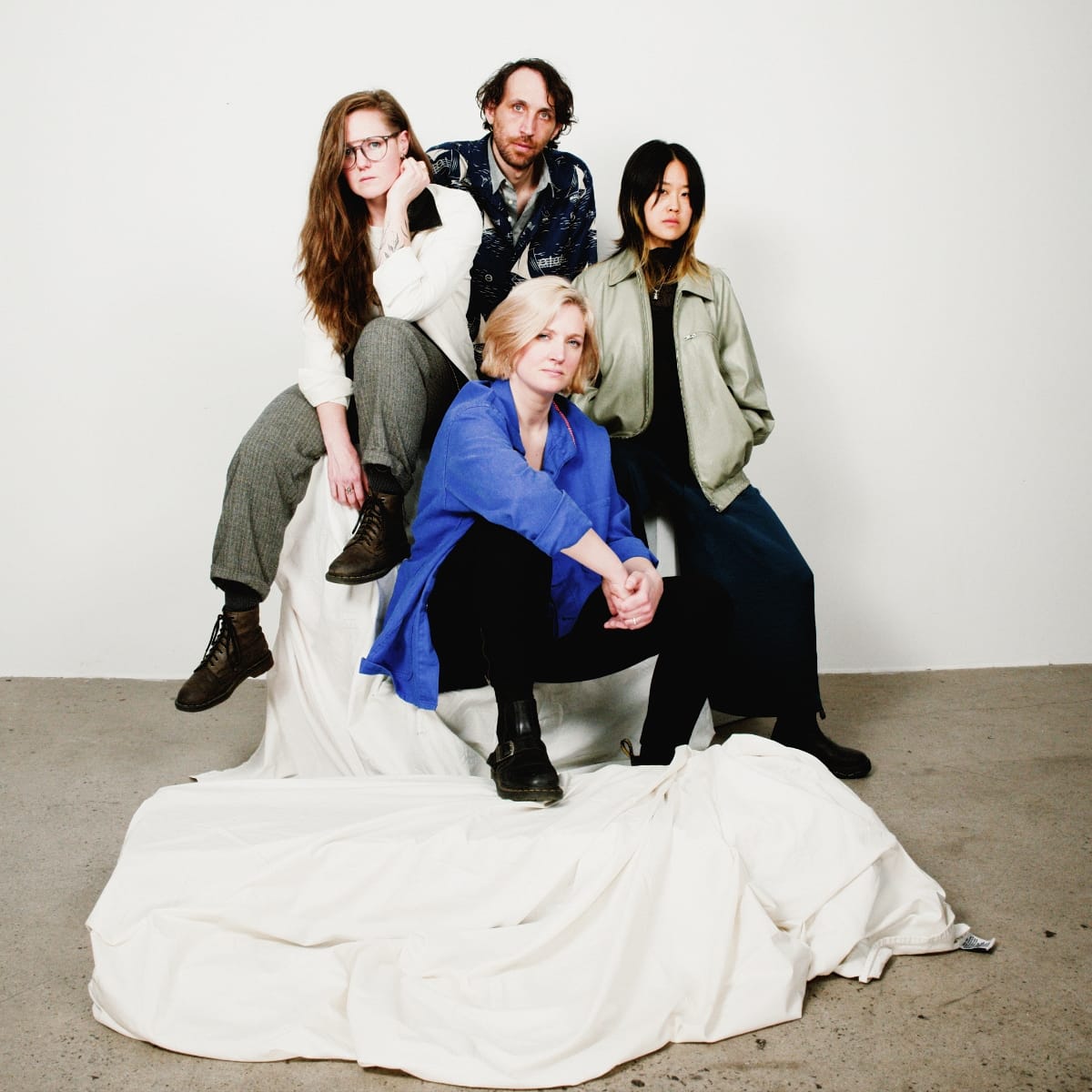
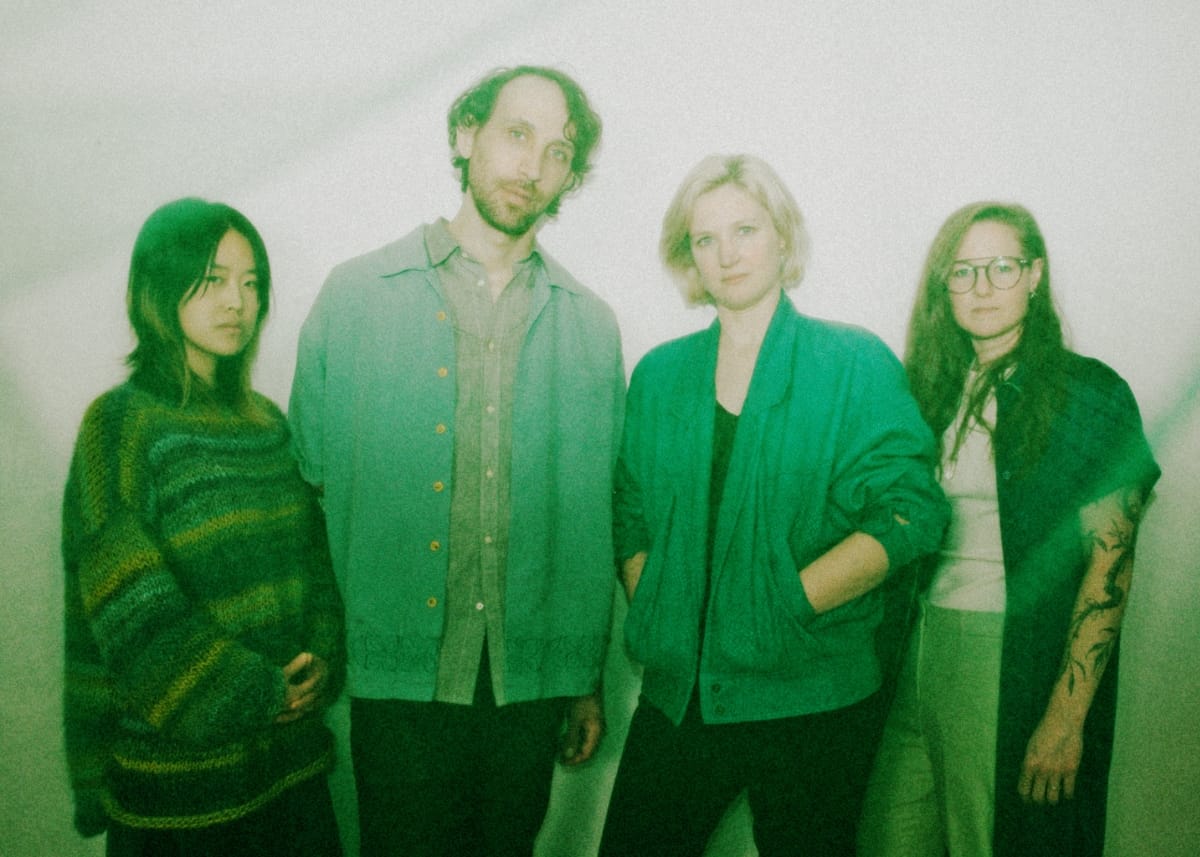
Allison Burik, Claire Devlin, Eli Davidovici, and Mili Hong arrived in Montréal from three different countries and markedly different musical backgrounds, drawn together by the city's experimental underground and the avant-jazz scene centered around Café Résonance. They began playing together during pandemic park jams and cohered as Bellbird after accepting an invitation to the 2021 Ottawa Jazz Festival. Recorded during winter at a lakeside cottage in Saint-Zénon, Quebec, their 2023 self-released debut Root in Tandem introduced a group with something to prove. All About Jazz found "deep method" even in the music's most unpredictable moments, and Textura praised the "thoughtfully structured compositions and empathetic group interplay." The summer of 2024 brought a Canadian jazz festival run spanning eleven cities and seven provinces.
The songs for The Call took shape during a residency at Orford Musique in the fall of 2024, where the quartet recorded and transcribed sounds from animals, ecosystems, and weather patterns as raw material for collective composition. It was laid down at Montréal's Hotel2Tango by engineer Sylvaine Arnaud and released on Constellation Records. Bellbird operate as a chordless quartet with no piano or guitar, giving Burik's dual roles on alto saxophone and bass clarinet particular weight; when Burik swaps instruments, the harmonic space shifts around Devlin's tenor. The Call channels the band's concerns with the climate crisis and global politics alongside its formal engagement with natural sound. As Davidovici puts it, the band are content to be "the weird jazz band instead of the jazz weird band," and it makes that self-awareness feel earned.
Claire Devlin and Eli Davidovici of Bellbird were recent guests on The Tonearm Podcast. The pair spoke to host Lawrence Peryer about Bellbird's origins in Montréal's experimental underground, what it means in practice to operate as a true collective, the demands and possibilities of the chordless quartet format, and the social and political commitments that inform The Call.
Listen to the entire conversation in the audio player below. The transcript has been edited for length, clarity, and flow.
Lawrence Peryer: Before we get into Bellbird, I'd love to ask each of you about your origin stories with the city of Montréal. Claire, how did you wind up there, and what's your relationship with the music scene?
Claire Devlin: I grew up in Ottawa, but I moved to Montréal when I was 18 for school. I went to McGill University for jazz and fell in love with the city, and decided to stay. The music scene in Montréal is so vibrant—I was immediately addicted. There's a really solid jazz scene, but also this amazing indie, underground, free jazz, and experimental scene. I kind of grew into those different areas over the last decade of being there.
Lawrence: How about you, Eli?
Eli Davidovici: I have a long history with Montréal, even though I grew up in Vancouver. My dad and his family were from there, and I spent a little bit of time living there with my grandparents when I was seven. It wasn't until I was 26 that I moved here permanently. There was this draw—it felt like a calling. It was a few years in when I felt like I'd really settled here. I'm blown away and excited by the music scene, but it doesn't feel foreign anymore. It feels really familiar.
Lawrence: How did you and Claire first cross paths?
Eli: I asked Claire to play a gig, probably a few months after I moved here—I was just trying to meet people. My roommate, Pompey—a great musician in Montréal—recommended her for this gig I was doing with him. So right away, we had Claire rehearse some weird music with us and did a gig at Café Résonance. That was the first time we got to play together.
Lawrence: How did the Bellbird collective come together?
Claire: Mili and Eli were kind of the organizers of these park jams up in the neighborhood of Parc-Ex in Montréal. It was just a way to play with people when we were in lockdown. The lockdown in Montréal was intense—there were curfews—and we were dying to play with each other, missing all of the opportunities and the venues. First, Allison was doing it, and I joined later. That was kind of how we all became friends as a group, and the band formed somewhat organically from there. I had gotten a gig at the Ottawa Jazz Festival and decided these were the people I'd been playing with, so let's do a collective project where we all bring in music. That was how it began.
Lawrence: Something I come back to at least a few times a year when I speak to ensembles that call themselves collectives: I love to explore this idea of what is a collective versus a band, and beyond that, what it means in practice when you're in the room together. How do decisions get made?
Claire: It's been a really amazing experience discovering what it means for us to be a collective, because I've never done anything quite like this in other groups before. We started with a pretty egalitarian approach. Back when we were bringing in sheet music for each other, we would all bring in compositions and play an equal distribution of each other’s tunes.
The way it developed is that, in both the music and the process of making it, we try to function without much hierarchy. Anyone's ideas are valid. There's no primary songwriter, and even with Mili, the drummer—she obviously knows more about drums than any of us—she's open to us saying, "What if you played the hi-hat here instead of the ride cymbal?" Vice versa for all of us—we're open to each other's suggestions and to learning about each other's instruments.
A piece of music might originate more from one person. There's a song on the record called "Murmuration" where I brought in a three-bar melody, and then we created a whole piece out of that. It eventually became this piece that everyone felt ownership of, and many parts didn't come from me at all. It's about being open and patient, because it does take time to do it that way.
Eli: And ultimately—and this is what we're still figuring out—it's about knowing each person's strengths and how those can best be manifested in the music and the music-making process. You do have to make decisions sometimes, and it's not that one person says, "I'm going to make the decision and not listen to your ideas because we have to get this done." It's more about how the group itself can become self-sustaining. Sometimes it means I'm going to be over here taking care of one thing, and I fully trust Claire to handle emailing the jazz festivals.
We're not all soloing all the time. We have some very structured music, and I fully embrace being a supportive bass player when I need to be, but I also get a lot of opportunities to fulfill a different role. It's something that's constantly evolving.
Lawrence: Is the designation as a collective a term you use? Is it a mindset, or do you use it interchangeably with the word "band"?
Claire: I think we do use it interchangeably among ourselves, but there is a difference, and we do specify “collective” a lot of the time in our write-ups because it implies something a bit different from "band." A band could be one person —the star, the leader, the writer—it's their brainchild. That's really not the case here. What's different about being a collective is just that: the collective, egalitarian nature.
Eli: It also shows up in things like the composing credits. On the first record, we split things up by who wrote which song, but on this record, we split most of the songs four ways because it just feels like a Bellbird song. None of them really feel like my songs and only my songs. Allison wrote "Blowing on Embers,” and that feels like their song—but even then, we all kind of wrote it together. What's been great is seeing how Bellbird has grown over time, becoming something greater than the sum of all four of us.
Lawrence: I'm curious about the possibilities for a quartet without a chordal instrument. What does that mean to each of you?
Eli: It's one of my favorite ways to play. I love playing with pianists and guitar players, but that's a different role—I'm collaborating on a certain aspect of the harmony. With the chordless quartet, I'm still collaborating in that sense, but I have a lot more freedom—every note I play fills up more of that harmonic space. There's more of a sense of movement. If I'm going somewhere and one horn is going somewhere else, you feel that.
One thing that's cool about this group is that you really start to feel that space when you play with a configuration like that, and you figure out how to make it work—how much you should be doing, and how much you shouldn’t mess with that space. It feels very full a lot of the time. I forget that we're a chordless quartet sometimes because it feels big. On this record, we actually considered bringing in electronic sounds and extra textures. But we decided to leave that and explore more of what we can do with just these four instruments. After the first record, there was so much more left to try, and I think that really had a huge hand in shaping what this record sounds like.
Claire: It is both a beautiful opportunity to try different roles when there's no piano or guitar, and also a huge challenge. We just got back from a tour of Western Canada, and those gigs are exhausting for me. I'm playing way more than in other ensembles—the saxophone is on my face more of the time, because I'm playing the melodies, playing solos, and also accompanying, for a drum moment or a bass moment. So it presents a lot of opportunity for growth because it's quite challenging.
Lawrence: My understanding from what I read was that you transcribed the sounds of nature and the environment and used them as musical material, rather than just as conceptual prompts or inspirations.
Eli: It definitely does serve as inspiration, and the setting we were in—we did a residency in Orford, Quebec—was inspirational to how we were writing music at the time. It's very personal. Listening to some of the songs on the record, I'm immediately brought back to those moments.
I think we have to really credit Allison with a lot of this—they did a lot of recording, taking transcriptions of bird sounds specifically, and used that for some of the pieces we were writing. "The Call" is the most obvious example on the record, because it's taking the call from the actual White Bellbird from the Amazon. We didn't make this recording—Allison just sourced it. It's a relatively rare bird, but a remarkable-sounding bird. It has the loudest known bird call, and it's got this amazing timbre to it. It's hard to find the right adjective, but it's terrifying. They transcribed it, spectrally analyzed it to figure out what was going on rhythmically, melodically, and harmonically, and used that as a basis to write the tune.
Some of the decisions we made in arranging the song, we reflexively went back to wanting to capture our feeling of listening to that sound. The multiphonics in the horns, the drum-bass hits—they all have this feeling to them that is trying to capture that, which is more of an emotional, aesthetic thing we're going for. While at the same time, there is this actual musical material underpinning it, connecting it as well.
Lawrence: That song grabbed me by my shoulders and made me pay attention. It's a very strong, muscular piece.
Claire: Muscular is a good word.
Lawrence: Hearing you describe the bird call, I'm like, yeah, that's exactly it. It's a little bit loud. I really like it. So, do you feel as though you're in collaboration with the ecosystem?
Claire: I think that's a big theme we explored on this album, especially our relationship with the environment, with nature, creatures, and plants. The idea that there is no separation between us and the natural world—capturing some of those sounds that already exist feels like an amazing way to connect with nature and try to preserve what is so beautiful out there. Especially because these environments—the Amazon and everywhere—these animals are in danger, and the environments are disappearing; it's an absolute tragedy. And so this is our way to connect with that.
Lawrence: I'm curious about "Soft Animal"—the story behind it, the poem that inspired it, and how, in a collective setting, text becomes instrumental music.
Claire: That was a unique moment for us—our first time writing music in this way. We were in the middle of the residency in Orford, Quebec. The first week had been spent doing a lot of intensive rehearsing and arranging, practicing really hard material. By the beginning of the second week, we were a little burnt out and ready to make music in a different way. Allison brought in a poem by Mary Oliver called "Wild Geese" and read it to us, and it just hit the right note at the right time. It was moving—really validating in how you can sometimes just rest. You can slow down and allow yourself to just be, and that's enough sometimes.
It wasn't even supposed to be a musical prompt. But we ended up improvising on it, using the text, the words, as if they were lyrics. As horn players—and for drums and bass, too—we imagined singing the words, then played the notes that would form the melody. We did that a few times, recorded it, listened back, and ended up codifying it into the piece it is now, which is more set in terms of the melody.
Eli: For me, "Soft Animal" captures the feeling we had when we read the poem. When we play that for people, I see the same reaction from a lot of audiences. Whenever we play that song, I see someone tearing up at the end. It's so gratifying that you made someone feel something, because the feeling we shared was genuine. It just worked, it happened, and it was really organic for this one song.
Lawrence: Tell me about "Blowing on Embers." Given the complicated moral, social, and political questions the track is inspired by, what's the role of instrumental music in a situation like the one that the track deals with?
Eli: It's a shame that Allison isn't here, because they wrote the piece and it was their idea to dedicate it to a free Palestine. But we all have a huge emotional attachment to that piece. The role of instrumental music—it's part of a much larger thing. We don't have grandiose perceptions of ourselves as making a huge difference. But when we get to play this live, we get to talk about what’s happening in the world and at least say something about it, rather than being completely silent. We get to express something that's real—how we play the piece and how we feel about it.
There are things that are harder to articulate. There is something about music, something about art, and playing something that you can't quite put into words. There's still that raw feeling of: this is something unacceptable to us. We're heartbroken about it every day.
To me, the piece starts off with a really dark, brooding, and haunting melody—a march that has a real vibe to it. But then it opens up into this euphoric, transformative improvised solo. It takes you to different places you really don't expect—there's this amazing saxophone cadenza that is one of my favorite moments on the record, taking us into the final melody—a much more intense, fast-paced version of what we do at the beginning. And that whole transformation—taking yourself out of that dark place into something euphoric and beautiful, almost out of your own body—trying to describe that to a stranger at the gig really meant something to me and helped me realize what's so great about this piece.
Lawrence: I’m also curious how Bellbird engages with the theme of the climate crisis—the commentary in the music and the interplay with the natural elements you used. Is Bellbird the place where you come to explore the world thematically?
Claire: We're not trying to take on the issues of the world in a way where we think it's about some kind of tangible effect. It's more that these are the things that we care about, and so we write music about them. I think that will continue to be the case for future records with Bellbird. There are world issues that we care deeply about, that we talk about, and those things come into the music on their own.
Eli: It's all connected. It's easy to say, "I'm just playing instrumental jazz, so that doesn't really mean anything." But it doesn't feel like something we hide, how we feel about these issues. It's pretty explicit. We're not under any illusion that we're making a huge change, but we do want to be part of something bigger than ourselves. We took our music off of Spotify and Amazon to be part of this. We don't accept what these companies are doing, and we don't feel like it represents us in any way. The least we can do is say we're not going to work with them. Maybe one person—my mom—isn’t going to use Spotify anymore because Bellbird isn't on it.
It's not that we think we're making a big difference on our own, but it does feel good to be part of a bigger movement of artists saying this is something we don't accept—and we're going to use the power we have, however small that is, to at least make a statement.
I do feel that empowers Bellbird for me. When I come back to Bellbird, I know I'm playing with people who really represent my values. That strengthens us. We're all such great friends, and we have this close connection. And musically, it's exciting, because the possibilities are really open right now. Also, I've seen since the first record that the energy in the music is kind of growing into this bigger thing. But I think we just love getting together, playing, and improvising, and I'm sure we'll keep doing that no matter what.
Check out more like this:
 Meredith Hobbs Coons
 Lawrence Peryer


Comments